Last Updated on April 22, 2026
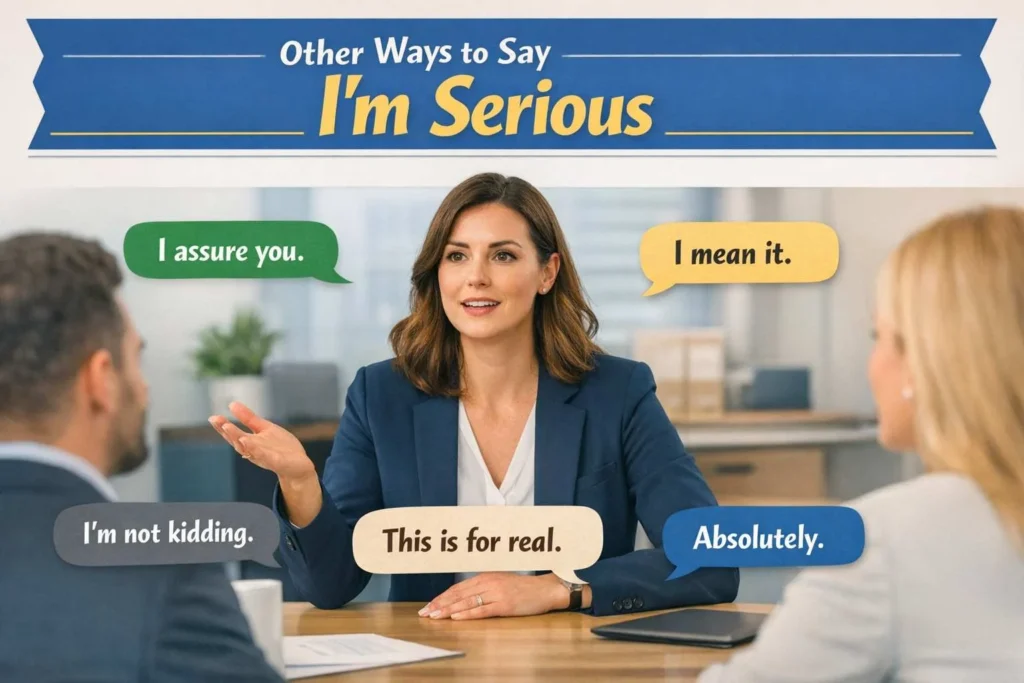
If you want other ways to say I’m serious, try:
I mean it, I’m not joking, I’m completely serious, I’m being honest, I’m dead serious.
These alternatives help you sound more confident, expressive, and appropriate depending on tone and situation.
The phrase “I’m serious” is commonly used to emphasize truth, sincerity, or importance. Whether you’re clarifying a point, expressing urgency, or reinforcing honesty, it’s a powerful expression.
However, repeating it too often can sound flat or unconvincing. Learning alternatives to “I’m serious” helps you communicate with greater clarity, emotional range, and professionalism.
It also improves fluency by giving you more ways to express excitement in English, assert yourself, and adapt your tone across casual and professional conversations.
“The way you express seriousness can change how people trust and respond to you.”
Quick Categories
Formal alternatives to “I’m serious”
- I assure you
- I mean this sincerely
- I’m speaking in earnest
- I can confirm this
Pro Tip: Use these in emails, presentations, or professional discussions.
Casual alternatives
- I’m not kidding
- For real
- No joke
- I’m telling the truth
Pro Tip: Great for conversations with friends or informal settings.
Professional alternatives
- I want to emphasize
- I’d like to be clear
- Let me be direct
- I’m being completely honest
Pro Tip: Perfect for meetings, workplace communication, or interviews.
Informal expressions
- I swear
- I’m dead serious
- Trust me
- I’m not messing around
Pro Tip: Use carefully some may sound too intense in formal contexts.
“Confidence in language comes from choosing the right tone, not just the right words.”
Common Mistakes
- Overusing “I’m serious”
Example: “I’m serious, I’m serious, I’m serious.” - Using informal phrases in professional settings
Example: “I swear this report is correct.” - Sounding aggressive instead of sincere
Example: “I’m serious, okay?!” - Not matching tone with context
Example: Saying “No joke” in a business meeting - Lack of supporting explanation
Example: “I’m serious.” (without context)
What Does “I’m Serious” Mean?
“I’m serious” means that the speaker is telling the truth, being sincere, or emphasizing importance. It is often used to remove doubt or reinforce credibility.
Grammatically, it is a present simple statement expressing a current state of sincerity.
Example: “I’m serious about improving my skills this year.”
When to Use “I’m Serious”
- Clarifying truth or honesty
- Emphasizing importance
- Responding to disbelief
- Giving warnings or advice
Spoken vs Written:
More common in spoken English, but can appear in informal writing.
Formal vs Informal:
Generally informal better replaced in professional contexts.
Is It Professional or Polite to Say “I’m Serious”?
Polite? ✔️ Yes
Professional? ❌ No (in most cases)
While it is polite, it lacks the refined tone required in business communication.
Business Example:
Instead of “I’m serious about this deadline,” say:
“I would like to emphasize the importance of this deadline.”
Pros and Cons of Using “I’m Serious”
Pros:
- Simple and natural
- Easy to understand
- Common in everyday English
- Direct communication
Cons:
- Too informal for work
- Overused
- Can sound repetitive
- Limited tone variety
Other Ways to Say “I’m Serious” With Examples
These alternatives will help you sound more fluent, confident, and natural in different situations.
Use them according to tone, context, and audience to express emphasis, honesty, or conviction.
1. Phrase: I mean it
Meaning: You are being truthful
Explanation: Emphasizes sincerity
Example Sentence: “I mean it, you did a great job.”
Best Use: casual emphasis
Worst Use: formal writing
Tone: sincere, direct
Context Variability: casual
2. Phrase: I’m not joking
Meaning: This is not a joke
Explanation: Clarifies seriousness
Example Sentence: “I’m not joking, this is important.”
Best Use: casual talk
Worst Use: formal emails
Tone: firm, clear
Context Variability: casual
3. Phrase: I’m completely serious
Meaning: Fully sincere
Explanation: Strong emphasis
Example Sentence: “I’m completely serious about this decision.”
Best Use: neutral situations
Worst Use: very formal writing
Tone: strong, confident
Context Variability: casual/professional
4. Phrase: I’m being honest
Meaning: Speaking truthfully
Explanation: Highlights honesty
Example Sentence: “I’m being honest, this needs improvement.”
Best Use: feedback
Worst Use: aggressive tone
Tone: honest, neutral
Context Variability: casual/professional
5. Phrase: I’m dead serious
Meaning: Extremely serious
Explanation: Strong emphasis
Example Sentence: “I’m dead serious about this opportunity.”
Best Use: strong emotion
Worst Use: workplace
Tone: intense, emphatic
Context Variability: casual
6. Phrase: I assure you
Meaning: Formal confirmation
Explanation: Builds trust
Example Sentence: “I assure you this will be completed on time.”
Best Use: professional
Worst Use: casual chat
Tone: formal, confident
Context Variability: professional
7. Phrase: I’m speaking sincerely
Meaning: Genuine statement
Explanation: Adds credibility
Example Sentence: “I’m speaking sincerely about this matter.”
Best Use: formal speech
Worst Use: casual talk
Tone: formal, respectful
Context Variability: professional
8. Phrase: I want to emphasize
Meaning: Highlight importance
Explanation: Used in professional tone
Example Sentence: “I want to emphasize the urgency of this task.”
Best Use: meetings
Worst Use: casual text
Tone: professional, assertive
Context Variability: professional
9. Phrase: Let me be clear
Meaning: Clarifying point
Explanation: Removes confusion
Example Sentence: “Let me be clear, this is a priority.”
Best Use: workplace
Worst Use: friendly chat
Tone: firm, professional
Context Variability: professional
10. Phrase: I’m telling the truth
Meaning: Honest statement
Explanation: Reinforces credibility
Example Sentence: “I’m telling the truth about what happened.”
Best Use: explanations
Worst Use: formal writing
Tone: honest, direct
Context Variability: casual
11. Phrase: No joke
Meaning: Not humorous
Explanation: Casual emphasis
Example Sentence: “No joke, this is serious.”
Best Use: friends
Worst Use: business emails
Tone: casual, emphatic
Context Variability: informal
12. Phrase: For real
Meaning: Truly serious
Explanation: Informal emphasis
Example Sentence: “For real, you should try this.”
Best Use: casual talk
Worst Use: professional
Tone: relaxed, informal
Context Variability: informal
13. Phrase: Trust me
Meaning: Believe me
Explanation: Builds confidence
Example Sentence: “Trust me, this will work.”
Best Use: persuasion
Worst Use: formal writing
Tone: confident, friendly
Context Variability: casual
14. Phrase: I’m not messing around
Meaning: Being serious
Explanation: Strong tone
Example Sentence: “I’m not messing around this time.”
Best Use: warnings
Worst Use: workplace
Tone: firm, intense
Context Variability: casual
15. Phrase: I genuinely mean it
Meaning: Deep sincerity
Explanation: Emotional honesty
Example Sentence: “I genuinely mean it when I say thank you.”
Best Use: emotional context
Worst Use: overly formal
Tone: sincere, warm
Context Variability: casual/professional
16. Phrase: I can confirm this
Meaning: Verified truth
Explanation: Professional tone
Example Sentence: “I can confirm this information is accurate.”
Best Use: workplace
Worst Use: casual chat
Tone: formal, factual
Context Variability: professional
17. Phrase: I’m being truthful
Meaning: Honest statement
Explanation: Reinforces trust
Example Sentence: “I’m being truthful about my intentions.”
Best Use: explanation
Worst Use: casual slang
Tone: honest, neutral
Context Variability: casual/professional
18. Phrase: I’m serious about this
Meaning: Strong commitment
Explanation: Emphasizes importance
Example Sentence: “I’m serious about improving my skills.”
Best Use: goals
Worst Use: repetition
Tone: determined, firm
Context Variability: casual/professional
19. Phrase: I mean this sincerely
Meaning: Genuine expression
Explanation: Formal sincerity
Example Sentence: “I mean this sincerely, your work is impressive.”
Best Use: professional praise
Worst Use: casual chat
Tone: formal, respectful
Context Variability: professional
20. Phrase: I’m in earnest
Meaning: Truly serious
Explanation: Formal expression
Example Sentence: “I’m in earnest about this proposal.”
Best Use: formal writing
Worst Use: casual speech
Tone: formal, serious
Context Variability: professional
21. Phrase: I truly mean it
Meaning: Strong sincerity
Explanation: Emotional emphasis
Example Sentence: “I truly mean it, you’re amazing.”
Best Use: emotional
Worst Use: strict business
Tone: warm, sincere
Context Variability: casual
22. Phrase: I’m not exaggerating
Meaning: Completely accurate
Explanation: Removes doubt
Example Sentence: “I’m not exaggerating, this is critical.”
Best Use: explanations
Worst Use: informal chat
Tone: factual, firm
Context Variability: casual/professional
23. Phrase: I’m being direct
Meaning: Clear honesty
Explanation: Professional clarity
Example Sentence: “I’m being direct, this needs revision.”
Best Use: workplace
Worst Use: casual tone
Tone: professional, assertive
Context Variability: professional
24. Phrase: I’m stating this clearly
Meaning: Clear emphasis
Explanation: Avoids confusion
Example Sentence: “I’m stating this clearly for transparency.”
Best Use: professional
Worst Use: casual
Tone: formal, precise
Context Variability: professional
25. Phrase: Believe me
Meaning: Trust statement
Explanation: Persuasive tone
Example Sentence: “Believe me, this works.”
Best Use: persuasion
Worst Use: formal writing
Tone: confident, friendly
Context Variability: casual
26. Phrase: I stand by this
Meaning: Strong conviction
Explanation: Shows confidence
Example Sentence: “I stand by this decision.”
Best Use: professional
Worst Use: casual jokes
Tone: firm, confident
Context Variability: professional
27. Phrase: I’m fully committed
Meaning: Serious intent
Explanation: Shows dedication
Example Sentence: “I’m fully committed to this project.”
Best Use: workplace
Worst Use: casual talk
Tone: professional, strong
Context Variability: professional
28. Phrase: I’m not kidding around
Meaning: Serious tone
Explanation: Emphasizes urgency
Example Sentence: “I’m not kidding around, this matters.”
Best Use: casual
Worst Use: formal
Tone: firm, informal
Context Variability: casual
29. Phrase: I’m genuinely serious
Meaning: Deep sincerity
Explanation: Reinforces intent
Example Sentence: “I’m genuinely serious about this plan.”
Best Use: neutral
Worst Use: repetition
Tone: sincere, strong
Context Variability: casual/professional
30. Phrase: This is no exaggeration
Meaning: Completely true
Explanation: Emphasizes accuracy
Example Sentence: “This is no exaggeration, it’s urgent.”
Best Use: professional
Worst Use: casual slang
Tone: formal, factual
Context Variability: professional
“Professional communication replaces simple phrases with clarity, tone, and intention.”
Mini Quiz / Self-Check
- Which is most professional?
A. I swear
B. I assure you
C. For real
Answer: B - Best for casual conversation?
A. I’m in earnest
B. I mean it
C. I can confirm this
Answer: B - Strong emotional sincerity?
A. I genuinely mean it
B. Let me be clear
C. I’m stating this clearly
Answer: A
Comparison Table: Top Alternatives
| Phrase | Tone | Best Use |
|---|---|---|
| I mean it | Casual | Conversations |
| I’m not joking | Casual | Clarification |
| I assure you | Formal | Business |
| Let me be clear | Professional | Meetings |
| I want to emphasize | Professional | Presentations |
| I genuinely mean it | Emotional | Personal talk |
| I stand by this | Professional | Decisions |
| I can confirm this | Formal | Reports |
| I’m fully committed | Professional | Work goals |
| This is no exaggeration | Formal | Statements |
FAQs
1. What is the most professional alternative to “I’m serious”?
“I assure you” or “I want to emphasize” are best for professional settings.
2. Can I use “I’m serious” in emails?
It’s better to replace it with formal alternatives for clarity and professionalism.
3. What’s a strong emotional alternative?
“I genuinely mean it” or “I truly mean it.”
4. Which phrases are informal?
“For real,” “No joke,” and “I’m not kidding.”
5. How do I sound more confident instead of repetitive?
Use varied alternatives and support them with explanations or examples.
Conclusion
Learning other ways to say “I’m serious” helps you communicate with confidence, clarity and professionalism. It allows you to adapt your tone across casual conversations, workplace communication, and emotional situations.
Practice using these alternatives daily to improve fluency, avoid repetition, and express yourself more effectively in English.
CTA: Start using 3 new alternatives today to sound more confident and expressive in your conversations.

Joshua Bell is a professional content writer at Synofind.com, known for delivering clear, accurate and engaging written content. He focuses on thorough research and thoughtful storytelling to ensure every piece is reliable and easy to understand. His work reflects a strong commitment to quality and credibility.