Last Updated on April 22, 2026
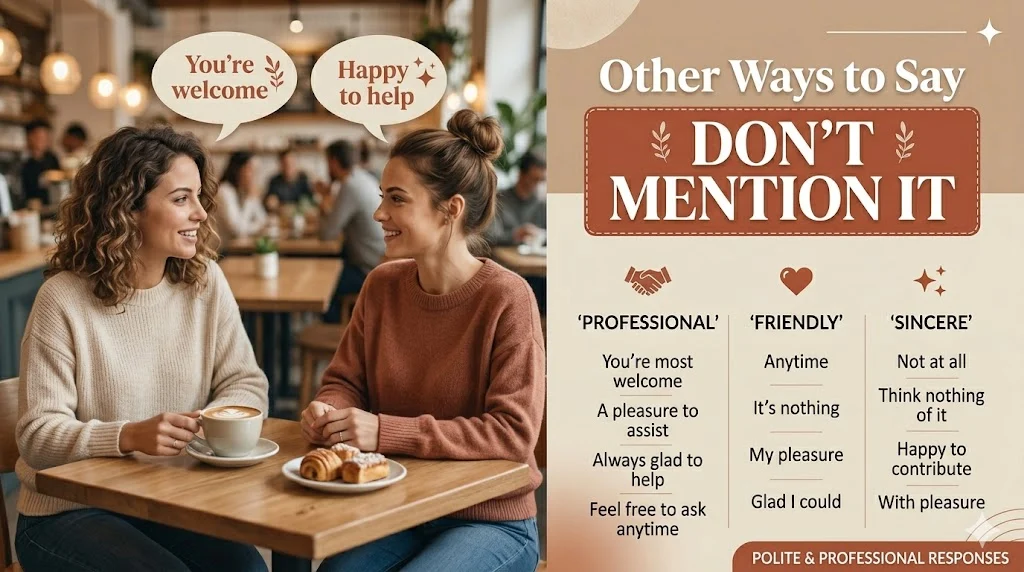
Looking for other ways to say don’t mention it? Try:
You’re welcome, No problem at all, Happy to help, It was nothing, Anytime.
These phrases help you respond to thanks politely, naturally, and appropriately in both casual and professional situations.
The phrase “don’t mention it” is commonly used to respond when someone says thank you. It shows humility and downplays the effort you made.
However, repeating it can sound outdated or overly formal in modern English. Learning alternatives to don’t mention it allows you to:
- Sound more natural and fluent
- Adjust tone for professional or casual settings
- Use varied professional reaction phrases
Expanding your responses also helps you express excitement in English or warmth depending on the situation.
“The way you respond to thanks shapes how polite and approachable you sound.”
Quick Categories
Formal alternatives to “don’t mention it”
- You’re most welcome
- It was my pleasure
- I’m happy to assist
- Not at all
Pro Tip: Use these in professional emails or client interactions.
Casual alternatives
- No problem
- Anytime
- Sure thing
- No worries
Pro Tip: Perfect for friends, teammates, and informal chats.
Professional alternatives
- Happy to help
- Glad to be of assistance
- Always happy to support
- It’s my pleasure to help
Pro Tip: Combine with polite tone for workplace communication.
Informal expressions
- It was nothing
- Don’t worry about it
- All good
- No big deal
Pro Tip: Use with close friends or relaxed environments.
“Choosing the right response makes your English sound confident and socially aware.”
Common Mistakes
- Using overly formal responses in casual settings
Example: “It was my utmost pleasure” (sounds stiff among friends) - Being too casual in professional settings
Example: “No worries” in a formal client email - Repeating the same phrase every time
Example: Always saying “don’t mention it” - Ignoring tone of conversation
Example: Using humor when someone is sincerely grateful - Sounding dismissive unintentionally
Example: “It was nothing” when effort was significant
What Does “Don’t Mention It” Mean?
Definition: A polite response to “thank you,” meaning the help you gave does not require acknowledgment.
Grammar Note: It’s an imperative phrase used idiomatically, not literally.
Example Sentence:
“Thanks for your help!”
“Don’t mention it.”
When to Use “Don’t Mention It”
- When someone thanks you for help
- In polite, slightly formal conversations
- In spoken English more than written
Spoken vs Written:
- More common in spoken English
- Less common in modern professional emails
Formal vs Informal:
- Slightly formal
- Can feel outdated in casual speech
Is It Professional or Polite to Say “Don’t Mention It”?
Polite? ✔️ Yes
Professional? ❌ Not always (can sound old-fashioned)
Business Example:
“Thank you for your support on this project.”
“Happy to help please feel free to reach out anytime.”
Pros and Cons of Using “Don’t Mention It”
Pros
- Simple and natural
- Friendly tone
- Common usage
- Easy to understand
Cons
- Slightly outdated
- Not ideal for modern business communication
- Limited emotional expression
- Can sound dismissive
“Modern English favors warm, engaging responses over neutral phrases.”
Other Ways to Say “Don’t Mention It” With Examples
These alternatives will help you sound more fluent, confident, and natural in different situations.
Use them based on tone, context, and audience to express appreciation or professionalism.
1. Phrase: You’re welcome
Meaning: Standard polite response
Explanation: Most common and neutral reply
Example Sentence: “You’re welcome, happy to help!”
Best Use: all contexts
Worst Use: none
Tone: neutral polite
Context Variability: casual / professional
2. Phrase: No problem
Meaning: The help wasn’t inconvenient
Explanation: Casual and widely used
Example Sentence: “No problem at all!”
Best Use: casual chat
Worst Use: formal email
Tone: relaxed friendly
Context Variability: casual / spoken
3. Phrase: Happy to help
Meaning: You’re glad to assist
Explanation: Warm and professional
Example Sentence: “Happy to help with the report.”
Best Use: workplace
Worst Use: very formal
Tone: friendly professional
Context Variability: professional / spoken
4. Phrase: My pleasure
Meaning: Helping was enjoyable
Explanation: Polite and slightly formal
Example Sentence: “My pleasure, anytime.”
Best Use: clients
Worst Use: casual slang
Tone: polite warm
Context Variability: professional
5. Phrase: Anytime
Meaning: Willing to help again
Explanation: Friendly and open
Example Sentence: “Anytime you need help!”
Best Use: friends
Worst Use: formal writing
Tone: casual warm
Context Variability: casual
6. Phrase: It was nothing
Meaning: The effort was small
Explanation: Downplays effort
Example Sentence: “It was nothing, really.”
Best Use: close friends
Worst Use: big favors
Tone: humble casual
Context Variability: informal
7. Phrase: Not at all
Meaning: No trouble at all
Explanation: Formal polite reply
Example Sentence: “Not at all, glad to assist.”
Best Use: professional
Worst Use: casual slang
Tone: formal polite
Context Variability: professional
8. Phrase: Glad to help
Meaning: Happy to assist
Explanation: Slightly less formal than “happy to help”
Example Sentence: “Glad to help anytime.”
Best Use: workplace
Worst Use: very formal
Tone: friendly professional
Context Variability: mixed
9. Phrase: No worries
Meaning: No inconvenience caused
Explanation: Common in modern English
Example Sentence: “No worries at all.”
Best Use: casual
Worst Use: corporate emails
Tone: relaxed modern
Context Variability: casual
10. Phrase: Sure thing
Meaning: You’re happy to help
Explanation: Informal and friendly
Example Sentence: “Sure thing, anytime!”
Best Use: peers
Worst Use: formal
Tone: casual upbeat
Context Variability: informal
11. Phrase: It’s all good
Meaning: Everything is fine
Explanation: Very casual reassurance
Example Sentence: “It’s all good, don’t worry.”
Best Use: friends
Worst Use: workplace
Tone: informal relaxed
Context Variability: casual
12. Phrase: Don’t worry about it
Meaning: No need to thank
Explanation: Casual reassurance
Example Sentence: “Don’t worry about it!”
Best Use: friends
Worst Use: formal
Tone: casual friendly
Context Variability: informal
13. Phrase: Always happy to help
Meaning: Willingness to assist repeatedly
Explanation: Professional and warm
Example Sentence: “Always happy to help with your requests.”
Best Use: workplace
Worst Use: casual slang
Tone: professional warm
Context Variability: professional
14. Phrase: I’m glad I could help
Meaning: Satisfaction from helping
Explanation: Polite and sincere
Example Sentence: “I’m glad I could help.”
Best Use: all settings
Worst Use: none
Tone: sincere neutral
Context Variability: universal
15. Phrase: It’s my pleasure to help
Meaning: Helping is enjoyable
Explanation: Formal and courteous
Example Sentence: “It’s my pleasure to help.”
Best Use: clients
Worst Use: casual
Tone: formal warm
Context Variability: professional
16. Phrase: No big deal
Meaning: The effort was small
Explanation: Informal and relaxed
Example Sentence: “No big deal at all.”
Best Use: friends
Worst Use: formal
Tone: casual relaxed
Context Variability: informal
17. Phrase: That’s okay
Meaning: No issue at all
Explanation: Reassuring response
Example Sentence: “That’s okay, really.”
Best Use: casual
Worst Use: formal
Tone: neutral soft
Context Variability: casual
18. Phrase: Think nothing of it
Meaning: No need to acknowledge
Explanation: Slightly formal and classic
Example Sentence: “Think nothing of it.”
Best Use: polite speech
Worst Use: modern casual
Tone: formal classic
Context Variability: formal
19. Phrase: Happy to be of help
Meaning: Glad to assist
Explanation: Professional tone
Example Sentence: “Happy to be of help anytime.”
Best Use: workplace
Worst Use: slang
Tone: professional warm
Context Variability: professional
20. Phrase: Always here to help
Meaning: Reliable support
Explanation: Encouraging and friendly
Example Sentence: “Always here to help if you need anything.”
Best Use: teams
Worst Use: formal writing
Tone: supportive friendly
Context Variability: mixed
21. Phrase: It’s the least I could do
Meaning: You could do more
Explanation: Humble expression
Example Sentence: “It’s the least I could do.”
Best Use: polite
Worst Use: formal docs
Tone: humble polite
Context Variability: mixed
22. Phrase: No trouble at all
Meaning: No inconvenience
Explanation: Polite and neutral
Example Sentence: “No trouble at all.”
Best Use: professional
Worst Use: slang
Tone: neutral polite
Context Variability: mixed
23. Phrase: Delighted to help
Meaning: Very happy to assist
Explanation: Positive and formal
Example Sentence: “Delighted to help with this project.”
Best Use: clients
Worst Use: casual
Tone: formal positive
Context Variability: professional
24. Phrase: Of course
Meaning: Naturally willing
Explanation: Confident and friendly
Example Sentence: “Of course, anytime.”
Best Use: casual
Worst Use: formal emails
Tone: confident friendly
Context Variability: casual
25. Phrase: It’s nothing at all
Meaning: No effort involved
Explanation: Soft reassurance
Example Sentence: “It’s nothing at all.”
Best Use: informal
Worst Use: big tasks
Tone: humble soft
Context Variability: informal
26. Phrase: I’ve got you
Meaning: You can rely on me
Explanation: Supportive, modern phrase
Example Sentence: “I’ve got you, no worries.”
Best Use: friends
Worst Use: professional
Tone: casual supportive
Context Variability: informal
27. Phrase: Happy to assist
Meaning: Professional willingness
Explanation: Common in business English
Example Sentence: “Happy to assist with your request.”
Best Use: emails
Worst Use: casual
Tone: professional polite
Context Variability: professional
28. Phrase: Always a pleasure
Meaning: Enjoyment in helping
Explanation: Polite and warm
Example Sentence: “Always a pleasure working with you.”
Best Use: clients
Worst Use: casual slang
Tone: warm professional
Context Variability: professional
29. Phrase: Not a problem at all
Meaning: No issue
Explanation: Friendly and clear
Example Sentence: “Not a problem at all!”
Best Use: casual
Worst Use: formal
Tone: relaxed friendly
Context Variability: casual
30. Phrase: You bet
Meaning: Definitely willing
Explanation: Informal affirmation
Example Sentence: “You bet, happy to help!”
Best Use: casual
Worst Use: formal
Tone: informal upbeat
Context Variability: casual
“Strong communication comes from choosing responses that match tone, context, and audience.”
Mini Quiz / Self-Check
1. Best professional alternative?
A. No worries
B. Happy to assist
C. You bet
Answer: B
2. Casual friendly option?
A. My pleasure
B. No problem
C. Delighted to help
Answer: B
3. Formal polite phrase?
A. Sure thing
B. Not at all
C. It’s all good
Answer: B
Comparison Table: Top Alternatives
| Phrase | Tone | Best Use |
|---|---|---|
| You’re welcome | Neutral | All contexts |
| Happy to help | Professional | Workplace |
| My pleasure | Formal | Clients |
| No problem | Casual | Friends |
| Anytime | Casual | Friendly chats |
| Not at all | Formal | Professional |
| Glad to help | Neutral | Mixed settings |
| No worries | Casual | Informal |
| Always happy to help | Professional | Workplace |
| Happy to assist | Professional | Emails |
FAQs
1. Is “don’t mention it” outdated?
Slightly it’s still correct but less common in modern English.
2. What’s the most professional alternative?
“Happy to assist” or “My pleasure.”
3. Can I use casual phrases at work?
Only in relaxed environments; otherwise use professional alternatives.
4. What’s the safest universal option?
“You’re welcome” works everywhere.
5. How do I sound more natural?
Mix responses and match tone to context and relationship.
Conclusion
Learning other ways to say don’t mention it helps you communicate more naturally and professionally. It allows you to adjust tone, sound more engaging, and respond appropriately in different situations.
Practice using these alternatives daily to improve your fluency and make your English sound more confident, polite, and modern.

Liam Reed is a skilled content writer at Synofind.com, known for crafting clear, engaging and well-researched pieces. His work focuses on accuracy, readability and delivering value to readers. He consistently produces content that informs and connects.