Last Updated on April 22, 2026
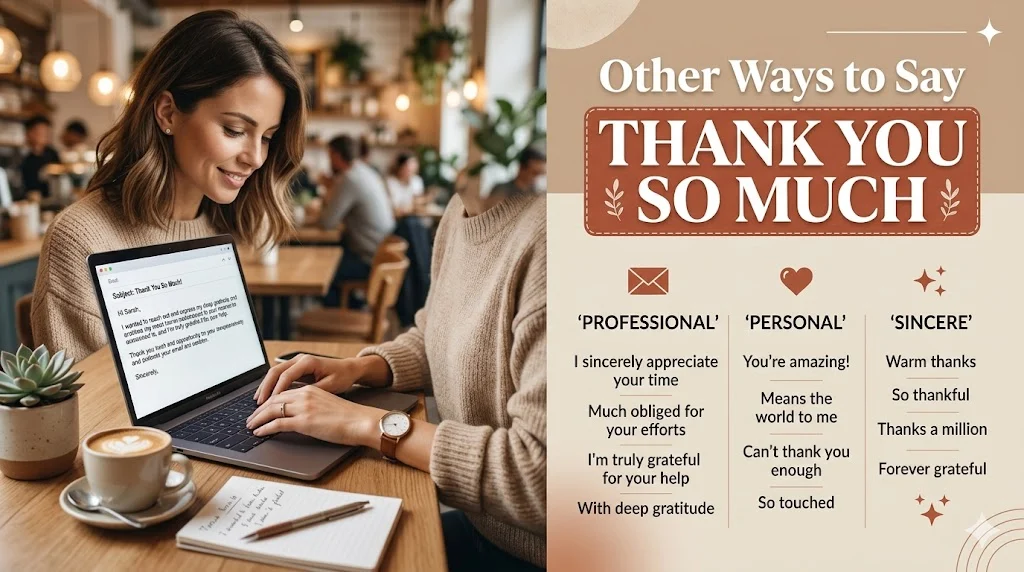
Looking for other ways to say thank you so much? Try:
Many thanks, I truly appreciate it, Much appreciated, Thanks a lot, I’m very grateful.
These alternatives help you sound more natural, professional, and expressive in different situations.
The phrase “thank you so much” is one of the most common ways to express gratitude in English. It’s warm, polite, and widely understood across both personal and professional contexts.
However, using the same phrase repeatedly can feel repetitive or less impactful. Learning alternatives to thank you so much helps you express gratitude with more variety, tone control, and precision.
It also allows you to express excitement in English, appreciation, or professionalism depending on the situation—whether you’re writing an email, speaking to a colleague, or texting a friend.
“The way you say thank you can shape how sincere and professional you sound.”
Quick Categories
Formal alternatives to “thank you so much”
- I sincerely appreciate it
- Much obliged
- I am very grateful
- Please accept my thanks
Pro Tip: Use these in emails, formal writing, or client communication.
Casual alternatives
- Thanks a lot
- Thanks tons
- Many thanks
- Big thanks
Pro Tip: Great for everyday conversations and friendly messages.
Professional alternatives
- Much appreciated
- I truly appreciate your help
- Thank you for your support
- I appreciate your assistance
Pro Tip: Pair with context for clarity and professionalism.
Informal expressions
- Thanks a bunch
- Appreciate it
- Thanks heaps
- Cheers
Pro Tip: Best used with friends or in relaxed environments.
Common Mistakes
- Overusing the same phrase
Example: “Thank you so much, thank you so much again.” - Using informal phrases in formal settings
Example: “Thanks a bunch” in a job email - Not specifying what you’re thankful for
Example: “Thanks!” (too vague) - Over-exaggerating gratitude
Example: “Thank you a million times forever!” - Forgetting tone/context
Example: “Cheers!” in a formal report
What Does “Thank You So Much” Mean?
“Thank you so much” is a polite expression of strong gratitude. It emphasizes appreciation more than a simple “thank you.”
Grammar Note:
“So much” intensifies the level of gratitude.
Example Sentence:
“Thank you so much for helping me complete the project.”
When to Use “Thank You So Much”
- When expressing deep appreciation
- In emails, conversations, or messages
- After receiving help, gifts, or support
- In both spoken and written English
Spoken vs Written: Works well in both
Formal vs Informal: Slightly informal but acceptable in most contexts
Is It Professional or Polite to Say “Thank You So Much”?
- Polite? ✔️ Yes
- Professional? ❌ Not always (can be too casual in formal writing)
Business Example:
“Thank you for your assistance” (better than “thank you so much” in formal emails)
Pros and Cons of Using “Thank You So Much”
Pros
- Simple and natural
- Friendly tone
- Widely understood
- Easy to use
Cons
- Slightly informal for business
- Overused
- Lacks specificity
- Less impactful in formal writing
Other Ways to Say “Thank You So Much” With Examples
These alternatives will help you sound more fluent, confident, and natural in different situations.
Use them according to tone, context, and audience to express gratitude effectively.
1. Phrase: Many thanks
Meaning: A polite way to express gratitude
Explanation: Common in both formal and informal contexts
Example Sentence: “Many thanks for your quick response.”
Best Use: emails, polite
Worst Use: very casual
Tone: polite, neutral
Context Variability: professional
2. Phrase: Much appreciated
Meaning: Shows sincere appreciation
Explanation: Common in professional communication
Example Sentence: “Your support is much appreciated.”
Best Use: work emails
Worst Use: casual chat
Tone: professional, warm
Context Variability: professional
3. Phrase: I truly appreciate it
Meaning: Deep gratitude
Explanation: Adds sincerity and emphasis
Example Sentence: “I truly appreciate your help today.”
Best Use: personal, work
Worst Use: sarcastic tone
Tone: sincere, warm
Context Variability: both
4. Phrase: Thanks a lot
Meaning: Strong but casual thanks
Explanation: Slightly informal
Example Sentence: “Thanks a lot for your help!”
Best Use: friends
Worst Use: formal email
Tone: casual, friendly
Context Variability: casual
5. Phrase: I’m very grateful
Meaning: Formal gratitude
Explanation: Strong appreciation
Example Sentence: “I’m very grateful for your support.”
Best Use: formal writing
Worst Use: texting
Tone: formal, sincere
Context Variability: professional
6. Phrase: I sincerely appreciate it
Meaning: Formal gratitude
Explanation: Emphasizes professionalism
Example Sentence: “I sincerely appreciate your assistance.”
Best Use: business
Worst Use: casual talk
Tone: formal, respectful
Context Variability: professional
7. Phrase: Thanks so much
Meaning: Similar to original phrase
Explanation: Friendly and common
Example Sentence: “Thanks so much for coming!”
Best Use: casual
Worst Use: formal reports
Tone: warm, casual
Context Variability: casual
8. Phrase: I appreciate your help
Meaning: Direct gratitude
Explanation: Specific and clear
Example Sentence: “I appreciate your help with the project.”
Best Use: workplace
Worst Use: vague context
Tone: professional, polite
Context Variability: both
9. Phrase: Thanks a ton
Meaning: Strong casual thanks
Explanation: Informal expression
Example Sentence: “Thanks a ton for your support!”
Best Use: friends
Worst Use: formal settings
Tone: casual, enthusiastic
Context Variability: informal
10. Phrase: Much obliged
Meaning: Formal gratitude
Explanation: Traditional expression
Example Sentence: “Much obliged for your assistance.”
Best Use: formal writing
Worst Use: modern casual
Tone: formal, classic
Context Variability: professional
11. Phrase: I can’t thank you enough
Meaning: Deep gratitude
Explanation: Emphasizes strong appreciation
Example Sentence: “I can’t thank you enough for your help.”
Best Use: emotional
Worst Use: formal docs
Tone: emotional, sincere
Context Variability: personal
12. Phrase: Thanks a bunch
Meaning: Friendly thanks
Explanation: Informal tone
Example Sentence: “Thanks a bunch for the gift!”
Best Use: casual
Worst Use: professional email
Tone: playful, friendly
Context Variability: informal
13. Phrase: I’m truly thankful
Meaning: Deep appreciation
Explanation: Slightly formal
Example Sentence: “I’m truly thankful for your guidance.”
Best Use: personal, formal
Worst Use: jokes
Tone: sincere, warm
Context Variability: both
14. Phrase: Thanks heaps
Meaning: Strong informal thanks
Explanation: Common in some regions
Example Sentence: “Thanks heaps for your help!”
Best Use: casual
Worst Use: formal
Tone: informal, friendly
Context Variability: informal
15. Phrase: I greatly appreciate it
Meaning: Strong gratitude
Explanation: Professional tone
Example Sentence: “I greatly appreciate your support.”
Best Use: work
Worst Use: casual chat
Tone: formal, sincere
Context Variability: professional
16. Phrase: I’m so thankful
Meaning: Emotional gratitude
Explanation: Warm and personal
Example Sentence: “I’m so thankful for your kindness.”
Best Use: personal
Worst Use: business
Tone: emotional, warm
Context Variability: personal
17. Phrase: Big thanks
Meaning: Friendly appreciation
Explanation: Informal expression
Example Sentence: “Big thanks for helping me out!”
Best Use: social
Worst Use: formal
Tone: casual, upbeat
Context Variability: informal
18. Phrase: I appreciate it greatly
Meaning: Strong appreciation
Explanation: Slightly formal
Example Sentence: “I appreciate it greatly.”
Best Use: professional
Worst Use: slang
Tone: polite, formal
Context Variability: professional
19. Phrase: Many thanks to you
Meaning: Direct gratitude
Explanation: Emphasizes the person
Example Sentence: “Many thanks to you for your support.”
Best Use: formal
Worst Use: texting
Tone: formal, polite
Context Variability: professional
20. Phrase: Thanks kindly
Meaning: Polite gratitude
Explanation: Slightly formal
Example Sentence: “Thanks kindly for your assistance.”
Best Use: polite writing
Worst Use: casual chat
Tone: polite, formal
Context Variability: professional
21. Phrase: I owe you one
Meaning: Informal gratitude
Explanation: Suggests return favor
Example Sentence: “I owe you one for this!”
Best Use: friends
Worst Use: formal
Tone: casual, friendly
Context Variability: informal
22. Phrase: Thanks a million
Meaning: Strong thanks
Explanation: Informal emphasis
Example Sentence: “Thanks a million for your help!”
Best Use: casual
Worst Use: business
Tone: enthusiastic, casual
Context Variability: informal
23. Phrase: I’m deeply grateful
Meaning: Strong formal gratitude
Explanation: Very sincere
Example Sentence: “I’m deeply grateful for your support.”
Best Use: formal
Worst Use: jokes
Tone: formal, emotional
Context Variability: professional
24. Phrase: I appreciate your support
Meaning: Direct appreciation
Explanation: Professional and clear
Example Sentence: “I appreciate your support throughout the project.”
Best Use: workplace
Worst Use: vague
Tone: professional, warm
Context Variability: both
25. Phrase: Cheers
Meaning: Informal thanks
Explanation: Common in casual speech
Example Sentence: “Cheers for that!”
Best Use: friends
Worst Use: formal email
Tone: casual, relaxed
Context Variability: informal
26. Phrase: Thanks again
Meaning: Repeated gratitude
Explanation: Used after prior thanks
Example Sentence: “Thanks again for your help.”
Best Use: follow-up
Worst Use: first mention
Tone: polite, neutral
Context Variability: both
27. Phrase: I appreciate everything
Meaning: Broad gratitude
Explanation: Covers multiple actions
Example Sentence: “I appreciate everything you’ve done.”
Best Use: emotional
Worst Use: vague formal
Tone: warm, sincere
Context Variability: personal
28. Phrase: Thanks for everything
Meaning: General gratitude
Explanation: Covers all help
Example Sentence: “Thanks for everything!”
Best Use: casual
Worst Use: formal
Tone: friendly, warm
Context Variability: informal
29. Phrase: I’m very appreciative
Meaning: Formal gratitude
Explanation: Less common but correct
Example Sentence: “I’m very appreciative of your help.”
Best Use: formal
Worst Use: casual
Tone: formal, polite
Context Variability: professional
30. Phrase: Endless thanks
Meaning: Strong appreciation
Explanation: Emphasizes gratitude
Example Sentence: “Endless thanks for your support.”
Best Use: emotional
Worst Use: business
Tone: expressive, warm
Context Variability: personal
“Specific and varied gratitude makes your English sound more natural and impactful.”
Mini Quiz / Self-Check
- Best formal alternative?
A. Thanks a ton
B. I sincerely appreciate it
C. Cheers
Answer: B - Best for casual conversation?
A. Much obliged
B. Thanks a bunch
C. I greatly appreciate it
Answer: B - Most emotional phrase?
A. I’m deeply grateful
B. Many thanks
C. Thanks again
Answer: A
Comparison Table: Top Alternatives
| Many thanks | Neutral | Emails |
| Much appreciated | Professional | Work |
| I truly appreciate it | Warm | Personal/work |
| Thanks a lot | Casual | Friends |
| I’m very grateful | Formal | Writing |
| I sincerely appreciate it | Formal | Business |
| I appreciate your help | Professional | Workplace |
| Thanks a ton | Informal | Social |
| I’m deeply grateful | Formal | Emotional |
| Cheers | Informal | Friends |
FAQs
1. Is “thank you so much” professional?
It’s polite but slightly informal; use more formal alternatives in business writing.
2. What is the most formal alternative?
“I sincerely appreciate it” or “I am very grateful.”
3. What’s best for emails?
“Many thanks” or “Much appreciated.”
4. Can I use informal phrases at work?
Only in casual team communication.
5. How can I sound more sincere?
Use specific phrases and mention what you’re thankful for.
Conclusion
Learning other ways to say thank you so much helps you communicate gratitude with precision, professionalism, and personality. It allows you to adapt your tone for formal, casual, or emotional situations.
Practice using different alternatives daily to make your English sound more natural, expressive and confident.

Joshua Bell is a professional content writer at Synofind.com, known for delivering clear, accurate and engaging written content. He focuses on thorough research and thoughtful storytelling to ensure every piece is reliable and easy to understand. His work reflects a strong commitment to quality and credibility.