Last Updated on April 22, 2026
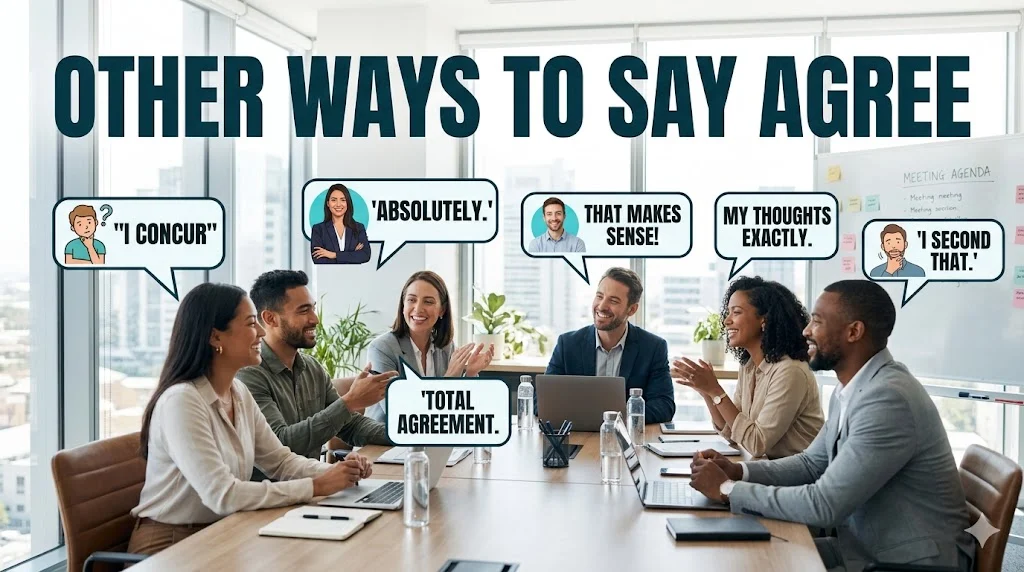
Looking for other ways to say agree? Try:
I concur, Absolutely, That’s correct, I’m on the same page, I agree completely.
These alternatives help you sound more professional, natural, and confident in different contexts.
The phrase “agree” is simple and widely used in English conversations. It expresses alignment with someone’s opinion, idea, or decision. However, repeating the same word can make your communication sound basic or repetitive.
Learning alternatives to “agree” helps you improve fluency, especially in professional communication, discussions, and writing. It also allows you to express excitement in English or emphasize strong agreement more effectively.
By expanding your vocabulary, you can adapt your tone—whether you’re speaking casually with friends or communicating in formal business environments.
“The way you express agreement can make you sound more confident, professional, and persuasive.”
Quick Categories
Formal alternatives to “agree”
- I concur
- I am in agreement
- That is correct
- I share the same view
Pro Tip: Use these in meetings, reports, and formal discussions.
Casual alternatives
- Totally
- Yep
- Sounds good
- I’m with you
Pro Tip: Best for conversations with friends or informal chats.
Professional alternatives
- I agree completely
- I’m on the same page
- That aligns with my thinking
- I support this
Pro Tip: Ideal for workplace communication and emails.
Informal expressions
- For sure
- Exactly
- You got it
- No doubt
Pro Tip: Keep these for relaxed conversations or social settings.
Common Mistakes
- Overusing “agree” repeatedly
Example: “I agree, I agree, I agree.” - Using informal phrases in professional settings
Example: “Yep, sounds good boss.” - Not showing strength of agreement
Example: “I agree” (when strong agreement is needed) - Ignoring tone/context
Example: Saying “Totally!” in a formal meeting - Not adding value
Example: “I agree” (without explanation or input)
What Does “Agree” Mean?
To agree means to have the same opinion, feeling, or understanding as someone else. It is commonly used in both spoken and written English.
Grammar Tip:
- Verb form: agree with someone / agree on something
Example Sentence:
“I agree with your idea about improving the process.”
When to Use “Agree”
- In conversations to show alignment
- In meetings to confirm decisions
- In emails to acknowledge ideas
- In debates to support a viewpoint
Spoken vs Written:
- Spoken: more casual alternatives are acceptable
- Written: often requires more formal phrasing
Formal vs Informal:
- Formal: “I concur,” “That is correct”
- Informal: “Totally,” “Exactly”
Is It Professional or Polite to Say “Agree”?
Polite? ✔️ Yes
Professional? ❌ Not always
While “agree” is polite, it can sound too basic in professional settings.
Business Example:
“I agree with your proposal” → Better: “I concur with your proposal”
Pros and Cons of Using “Agree”
Pros
- Simple and natural
- Friendly tone
- Common usage
- Easy to understand
Cons
- Too informal for work
- Overused
- Limited emotional range
- Not suitable for formal writing
“Using varied agreement phrases makes your communication more engaging and professional.”
Other Ways to Say “Agree” (With Examples)
These alternatives will help you sound more fluent, confident, and natural in different situations.
Use them according to tone, context, and audience to express agreement clearly and effectively.
1. Phrase: I concur
Meaning: Strong formal agreement
Explanation: Used in professional or academic settings
Example Sentence: “I concur with your assessment of the situation.”
Best Use: formal meetings
Worst Use: casual chats
Tone: formal, confident
Context Variability: professional
2. Phrase: Absolutely
Meaning: Strong agreement
Explanation: Emphasizes full support
Example Sentence: “Absolutely, that’s the best approach.”
Best Use: conversations
Worst Use: formal reports
Tone: confident, positive
Context Variability: casual / spoken
3. Phrase: That’s correct
Meaning: Confirms accuracy
Explanation: Used when validating information
Example Sentence: “That’s correct; the meeting is at 10 AM.”
Best Use: confirmations
Worst Use: emotional talks
Tone: neutral, professional
Context Variability: professional
4. Phrase: I agree completely
Meaning: Full agreement
Explanation: Adds emphasis to agreement
Example Sentence: “I agree completely with your proposal.”
Best Use: workplace
Worst Use: informal texting
Tone: professional, clear
Context Variability: professional
5. Phrase: I’m on the same page
Meaning: Shared understanding
Explanation: Indicates alignment in thinking
Example Sentence: “I’m on the same page regarding the strategy.”
Best Use: teamwork
Worst Use: formal writing
Tone: collaborative, modern
Context Variability: professional
6. Phrase: Exactly
Meaning: Strong agreement
Explanation: Shows precise alignment
Example Sentence: “Exactly, that’s what I meant.”
Best Use: discussions
Worst Use: formal emails
Tone: casual, affirming
Context Variability: casual / spoken
7. Phrase: That aligns with my thinking
Meaning: Agreement in ideas
Explanation: Professional phrasing for meetings
Example Sentence: “That aligns with my thinking on this project.”
Best Use: meetings
Worst Use: casual chats
Tone: professional, thoughtful
Context Variability: professional
8. Phrase: I support this
Meaning: Expresses approval
Explanation: Shows backing for an idea
Example Sentence: “I support this plan moving forward.”
Best Use: decisions
Worst Use: casual talk
Tone: formal, supportive
Context Variability: professional
9. Phrase: Sounds good
Meaning: Accepting an idea
Explanation: Casual agreement
Example Sentence: “Sounds good, let’s proceed.”
Best Use: informal work chats
Worst Use: formal proposals
Tone: friendly, relaxed
Context Variability: casual
10. Phrase: Totally
Meaning: Strong informal agreement
Explanation: Expresses enthusiasm
Example Sentence: “Totally, I agree with you.”
Best Use: friends
Worst Use: workplace
Tone: casual, energetic
Context Variability: informal
11. Phrase: I share the same view
Meaning: Similar opinion
Explanation: Formal agreement expression
Example Sentence: “I share the same view on this matter.”
Best Use: formal writing
Worst Use: casual talk
Tone: formal, polite
Context Variability: professional
12. Phrase: No doubt
Meaning: Strong agreement
Explanation: Confirms certainty
Example Sentence: “No doubt, that’s the right choice.”
Best Use: casual talk
Worst Use: formal meetings
Tone: confident, informal
Context Variability: informal
13. Phrase: You’re right
Meaning: Agreement with person
Explanation: Direct acknowledgment
Example Sentence: “You’re right about the timeline.”
Best Use: conversations
Worst Use: formal reports
Tone: neutral, conversational
Context Variability: casual
14. Phrase: For sure
Meaning: Confident agreement
Explanation: Informal affirmation
Example Sentence: “For sure, let’s do it.”
Best Use: friends
Worst Use: business emails
Tone: relaxed, confident
Context Variability: informal
15. Phrase: That makes sense
Meaning: Logical agreement
Explanation: Accepts reasoning
Example Sentence: “That makes sense given the data.”
Best Use: discussions
Worst Use: emotional context
Tone: thoughtful, neutral
Context Variability: both
16. Phrase: I couldn’t agree more
Meaning: Strong agreement
Explanation: Emphasizes full alignment
Example Sentence: “I couldn’t agree more with your idea.”
Best Use: discussions
Worst Use: short replies
Tone: strong, expressive
Context Variability: both
17. Phrase: I’m with you
Meaning: Support and agreement
Explanation: Shows alignment
Example Sentence: “I’m with you on this decision.”
Best Use: teamwork
Worst Use: formal docs
Tone: supportive, casual
Context Variability: casual
18. Phrase: That’s true
Meaning: Acknowledges correctness
Explanation: Confirms a statement
Example Sentence: “That’s true, we need more time.”
Best Use: discussions
Worst Use: strong agreement
Tone: neutral
Context Variability: both
19. Phrase: Good point
Meaning: Acknowledges idea
Explanation: Appreciates reasoning
Example Sentence: “Good point, we should consider that.”
Best Use: meetings
Worst Use: final decisions
Tone: thoughtful
Context Variability: both
20. Phrase: Fair enough
Meaning: Accepting viewpoint
Explanation: Shows reasonable agreement
Example Sentence: “Fair enough, that works.”
Best Use: discussions
Worst Use: formal writing
Tone: casual, balanced
Context Variability: casual
21. Phrase: I see your point
Meaning: Understanding agreement
Explanation: Acknowledges perspective
Example Sentence: “I see your point on this issue.”
Best Use: debates
Worst Use: strong agreement
Tone: neutral
Context Variability: both
22. Phrase: That works for me
Meaning: Accepting suggestion
Explanation: Agreement with plan
Example Sentence: “That works for me, let’s proceed.”
Best Use: planning
Worst Use: formal docs
Tone: neutral
Context Variability: both
23. Phrase: I’m in agreement
Meaning: Formal agreement
Explanation: Professional expression
Example Sentence: “I’m in agreement with the proposal.”
Best Use: business
Worst Use: casual talk
Tone: formal
Context Variability: professional
24. Phrase: You got it
Meaning: Accepting idea
Explanation: Informal agreement
Example Sentence: “You got it, I agree.”
Best Use: casual
Worst Use: formal
Tone: relaxed
Context Variability: informal
25. Phrase: That’s valid
Meaning: Logical agreement
Explanation: Accepts reasoning
Example Sentence: “That’s a valid point.”
Best Use: discussions
Worst Use: emotional
Tone: analytical
Context Variability: both
26. Phrase: I’m convinced
Meaning: Persuaded agreement
Explanation: Shows changed opinion
Example Sentence: “I’m convinced by your argument.”
Best Use: debates
Worst Use: casual talk
Tone: thoughtful
Context Variability: both
27. Phrase: Precisely
Meaning: Exact agreement
Explanation: Strong alignment
Example Sentence: “Precisely, that’s the issue.”
Best Use: discussions
Worst Use: informal chat
Tone: sharp, confident
Context Variability: professional
28. Phrase: That’s right
Meaning: Confirming agreement
Explanation: Validates statement
Example Sentence: “That’s right, we should proceed.”
Best Use: confirmations
Worst Use: strong opinions
Tone: neutral
Context Variability: both
29. Phrase: Couldn’t have said it better
Meaning: Strong agreement
Explanation: Praises statement
Example Sentence: “Couldn’t have said it better myself.”
Best Use: conversations
Worst Use: formal writing
Tone: expressive
Context Variability: casual
30. Phrase: I second that
Meaning: Support agreement
Explanation: Often used in group settings
Example Sentence: “I second that idea.”
Best Use: meetings
Worst Use: casual talk
Tone: formal, supportive
Context Variability: professional
“Using the right agreement phrase can make your response sound more intelligent and engaging.”
Mini Quiz / Self-Check
1. Which is most formal?
A. Totally
B. I concur
C. Sounds good
Answer: B
2. Best for casual chat?
A. I’m in agreement
B. For sure
C. That aligns with my thinking
Answer: B
3. Best for professional meeting?
A. Yep
B. That aligns with my thinking
C. No doubt
Answer: B
Comparison Table: Top Alternatives
| Phrase | Tone | Best Use |
|---|---|---|
| I concur | Formal | Meetings |
| Absolutely | Casual | Conversations |
| I agree completely | Professional | Workplace |
| I’m on the same page | Professional | Teamwork |
| Exactly | Casual | Discussions |
| That aligns with my thinking | Professional | Meetings |
| Sounds good | Casual | Informal work |
| I support this | Formal | Decisions |
| I couldn’t agree more | Strong | Both |
| Good point | Neutral | Discussions |
FAQs
1. What is the most formal way to say agree?
“I concur” or “I am in agreement.”
2. What is a professional alternative?
“That aligns with my thinking” or “I support this.”
3. Can I use casual phrases at work?
Only in informal settings or team chats.
4. How do I show strong agreement?
Use “I couldn’t agree more” or “Absolutely.”
5. Why should I avoid repeating “agree”?
It sounds repetitive and less engaging.
Conclusion
Using other ways to say agree improves your communication by making it more engaging, professional, and expressive.
Practice these alternatives daily to adapt your tone, express agreement clearly, and sound more confident in English conversations and workplace communication.

Joshua Bell is a professional content writer at Synofind.com, known for delivering clear, accurate and engaging written content. He focuses on thorough research and thoughtful storytelling to ensure every piece is reliable and easy to understand. His work reflects a strong commitment to quality and credibility.