Last Updated on April 22, 2026
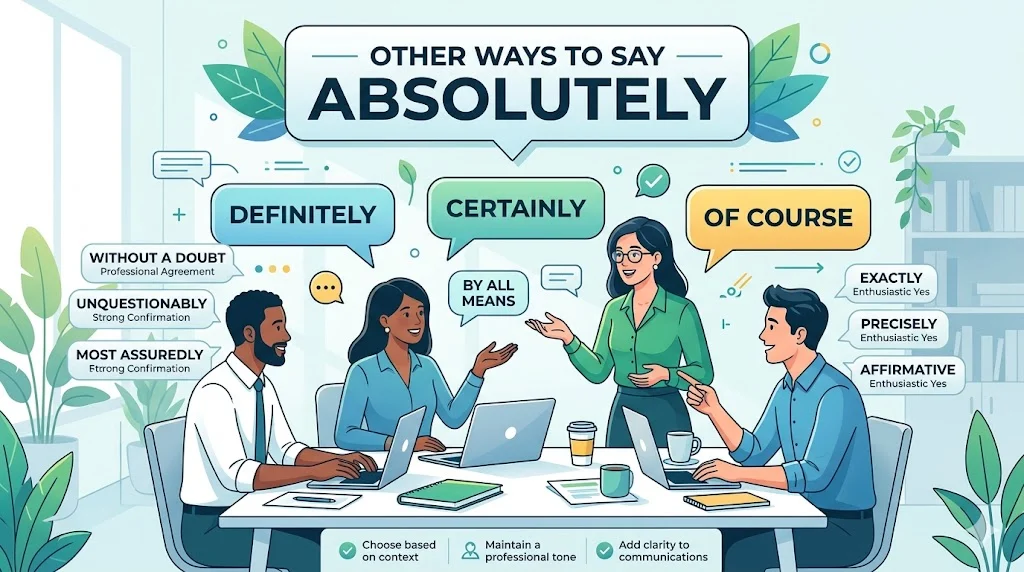
Looking for other ways to say absolutely? Try:
Definitely, Certainly, Of course, Without a doubt, Completely.
These alternatives help you express agreement, certainty, or emphasis more naturally in both professional and casual English.
The word “absolutely” is commonly used to show strong agreement, certainty, or emphasis. Whether you’re responding in a meeting, writing an email, or having a conversation, it’s a powerful word but also one that can become repetitive.
Learning alternatives to “absolutely” allows you to:
- Sound more fluent and expressive
- Adjust your tone for formal or informal situations
- Improve your ability to express excitement in English naturally
Expanding your vocabulary also helps you use more varied professional reaction phrases and informal expressions in English depending on context.
“Using the right synonym for ‘absolutely’ makes your English sound confident and polished.”
Quick Categories
Formal alternatives to “absolutely”
- Certainly
- Indeed
- Without a doubt
- Undoubtedly
Pro Tip: Use these in emails, meetings, and professional communication.
Casual alternatives
- Totally
- For sure
- Yup
- 100%
Pro Tip: Best for conversations, texts, and informal settings.
Professional alternatives
- Definitely
- Of course
- By all means
- Affirmative
Pro Tip: Great for workplace communication and client interactions.
Informal expressions
- You bet
- No doubt
- Absolutely yes
- Sure thing
Pro Tip: Use only with friends or relaxed environments.
Common Mistakes
- Overusing “absolutely”
Example: “Absolutely, absolutely, absolutely.” - Using informal alternatives in formal settings
Example: “Yup, I agree with the proposal.” - Using weak synonyms in strong contexts
Example: “Maybe” instead of “definitely.” - Not matching tone with context
Example: “Totally” in a business report - Overemphasizing unnecessarily
Example: “Absolutely perfect in every single way.”
What Does “Absolutely” Mean?
“Absolutely” means completely, certainly, or without any doubt. It is often used to show strong agreement or confirmation.
Grammar Note: It is an adverb used to modify verbs, adjectives, or entire sentences.
Example:
“I absolutely agree with your suggestion.”
When to Use “Absolutely”
- To show strong agreement
- To express certainty or confidence
- To emphasize a statement
- In spoken and written English
Spoken vs Written:
- Spoken: very common
- Written: best in semi-formal or persuasive contexts
Formal vs Informal:
- Formal: acceptable but may need alternatives
- Informal: very common
Is It Professional or Polite to Say “Absolutely”?
Polite? ✔️ Yes
Professional? ✔️ Yes (with context)
Business Example:
“Absolutely, I will complete the task by the deadline.”
It works well professionally, but overuse can reduce impact.
Pros and Cons of Using “Absolutely”
Pros
- Simple and natural
- Shows strong agreement
- Widely understood
- Works in most contexts
Cons
- Can sound repetitive
- Less formal in some cases
- Overused in conversations
- Limited variation
Other Ways to Say “Absolutely” With Examples
These alternatives will help you sound more fluent, confident, and natural in different situations.
Use them according to tone, context, and audience to express excitement, agreement, or certainty.
1. Phrase: Definitely
Meaning: Strong agreement or certainty
Explanation: Very common and versatile alternative
Example Sentence: “Definitely, I’ll join the meeting.”
Best Use: workplace, daily use
Worst Use: legal writing
Tone: confident, clear
Context Variability: casual / professional / spoken
2. Phrase: Certainly
Meaning: Polite agreement
Explanation: Formal and respectful tone
Example Sentence: “Certainly, I will assist you with that.”
Best Use: formal emails
Worst Use: casual chats
Tone: polite, formal
Context Variability: professional / written
3. Phrase: Of course
Meaning: Expected agreement
Explanation: Shows willingness and ease
Example Sentence: “Of course, I can help you.”
Best Use: everyday speech
Worst Use: strict formal docs
Tone: friendly, natural
Context Variability: casual / professional
4. Phrase: Without a doubt
Meaning: Complete certainty
Explanation: Strong emphasis
Example Sentence: “Without a doubt, this is the best option.”
Best Use: persuasive speech
Worst Use: casual texting
Tone: strong, assertive
Context Variability: professional / spoken
5. Phrase: Totally
Meaning: Full agreement
Explanation: Informal emphasis
Example Sentence: “Totally agree with you.”
Best Use: friends, social
Worst Use: workplace emails
Tone: casual, relaxed
Context Variability: informal / spoken
6. Phrase: For sure
Meaning: Confirmation
Explanation: Friendly and relaxed
Example Sentence: “For sure, I’ll be there.”
Best Use: texting
Worst Use: formal writing
Tone: casual, confident
Context Variability: informal
7. Phrase: Indeed
Meaning: Strong agreement
Explanation: Formal and slightly emphatic
Example Sentence: “Indeed, that is correct.”
Best Use: formal discussion
Worst Use: slang conversations
Tone: formal, intellectual
Context Variability: professional
8. Phrase: By all means
Meaning: Permission or agreement
Explanation: Encouraging response
Example Sentence: “By all means, go ahead.”
Best Use: professional
Worst Use: casual texting
Tone: polite, supportive
Context Variability: professional
9. Phrase: Affirmative
Meaning: Yes (formal confirmation)
Explanation: Often used in technical or official contexts
Example Sentence: “Affirmative, task completed.”
Best Use: formal, technical
Worst Use: casual use
Tone: formal, direct
Context Variability: professional
10. Phrase: No doubt
Meaning: Strong certainty
Explanation: Confident agreement
Example Sentence: “No doubt, that’s the right choice.”
Best Use: casual speech
Worst Use: formal writing
Tone: confident, casual
Context Variability: informal
11. Phrase: Exactly
Meaning: Complete agreement
Explanation: Emphasizes correctness
Example Sentence: “Exactly, that’s what I meant.”
Best Use: discussions
Worst Use: formal reports
Tone: confident, clear
Context Variability: spoken
12. Phrase: Precisely
Meaning: Exact agreement
Explanation: More formal than “exactly”
Example Sentence: “Precisely, that is the issue.”
Best Use: professional
Worst Use: casual chat
Tone: formal, precise
Context Variability: professional
13. Phrase: You bet
Meaning: Strong informal yes
Explanation: Friendly agreement
Example Sentence: “You bet, I’ll help.”
Best Use: friends
Worst Use: business emails
Tone: casual, upbeat
Context Variability: informal
14. Phrase: Sure thing
Meaning: Willing agreement
Explanation: Relaxed tone
Example Sentence: “Sure thing, I’ll do it.”
Best Use: casual
Worst Use: formal writing
Tone: friendly, relaxed
Context Variability: informal
15. Phrase: 100%
Meaning: Complete agreement
Explanation: Modern informal emphasis
Example Sentence: “100%, I agree.”
Best Use: social media
Worst Use: formal writing
Tone: modern, casual
Context Variability: informal
16. Phrase: Undoubtedly
Meaning: Without doubt
Explanation: Strong formal certainty
Example Sentence: “Undoubtedly, this will succeed.”
Best Use: formal writing
Worst Use: casual chat
Tone: formal, strong
Context Variability: professional
17. Phrase: Positively
Meaning: Certainly
Explanation: Confident tone
Example Sentence: “I can positively confirm that.”
Best Use: professional
Worst Use: casual use
Tone: formal, confident
Context Variability: professional
18. Phrase: Unquestionably
Meaning: Beyond doubt
Explanation: Very strong emphasis
Example Sentence: “Unquestionably, the best solution.”
Best Use: formal
Worst Use: casual
Tone: strong, formal
Context Variability: professional
19. Phrase: Naturally
Meaning: Expected agreement
Explanation: Suggests something is obvious
Example Sentence: “Naturally, I agree.”
Best Use: conversations
Worst Use: strict formal docs
Tone: smooth, confident
Context Variability: spoken
20. Phrase: Sure
Meaning: Yes
Explanation: Simple and flexible
Example Sentence: “Sure, I’ll handle it.”
Best Use: casual
Worst Use: formal writing
Tone: neutral, relaxed
Context Variability: casual
21. Phrase: That’s right
Meaning: Agreement
Explanation: Confirms correctness
Example Sentence: “That’s right, exactly.”
Best Use: spoken
Worst Use: formal writing
Tone: conversational
Context Variability: spoken
22. Phrase: Absolutely yes
Meaning: Strong confirmation
Explanation: Emphasized version
Example Sentence: “Absolutely yes, I support this.”
Best Use: emphasis
Worst Use: repetitive use
Tone: strong
Context Variability: spoken
23. Phrase: Without question
Meaning: Certain agreement
Explanation: Strong and formal
Example Sentence: “Without question, this is correct.”
Best Use: formal
Worst Use: casual
Tone: firm, professional
Context Variability: professional
24. Phrase: Certainly so
Meaning: Formal agreement
Explanation: Traditional tone
Example Sentence: “Certainly so, I agree.”
Best Use: formal
Worst Use: casual
Tone: formal
Context Variability: professional
25. Phrase: I couldn’t agree more
Meaning: Strong agreement
Explanation: Expressive phrase
Example Sentence: “I couldn’t agree more with you.”
Best Use: discussions
Worst Use: short replies
Tone: expressive
Context Variability: spoken / professional
26. Phrase: That’s for sure
Meaning: Strong confirmation
Explanation: Casual emphasis
Example Sentence: “That’s for sure!”
Best Use: casual
Worst Use: formal
Tone: relaxed
Context Variability: informal
27. Phrase: Absolutely correct
Meaning: Strong confirmation
Explanation: Emphasizes correctness
Example Sentence: “That is absolutely correct.”
Best Use: professional
Worst Use: casual
Tone: formal
Context Variability: professional
28. Phrase: Agreed completely
Meaning: Full agreement
Explanation: Slightly formal
Example Sentence: “Agreed completely on this point.”
Best Use: workplace
Worst Use: casual chat
Tone: professional
Context Variability: professional
29. Phrase: Entirely
Meaning: Fully
Explanation: Subtle emphasis
Example Sentence: “I entirely agree.”
Best Use: formal writing
Worst Use: casual speech
Tone: refined
Context Variability: professional
30. Phrase: Fully
Meaning: Completely
Explanation: Direct and simple
Example Sentence: “I fully support this idea.”
Best Use: workplace
Worst Use: casual chat
Tone: clear
Context Variability: professional
“The more alternatives you know, the more natural and confident your English becomes.”
Mini Quiz / Self-Check
1. Which is best for formal writing?
A. Totally
B. Undoubtedly
C. Yup
Answer: B
2. Best for casual conversation?
A. Certainly
B. Totally
C. Unquestionably
Answer: B
3. Strongest agreement phrase?
A. Sure
B. Without a doubt
C. Maybe
Answer: B
Comparison Table: Top Alternatives
| Phrase | Tone | Best Use |
|---|---|---|
| Definitely | Neutral | Everyday use |
| Certainly | Formal | Emails |
| Of course | Friendly | Conversations |
| Without a doubt | Strong | Persuasive speech |
| Totally | Casual | Friends |
| Indeed | Formal | Discussions |
| By all means | Professional | Workplace |
| Precisely | Formal | Meetings |
| Undoubtedly | Strong formal | Writing |
| I couldn’t agree more | Expressive | Conversations |
FAQs
1. Is “absolutely” formal or informal?
It works in both, but may sound casual in strict formal writing.
2. What is the most professional alternative?
“Certainly,” “Undoubtedly,” or “Without a doubt.”
3. Can I use “totally” at work?
Only in casual workplace conversations, not formal emails.
4. What’s the strongest synonym?
“Without a doubt” or “Unquestionably.”
5. How can I sound more natural?
Mix different alternatives based on tone and context.
Conclusion
Learning other ways to say absolutely helps you:
- Improve fluency and expression
- Adjust tone across formal and informal situations
- Use more natural professional reaction phrases
Practice using these alternatives daily to make your English sound more confident varied, and polished.

Liam Reed is a skilled content writer at Synofind.com, known for crafting clear, engaging and well-researched pieces. His work focuses on accuracy, readability and delivering value to readers. He consistently produces content that informs and connects.