Last Updated on April 24, 2026
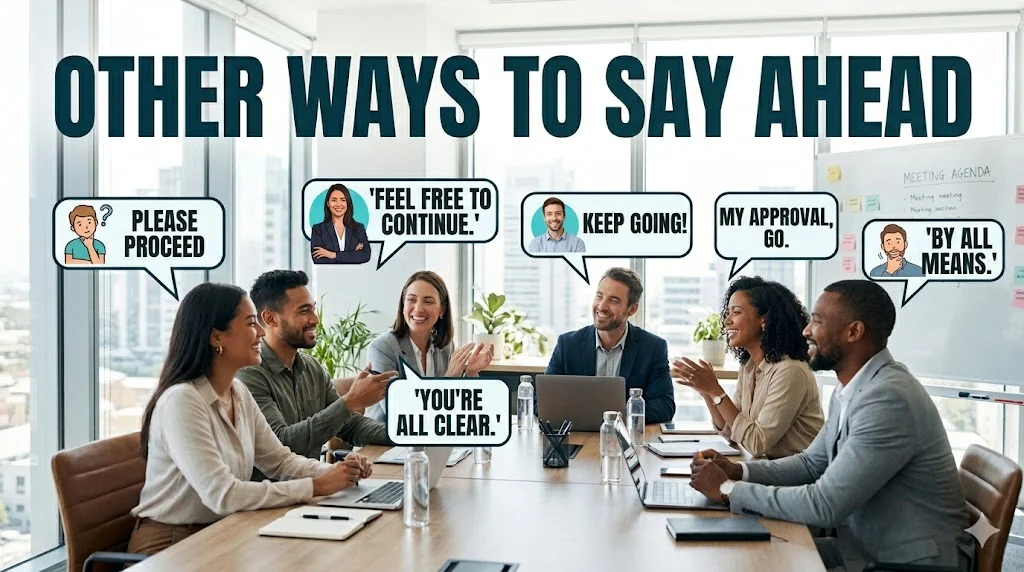
If you’re looking for other ways to say go ahead, try:
Please proceed, Feel free to continue, You may go ahead, Go right ahead, Carry on.
These alternatives help you sound more polite, professional, and context-appropriate in both spoken and written English.
The phrase “go ahead” is commonly used to give permission, encourage someone to continue, or allow action. While simple and widely understood, it can sometimes sound too casual or repetitive, especially in professional communication.
Learning alternatives to “go ahead” helps you adapt your tone depending on the situation whether you’re in a meeting, writing an email, or having a casual conversation. It also improves your ability to express excitement in English or give approval in a more refined way.
Using varied expressions allows you to sound more confident, polite, and natural, especially in workplace settings or formal discussions.
“The way you give permission can shape how professional and respectful you sound.”
Quick Categories
Formal alternatives to “go ahead”
- Please proceed
- You may proceed
- Kindly continue
- You have my approval
Pro Tip: Use these in emails, meetings, or client communication to sound polished and respectful.
Casual alternatives
- Go for it
- Sure, go ahead
- No problem, continue
- Yeah, go on
Pro Tip: Great for friendly conversations, but avoid in formal writing.
Professional alternatives
- Feel free to proceed
- You’re welcome to continue
- Please carry on
- You may move forward
Pro Tip: These work well in workplace discussions and leadership communication.
Informal expressions
- Go right ahead
- Fire away
- Be my guest
- Knock yourself out
Pro Tip: Use only in relaxed or friendly settings to avoid sounding unprofessional.
Common Mistakes
- Using “go ahead” in overly formal situations
Example: “Go ahead with the contract approval.” - Sounding too blunt
Example: “Go ahead.” (without context or politeness) - Using slang in professional emails
Example: “Knock yourself out with the report.” - Repeating the same phrase multiple times
Example: “Go ahead go ahead go ahead.” - Not clarifying permission
Example: “Go ahead.” (unclear what action is allowed)
What Does “Go Ahead” Mean?
“Go ahead” means to give permission, encourage action, or allow someone to continue speaking or doing something.
It functions as a phrasal verb expression often used in spoken English and informal writing.
Example:
“Go ahead and start the presentation.”
When to Use “Go Ahead”
- Giving permission
- Encouraging someone to speak
- Allowing action or decision-making
- Informal conversations
- Team discussions
Spoken vs Written:
More common in spoken English, less formal in writing
Formal vs Informal:
Mostly informal; better alternatives exist for professional contexts
Is It Professional or Polite to Say “Go Ahead”?
Polite? ✔️ Yes
Professional? ❌ Not always
In business settings, it’s better to use alternatives like:
“Please proceed with the proposal.”
Pros and Cons of Using “Go Ahead”
Pros
- Simple and natural
- Friendly tone
- Easy to understand
- Common usage
Cons
- Too informal for work
- Overused
- Limited emotional range
- Not suitable for formal writing
Other Ways to Say “Go Ahead” With Examples
These alternatives will help you sound more fluent, confident, and natural in different situations.
Use them according to tone, context, and audience to express approval, encouragement, or permission.
1. Phrase: Please proceed
Meaning: Formal way to allow action
Explanation: Common in professional communication
Example Sentence: “Please proceed with the project as discussed.”
Best Use: business emails
Worst Use: casual chat
Tone: formal, polite
Context Variability: professional
2. Phrase: You may proceed
Meaning: Granting permission formally
Explanation: Often used in meetings or instructions
Example Sentence: “You may proceed with the presentation.”
Best Use: formal meetings
Worst Use: casual talk
Tone: formal, authoritative
Context Variability: professional
3. Phrase: Kindly continue
Meaning: Polite request to continue
Explanation: Soft and respectful tone
Example Sentence: “Kindly continue with your explanation.”
Best Use: formal discussion
Worst Use: informal chat
Tone: polite, gentle
Context Variability: professional
4. Phrase: Feel free to proceed
Meaning: Permission with encouragement
Explanation: Friendly yet professional
Example Sentence: “Feel free to proceed when ready.”
Best Use: workplace
Worst Use: strict authority
Tone: polite, relaxed
Context Variability: professional
5. Phrase: Carry on
Meaning: Continue what you’re doing
Explanation: Neutral and widely used
Example Sentence: “Please carry on with your work.”
Best Use: general use
Worst Use: formal documents
Tone: neutral, calm
Context Variability: spoken
“Using the right phrase can make your communication sound confident and respectful.”
6. Phrase: Go right ahead
Meaning: Strong encouragement to proceed
Explanation: Slightly more enthusiastic
Example Sentence: “Go right ahead and start.”
Best Use: casual permission
Worst Use: formal writing
Tone: friendly, encouraging
Context Variability: casual
7. Phrase: Go for it
Meaning: Encouragement to take action
Explanation: Motivational tone
Example Sentence: “Go for it you’ve got this!”
Best Use: encouragement
Worst Use: professional emails
Tone: energetic, casual
Context Variability: casual
8. Phrase: Be my guest
Meaning: Polite permission
Explanation: Slightly humorous tone
Example Sentence: “Be my guest, take the lead.”
Best Use: friendly settings
Worst Use: formal work
Tone: light, polite
Context Variability: casual
9. Phrase: Fire away
Meaning: Start asking or speaking
Explanation: Informal and conversational
Example Sentence: “Fire away with your questions.”
Best Use: Q&A sessions
Worst Use: formal emails
Tone: casual, open
Context Variability: spoken
10. Phrase: You have my approval
Meaning: Official permission
Explanation: Strong and authoritative
Example Sentence: “You have my approval to proceed.”
Best Use: leadership
Worst Use: casual talk
Tone: formal, authoritative
Context Variability: professional
11. Phrase: Proceed as planned
Meaning: Continue according to plan
Explanation: Used in structured tasks
Example Sentence: “Proceed as planned with the rollout.”
Best Use: project management
Worst Use: casual
Tone: formal, clear
Context Variability: professional
12. Phrase: Continue as discussed
Meaning: Follow previous instructions
Explanation: Reinforces agreement
Example Sentence: “Continue as discussed in the meeting.”
Best Use: business
Worst Use: informal
Tone: professional, direct
Context Variability: professional
13. Phrase: You’re good to go
Meaning: Ready to proceed
Explanation: Informal approval
Example Sentence: “Everything looks fine you’re good to go.”
Best Use: teams
Worst Use: formal writing
Tone: casual, positive
Context Variability: casual
14. Phrase: Please carry on
Meaning: Polite continuation
Explanation: Slightly formal version of “carry on”
Example Sentence: “Please carry on with your presentation.”
Best Use: meetings
Worst Use: slang context
Tone: polite, neutral
Context Variability: professional
15. Phrase: You can continue
Meaning: Permission to proceed
Explanation: Direct and clear
Example Sentence: “You can continue with your report.”
Best Use: neutral
Worst Use: formal writing
Tone: simple, neutral
Context Variability: spoken
16. Phrase: Move forward
Meaning: Progress to next step
Explanation: Professional and goal-oriented
Example Sentence: “Let’s move forward with the proposal.”
Best Use: business
Worst Use: casual chat
Tone: professional, decisive
Context Variability: professional
17. Phrase: Advance
Meaning: Proceed formally
Explanation: Short and direct
Example Sentence: “You may advance to the next stage.”
Best Use: formal systems
Worst Use: casual talk
Tone: formal, concise
Context Variability: professional
18. Phrase: Proceed accordingly
Meaning: Follow instructions
Explanation: Formal directive
Example Sentence: “Please proceed accordingly.”
Best Use: official communication
Worst Use: casual
Tone: formal, authoritative
Context Variability: professional
19. Phrase: Feel free to continue
Meaning: Encouraging continuation
Explanation: Friendly and polite
Example Sentence: “Feel free to continue your explanation.”
Best Use: discussions
Worst Use: strict authority
Tone: polite, relaxed
Context Variability: spoken/professional
20. Phrase: Keep going
Meaning: Continue action
Explanation: Motivational
Example Sentence: “Keep going, you’re doing great.”
Best Use: encouragement
Worst Use: formal emails
Tone: motivating, casual
Context Variability: casual
“Professional communication is not just about what you say but how you say it.”
Mini Quiz / Self-Check
- Best formal alternative?
A. Go for it
B. Please proceed
C. Fire away
Answer: B - Casual encouragement?
A. Proceed accordingly
B. Go for it
C. Advance
Answer: B - Professional meeting phrase?
A. Be my guest
B. Kindly continue
C. Knock yourself out
Answer: B
Comparison Table: Top Alternatives
| Phrase | Tone | Best Use |
|---|---|---|
| Please proceed | Formal | Business emails |
| You may proceed | Formal | Meetings |
| Feel free to proceed | Professional | Workplace |
| Carry on | Neutral | General use |
| Go for it | Casual | Encouragement |
| Be my guest | Informal | Friendly talk |
| You have my approval | Formal | Leadership |
| Move forward | Professional | Projects |
| Proceed accordingly | Formal | Official emails |
| Keep going | Casual | Motivation |
FAQs
1. Is “go ahead” rude?
No, but it can sound too casual in formal situations.
2. What’s the most professional alternative?
“Please proceed” or “You may proceed.”
3. Can I use “go ahead” in emails?
Yes, but better to use more formal alternatives in business emails.
4. What’s a friendly alternative?
“Go for it” or “Be my guest.”
5. How do I sound more polite?
Use phrases like “Kindly continue” or “Feel free to proceed.”
Conclusion
Using other ways to say go ahead helps you sound more polished, confident, and context-aware. Whether you’re communicating in business or casual settings, choosing the right phrase improves clarity and professionalism.
Practice using these alternatives daily to enhance your spoken and written English fluency while maintaining the right tone.

Joshua Bell is a professional content writer at Synofind.com, known for delivering clear, accurate and engaging written content. He focuses on thorough research and thoughtful storytelling to ensure every piece is reliable and easy to understand. His work reflects a strong commitment to quality and credibility.