
Last Updated on April 24, 2026
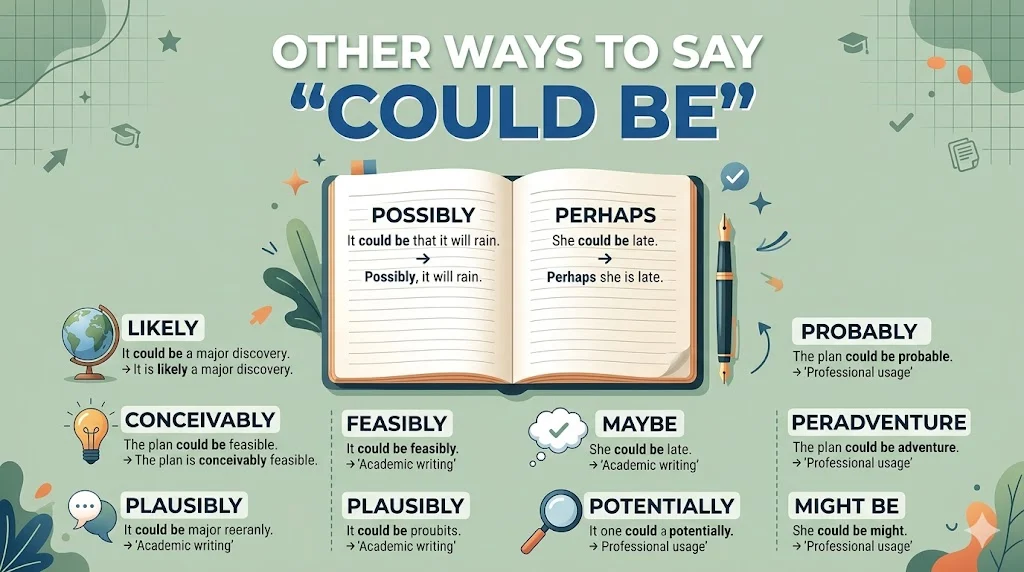
Looking for other ways to say could be? Try:
Possibly, Might be, May be, Perhaps, It’s likely.
These alternatives help you express uncertainty, possibility, or suggestion more clearly and professionally.
The phrase “could be” is commonly used to express possibility, uncertainty, or speculation in English. It’s simple, but often overused in both spoken and written communication.
Learning alternatives to “could be” allows you to sound more precise, fluent, and confident, especially in professional or academic contexts. It also helps you adapt your tone depending on whether you’re speaking casually, writing formally, or presenting ideas.
Expanding your vocabulary also helps you express excitement in English, uncertainty, or probability more naturally and effectively.
“The right word for possibility can make your English sound more confident and precise.”
Quick Categories
Formal alternatives to “could be”
- It is possible that
- It may be the case
- It is conceivable that
- It appears that
Pro Tip: Use these in academic writing, reports, and professional emails.
Casual alternatives
- Maybe
- Might be
- Could happen
- There’s a chance
Pro Tip: Ideal for everyday conversation and informal writing.
Professional alternatives
- It is likely
- It is plausible
- There is a possibility
- It seems probable
Pro Tip: Best for business communication, presentations, and analysis.
Informal expressions
- Could turn out
- Might just be
- Guess it’s
- Looks like
Pro Tip: Use these in relaxed, spoken English or friendly chats.
Common Mistakes
- Overusing “could be” repeatedly
Example: “It could be this, or it could be that.” - Using it without clarity
Example: “It could be something.” (Too vague) - Mixing tenses incorrectly
Example: “It could be happened.” - Using informal alternatives in formal writing
Example: “Guess it’s correct.” - Ignoring probability level
Example: Using “could be” when something is very likely
What Does “Could Be” Mean?
Definition:
“Could be” expresses possibility or uncertainty about something happening or being true.
Grammar:
Modal verb structure:
Subject + could + base verb
Example Sentence:
“It could be the reason for the delay.”
When to Use “Could Be”
- When you are not fully certain
- When suggesting a possible explanation
- In casual conversation
- In hypotheses or predictions
Spoken vs Written:
- Spoken: Very common
- Written: Acceptable but often replaced with more precise alternatives
Formal vs Informal:
- Informal: ✔️ Common
- Formal: ⚠️ Better alternatives preferred
Is It Professional or Polite to Say “Could Be”?
Polite? ✔️ Yes
Professional? ❌ Not always
It’s acceptable but may sound uncertain or weak in professional settings.
Example:
“It could be a viable solution.” (Better: “It is a viable solution.”)
Pros and Cons of Using “Could Be”
Pros
- Simple and natural
- Easy to understand
- Common in conversation
- Flexible usage
Cons
- Too vague
- Overused
- Lacks precision
- Weak in formal writing
Other Ways to Say “Could Be” With Examples
These alternatives will help you sound more fluent, confident, and natural in different situations.
Use them according to tone, context, and audience to express possibility, speculation, or probability.
- Phrase: Possibly
Meaning: Indicates chance
Explanation: Neutral probability expression
Example Sentence: “It’s possibly the best option.”
Best Use: General use
Worst Use: Formal reports
Tone: Neutral, simple
Context Variability: casual / professional
- Phrase: Maybe
Meaning: Something uncertain
Explanation: Very common casual alternative
Example Sentence: “Maybe we should try again.”
Best Use: Conversation
Worst Use: Formal writing
Tone: Casual, relaxed
Context Variability: spoken
- Phrase: Might be
Meaning: Slight possibility
Explanation: Similar to “could be”
Example Sentence: “It might be the answer.”
Best Use: General use
Worst Use: Strong claims
Tone: Neutral
Context Variability: casual / professional
- Phrase: Perhaps
Meaning: Polite uncertainty
Explanation: Slightly more formal than “maybe”
Example Sentence: “Perhaps we should reconsider.”
Best Use: Writing
Worst Use: Informal chat
Tone: Polite, formal
Context Variability: professional
- Phrase: It is possible that
Meaning: Indicates possibility
Explanation: Formal expression
Example Sentence: “It is possible that the results will change.”
Best Use: Reports
Worst Use: Casual talk
Tone: Formal
Context Variability: professional
- Phrase: It may be
Meaning: Moderate possibility
Explanation: Formal and concise
Example Sentence: “It may be the right decision.”
Best Use: Professional writing
Worst Use: Casual speech
Tone: Formal
Context Variability: professional
- Phrase: There is a chance
Meaning: Indicates likelihood
Explanation: Common and clear
Example Sentence: “There is a chance of rain.”
Best Use: General
Worst Use: Academic writing
Tone: Neutral
Context Variability: casual / professional
- Phrase: It seems
Meaning: Suggests observation
Explanation: Based on evidence
Example Sentence: “It seems correct.”
Best Use: Analysis
Worst Use: Strong certainty
Tone: Neutral
Context Variability: professional
- Phrase: It appears
Meaning: Based on observation
Explanation: Slightly formal
Example Sentence: “It appears to be working.”
Best Use: Reports
Worst Use: Casual chat
Tone: Formal
Context Variability: professional
- Phrase: Likely
Meaning: High probability
Explanation: Stronger than “could be”
Example Sentence: “It’s likely to happen.”
Best Use: Professional
Worst Use: Low certainty
Tone: Confident
Context Variability: professional
- Phrase: Unlikely
Meaning: Low probability
Explanation: Opposite meaning
Example Sentence: “It’s unlikely to succeed.”
Best Use: Analysis
Worst Use: Positive tone
Tone: Negative, factual
Context Variability: professional
- Phrase: Conceivably
Meaning: Theoretically possible
Explanation: Formal usage
Example Sentence: “It could conceivably work.”
Best Use: Academic
Worst Use: Casual
Tone: Formal
Context Variability: professional
- Phrase: Potentially
Meaning: Has potential
Explanation: Common professional term
Example Sentence: “This could potentially improve results.”
Best Use: Business
Worst Use: Casual talk
Tone: Professional
Context Variability: professional
- Phrase: It’s plausible
Meaning: Reasonable possibility
Explanation: Logical context
Example Sentence: “It’s plausible that demand will rise.”
Best Use: Reports
Worst Use: Casual
Tone: Analytical
Context Variability: professional
- Phrase: It could turn out
Meaning: Future possibility
Explanation: Outcome-focused
Example Sentence: “It could turn out well.”
Best Use: Conversation
Worst Use: Formal
Tone: Casual
Context Variability: spoken
- Phrase: There’s a possibility
Meaning: Expresses chance
Explanation: Formal-neutral
Example Sentence: “There’s a possibility of delay.”
Best Use: Professional
Worst Use: Informal
Tone: Neutral
Context Variability: professional
- Phrase: It’s feasible
Meaning: Possible and practical
Explanation: Business-focused
Example Sentence: “It’s feasible to complete this on time.”
Best Use: Workplace
Worst Use: Casual
Tone: Professional
Context Variability: professional
- Phrase: It’s probable
Meaning: High likelihood
Explanation: Stronger than “could be”
Example Sentence: “It’s probable that sales will increase.”
Best Use: Reports
Worst Use: Uncertain ideas
Tone: Confident
Context Variability: professional
- Phrase: It’s doubtful
Meaning: Low chance
Explanation: Opposite tone
Example Sentence: “It’s doubtful this will work.”
Best Use: Analysis
Worst Use: Positive messaging
Tone: Negative
Context Variability: professional
- Phrase: It looks like
Meaning: Based on appearance
Explanation: Informal observation
Example Sentence: “It looks like rain.”
Best Use: Casual
Worst Use: Formal
Tone: Informal
Context Variability: spoken
- Phrase: Guess it’s
Meaning: Informal assumption
Explanation: Casual speech
Example Sentence: “Guess it’s done.”
Best Use: Friends
Worst Use: Work
Tone: Informal
Context Variability: spoken
- Phrase: Could happen
Meaning: Possibility
Explanation: Simple expression
Example Sentence: “It could happen soon.”
Best Use: Casual
Worst Use: Formal
Tone: Neutral
Context Variability: casual
- Phrase: Might just be
Meaning: Slight speculation
Explanation: Informal tone
Example Sentence: “It might just be coincidence.”
Best Use: Casual
Worst Use: Formal
Tone: Relaxed
Context Variability: spoken
- Phrase: It seems likely
Meaning: Strong possibility
Explanation: Confident but cautious
Example Sentence: “It seems likely to succeed.”
Best Use: Reports
Worst Use: Informal
Tone: Professional
Context Variability: professional
- Phrase: It may turn out
Meaning: Future outcome
Explanation: Predictive
Example Sentence: “It may turn out better than expected.”
Best Use: Neutral
Worst Use: Strong claims
Tone: Balanced
Context Variability: professional
- Phrase: It’s within the realm of possibility
Meaning: Possible but uncertain
Explanation: Formal phrase
Example Sentence: “It’s within the realm of possibility.”
Best Use: Formal writing
Worst Use: Casual
Tone: Formal
Context Variability: professional
- Phrase: It’s on the cards
Meaning: Likely to happen
Explanation: Informal idiom
Example Sentence: “A promotion is on the cards.”
Best Use: Casual
Worst Use: Formal
Tone: Informal
Context Variability: spoken
- Phrase: It stands to reason
Meaning: Logical possibility
Explanation: Based on reasoning
Example Sentence: “It stands to reason this will work.”
Best Use: Argument
Worst Use: Casual
Tone: Formal
Context Variability: professional
- Phrase: It could well be
Meaning: Strong possibility
Explanation: Slightly more confident
Example Sentence: “It could well be the solution.”
Best Use: General
Worst Use: Strong certainty
Tone: Neutral
Context Variability: professional
- Phrase: There’s every chance
Meaning: High probability
Explanation: Strong optimistic tone
Example Sentence: “There’s every chance we’ll succeed.”
Best Use: Positive context
Worst Use: Negative
Tone: Confident
Context Variability: professional
“Choosing the right level of certainty makes your communication clearer and more persuasive.”
Mini Quiz / Self-Check
- Which is most formal?
A. Maybe
B. It is possible that
C. Guess it’s
Answer: B - Best for casual conversation?
A. Perhaps
B. Maybe
C. It’s feasible
Answer: B - Strong probability?
A. Could be
B. Likely
C. Might just be
Answer: B
Comparison Table: Top Alternatives
| Phrase | Tone | Best Use |
|---|---|---|
| Possibly | Neutral | General |
| Maybe | Casual | Conversation |
| Perhaps | Formal | Writing |
| It is possible that | Formal | Reports |
| Likely | Confident | Professional |
| It appears | Formal | Analysis |
| There is a chance | Neutral | General |
| Potentially | Professional | Business |
| It’s plausible | Analytical | Reports |
| It seems likely | Professional | Predictions |
FAQs
1. Is “could be” too informal?
Not always, but it’s less precise in formal writing.
2. What’s the most professional alternative?
“It is possible that” or “It is plausible.”
3. What’s the simplest alternative?
“Maybe” or “possibly.”
4. Can I use “could be” in emails?
Yes, but professional alternatives are often better.
5. How do I sound more confident?
Use stronger words like “likely” or “probable.”
Conclusion
Using other ways to say “could be” helps you sound more clear, professional and confident. It allows you to express different levels of certainty effectively.
Practice using these alternatives daily to improve your fluency and ensure your communication matches the right tone and context.

Liam Reed is a skilled content writer at Synofind.com, known for crafting clear, engaging and well-researched pieces. His work focuses on accuracy, readability and delivering value to readers. He consistently produces content that informs and connects.