Last Updated on April 24, 2026
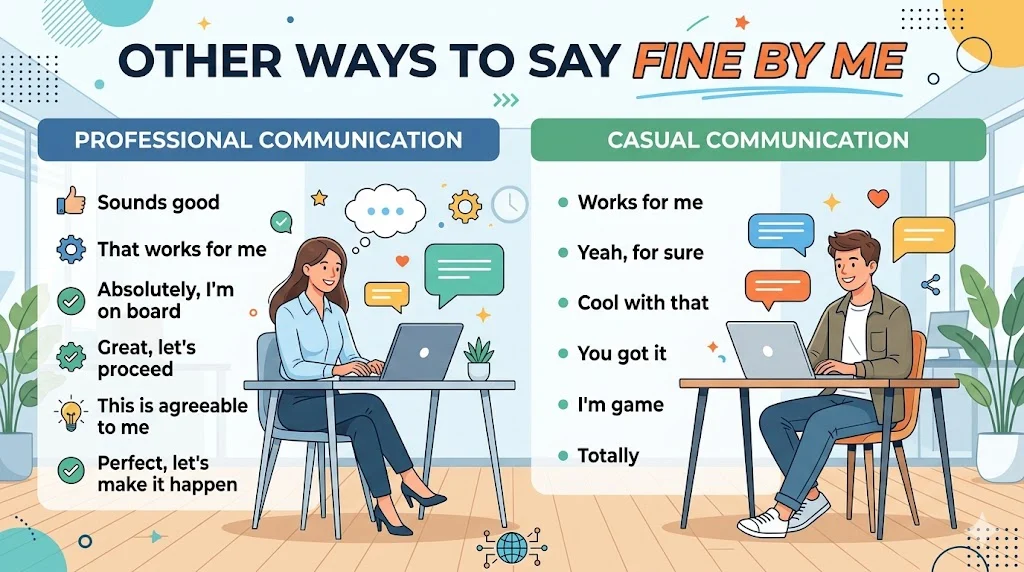
Looking for other ways to say fine by me? Try:
That works for me, I’m okay with that, Sounds good, I have no objections, That’s acceptable.
These alternatives help you sound more natural, professional, or expressive depending on the situation.
The phrase “fine by me” is commonly used to show agreement, acceptance, or approval of a suggestion or decision. It’s simple and widely understood, but it can sound too casual or passive in professional or formal contexts.
Learning alternatives to fine by me allows you to communicate your agreement more clearly and appropriately. Whether you’re replying to an email, confirming a plan, or responding in a meeting, choosing the right phrase helps you sound more confident and polished.
It also helps you express excitement in English or show enthusiasm instead of just passive agreement.
“The way you agree matters just as much as what you agree to.”
Quick Categories
Formal alternatives to “fine by me”
- That is acceptable
- I have no objections
- I am agreeable to that
- That meets my approval
Pro Tip: Use these in emails, meetings, or professional discussions.
Casual alternatives
- Sounds good
- Works for me
- No problem
- I’m good with that
Pro Tip: Perfect for everyday conversations and quick responses.
Professional alternatives
- That works well for me
- I’m aligned with that
- That is suitable
- I can proceed with that
Pro Tip: Ideal for workplace communication and client interactions.
Informal expressions
- Sure thing
- All good
- Cool with me
- I’m down
Pro Tip: Use only with friends or close colleagues.
Common Mistakes
- Using it in formal emails
Example: “Fine by me, let’s proceed.” - Sounding passive or uninterested
Example: “Fine by me” (no enthusiasm) - Overusing the phrase
Example: Repeating “fine by me” in multiple replies - Not matching tone to context
Example: Using “cool with me” in a business meeting - Lack of clarity
Example: “Fine by me.” (without confirming details)
What Does “Fine by Me” Mean?
“Fine by me” means you agree with a suggestion or decision and have no objections. It expresses acceptance, often in a relaxed or neutral tone.
Example:
“Let’s meet at 3 PM.”
“Fine by me.”
When to Use “Fine by Me”
- Responding to suggestions
- Accepting plans
- Agreeing casually in conversations
- Informal workplace chats
Spoken vs Written:
- More common in spoken English
- Less suitable for formal written communication
Formal vs Informal:
- Informal ✔️
- Formal ❌
Is It Professional or Polite to Say “Fine by Me”?
While polite, it’s not always professional in formal settings.
Example (Business):
Instead of: “Fine by me.”
Say: “That works well for me.”
Polite? ✔️ Yes
Professional? ❌ No (in most cases)
Pros and Cons of Using “Fine by Me”
Pros
- Simple and natural
- Friendly tone
- Common usage
- Easy to understand
Cons
- Too informal for work
- Overused
- Limited emotional range
- Not suitable for formal writing
Other Ways to Say “Fine by Me” With Examples
These alternatives will help you sound more fluent, confident, and natural in different situations.
Use them according to tone, context, and audience to express agreement, approval, or acceptance.
1. Phrase: That works for me
Meaning: You agree with the plan
Explanation: A versatile and professional alternative
Example Sentence: “Tuesday afternoon? That works for me.”
Best Use: work, meetings
Worst Use: formal legal
Tone: neutral, polite
Context Variability: casual / professional / spoken
2. Phrase: Sounds good
Meaning: You approve the idea
Explanation: Friendly and positive response
Example Sentence: “Let’s go with option B.” “Sounds good.”
Best Use: casual, team
Worst Use: formal writing
Tone: friendly, upbeat
Context Variability: casual / spoken
3. Phrase: I’m okay with that
Meaning: You accept the suggestion
Explanation: Neutral and clear
Example Sentence: “We’ll delay the launch.” “I’m okay with that.”
Best Use: general use
Worst Use: formal reports
Tone: neutral, calm
Context Variability: casual / professional
4. Phrase: That is acceptable
Meaning: Formal agreement
Explanation: Suitable for professional contexts
Example Sentence: “The revised terms are acceptable.”
Best Use: formal, contracts
Worst Use: casual chat
Tone: formal, neutral
Context Variability: professional
5. Phrase: I have no objections
Meaning: You fully agree
Explanation: Strong formal approval
Example Sentence: “I have no objections to this proposal.”
Best Use: meetings, approvals
Worst Use: casual talk
Tone: formal, confident
Context Variability: professional
6. Phrase: Works for me
Meaning: Agreement with plan
Explanation: Short and casual
Example Sentence: “Lunch at 1?” “Works for me.”
Best Use: casual
Worst Use: formal email
Tone: relaxed, simple
Context Variability: casual / spoken
7. Phrase: I’m good with that
Meaning: You are satisfied
Explanation: Casual approval
Example Sentence: “We’ll proceed tomorrow.” “I’m good with that.”
Best Use: casual teams
Worst Use: formal settings
Tone: relaxed
Context Variability: informal
8. Phrase: That’s fine with me
Meaning: Neutral agreement
Explanation: Slightly more polite version
Example Sentence: “We’ll move the meeting.” “That’s fine with me.”
Best Use: general
Worst Use: high-level formal
Tone: neutral
Context Variability: casual / professional
9. Phrase: I’m aligned with that
Meaning: Professional agreement
Explanation: Common in corporate language
Example Sentence: “I’m aligned with that strategy.”
Best Use: corporate
Worst Use: casual talk
Tone: professional
Context Variability: professional
10. Phrase: That works well for me
Meaning: Positive agreement
Explanation: More polished than basic version
Example Sentence: “That timeline works well for me.”
Best Use: emails
Worst Use: slang settings
Tone: professional
Context Variability: professional
11. Phrase: No problem
Meaning: Easy acceptance
Explanation: Casual and friendly
Example Sentence: “Can we reschedule?” “No problem.”
Best Use: casual
Worst Use: formal
Tone: friendly
Context Variability: informal
12. Phrase: Sure
Meaning: Simple agreement
Explanation: Very common and short
Example Sentence: “Want to join?” “Sure.”
Best Use: casual
Worst Use: professional emails
Tone: neutral
Context Variability: casual
13. Phrase: Absolutely
Meaning: Strong agreement
Explanation: Shows enthusiasm
Example Sentence: “Can you help?” “Absolutely.”
Best Use: positive responses
Worst Use: negative contexts
Tone: enthusiastic
Context Variability: all
14. Phrase: That’s agreeable
Meaning: Formal acceptance
Explanation: Polished and professional
Example Sentence: “That timeline is agreeable.”
Best Use: formal
Worst Use: casual
Tone: formal
Context Variability: professional
15. Phrase: I can go with that
Meaning: Willing agreement
Explanation: Slightly informal
Example Sentence: “Let’s try option A.” “I can go with that.”
Best Use: casual teams
Worst Use: formal
Tone: relaxed
Context Variability: casual
16. Phrase: All good
Meaning: Everything is fine
Explanation: Very informal
Example Sentence: “We’ll proceed tomorrow.” “All good.”
Best Use: friends
Worst Use: workplace
Tone: casual
Context Variability: informal
17. Phrase: That’s suitable
Meaning: Appropriate agreement
Explanation: Professional and neutral
Example Sentence: “That solution is suitable.”
Best Use: business
Worst Use: casual
Tone: formal
Context Variability: professional
18. Phrase: I approve
Meaning: Formal approval
Explanation: Direct and authoritative
Example Sentence: “I approve the proposal.”
Best Use: leadership
Worst Use: casual
Tone: formal
Context Variability: professional
19. Phrase: That makes sense
Meaning: Logical agreement
Explanation: Shows understanding
Example Sentence: “We’ll adjust pricing.” “That makes sense.”
Best Use: discussions
Worst Use: legal
Tone: neutral
Context Variability: all
20. Phrase: I’m on board
Meaning: You support the idea
Explanation: Positive agreement
Example Sentence: “I’m on board with the plan.”
Best Use: teams
Worst Use: formal docs
Tone: positive
Context Variability: casual / professional
21. Phrase: That’s okay by me
Meaning: Casual approval
Explanation: Similar to original phrase
Example Sentence: “That’s okay by me.”
Best Use: casual
Worst Use: formal
Tone: relaxed
Context Variability: informal
22. Phrase: I can accept that
Meaning: You agree logically
Explanation: Slightly formal
Example Sentence: “I can accept that outcome.”
Best Use: discussions
Worst Use: casual chat
Tone: neutral
Context Variability: professional
23. Phrase: That meets my approval
Meaning: Formal acceptance
Explanation: Strong professional tone
Example Sentence: “The plan meets my approval.”
Best Use: formal
Worst Use: casual
Tone: formal
Context Variability: professional
24. Phrase: Fair enough
Meaning: You accept reasoning
Explanation: Casual agreement
Example Sentence: “Fair enough, let’s proceed.”
Best Use: casual
Worst Use: formal
Tone: relaxed
Context Variability: informal
25. Phrase: I’m happy with that
Meaning: Positive acceptance
Explanation: Friendly agreement
Example Sentence: “I’m happy with that decision.”
Best Use: general
Worst Use: legal
Tone: positive
Context Variability: all
26. Phrase: That works perfectly
Meaning: Ideal agreement
Explanation: Shows strong approval
Example Sentence: “That timing works perfectly.”
Best Use: positive replies
Worst Use: negative context
Tone: enthusiastic
Context Variability: all
27. Phrase: No issues from me
Meaning: No objections
Explanation: Professional tone
Example Sentence: “No issues from me regarding the update.”
Best Use: workplace
Worst Use: casual chat
Tone: professional
Context Variability: professional
28. Phrase: I’m fine with that plan
Meaning: Acceptance
Explanation: Neutral and clear
Example Sentence: “I’m fine with that plan.”
Best Use: general
Worst Use: formal
Tone: neutral
Context Variability: casual
29. Phrase: That’s perfectly fine
Meaning: Strong agreement
Explanation: Slightly more emphatic
Example Sentence: “That’s perfectly fine with me.”
Best Use: general
Worst Use: formal
Tone: polite
Context Variability: all
30. Phrase: Consider it approved
Meaning: Formal acceptance
Explanation: Confident approval
Example Sentence: “Consider it approved.”
Best Use: leadership
Worst Use: casual
Tone: authoritative
Context Variability: professional
“Choosing the right agreement phrase makes your communication clearer and more confident.”
Mini Quiz / Self-Check
- Best professional alternative?
A. Cool with me
B. That works well for me
C. All good
Answer: B - Casual alternative?
A. I have no objections
B. Sounds good
C. That is acceptable
Answer: B - Formal approval phrase?
A. Sure
B. Consider it approved
C. Works for me
Answer: B
Comparison Table: Top Alternatives
| Phrase | Tone | Best Use |
|---|---|---|
| That works for me | Neutral | Meetings |
| Sounds good | Casual | Conversations |
| I’m okay with that | Neutral | General use |
| That is acceptable | Formal | Business |
| I have no objections | Formal | Approvals |
| Works for me | Casual | Spoken English |
| I’m aligned with that | Professional | Corporate |
| No problem | Casual | Everyday |
| That works well for me | Professional | Emails |
| I’m on board | Positive | Teams |
FAQs
1. Is “fine by me” rude?
No, but it can sound casual or slightly uninterested in formal settings.
2. What is the most professional alternative?
“That works well for me” or “I have no objections.”
3. Can I use “sounds good” in emails?
Yes, but only in informal or internal communication.
4. How do I sound more enthusiastic?
Use phrases like “Absolutely” or “That works perfectly.”
5. What’s the safest universal alternative?
“That works for me.”
Conclusion
Using other ways to say fine by me helps you sound more natural, confident, and context-appropriate. Instead of relying on one phrase, choose alternatives that match the tone, setting, and audience.
With practice, you’ll be able to communicate agreement clearly and professionally, whether in conversations, emails, or meetings.

Owen Price is a skilled content writer at Synofind.com, known for crafting clear, engaging and reader-focused content. He brings a thoughtful approach to research and storytelling, ensuring every piece is accurate, concise and easy to understand.