Last Updated on April 24, 2026
Looking for other ways to say good work? Try:
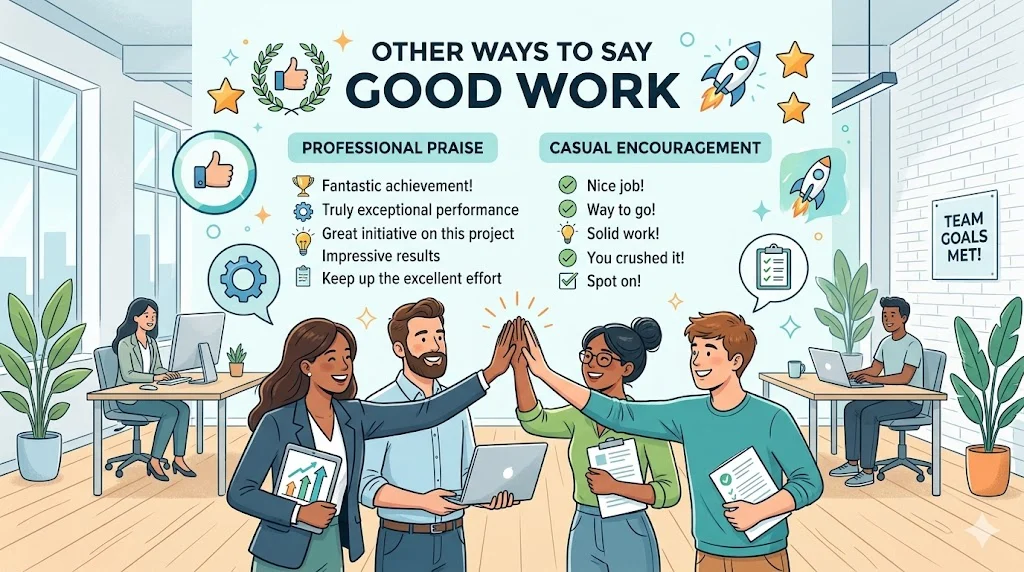
Excellent job, Well done, Great effort, Impressive work, Outstanding performance.
These alternatives help you give praise more effectively, whether in professional settings or everyday conversations.
Saying “good work” is one of the most common ways to praise someone. It’s simple, positive, and widely understood. However, it can also feel generic or repetitive, especially in professional or academic environments.
Learning alternatives to “good work” allows you to:
- Provide more specific and meaningful feedback
- Sound more professional and expressive
- Match your tone to the situation (formal, casual, or motivational)
Expanding your vocabulary also helps you express excitement in English while encouraging others effectively.
“Specific praise is more powerful than generic compliments.”
Quick Categories
Formal alternatives to “good work”
- Excellent work
- Outstanding performance
- Commendable effort
- Exceptional job
Pro Tip: Use these in performance reviews, emails, and official recognition.
Casual alternatives
- Nice job
- Great stuff
- Well done
- Good going
Pro Tip: Ideal for friends, teammates, or informal settings.
Professional alternatives
- Strong performance
- Impressive results
- Great execution
- Solid contribution
Pro Tip: Pair with results or metrics for maximum impact.
Informal expressions
- You nailed it
- Way to go
- Keep it up
- That’s awesome
Pro Tip: Use for motivation and encouragement, not formal feedback.
Common Mistakes
- Overusing “good work”
Example: “Good work, good work, good work.” - Being too vague
Example: “Good work.” (No detail about what was good) - Using casual phrases in formal settings
Example: “You nailed it” in a business report - Not matching tone to situation
Example: “Awesome job!” in a serious performance review - Ignoring specific achievements
Example: “Good work on the project” (without highlighting impact)
What Does “Good Work” Mean?
“Good work” is a general expression of praise used to recognize effort, performance, or results.
It functions as a positive feedback phrase and can apply to both tasks and behavior.
Example:
“Good work on completing the report ahead of schedule.”
When to Use “Good Work”
- Praising completed tasks
- Encouraging team members
- Recognizing effort
- Informal feedback
Spoken vs Written:
- Spoken: Common and natural
- Written: Acceptable but often too basic
Formal vs Informal:
- Formal: ❌ Limited use
- Informal: ✔️ Very common
Is It Professional or Polite to Say “Good Work”?
Polite? ✔️ Yes
Professional? ❌ Not always
While polite, it can sound too simple or generic in professional communication.
Business Example:
“Good work on the presentation” → Better: “Excellent presentation with clear insights and strong delivery.”
Pros and Cons of Using “Good Work”
Pros
- Simple and natural
- Friendly tone
- Widely understood
- Easy to use
Cons
- Too generic
- Overused
- Lacks detail
- Not ideal for formal feedback
Other Ways to Say “Good Work” With Examples
These alternatives help you sound more fluent, confident, and natural in different situations.
Use them according to tone, context, and audience to express praise effectively.
- Phrase: Excellent work
Meaning: Very high-quality performance
Explanation: Strong professional praise
Example Sentence: “Excellent work on the client presentation.”
Best Use: formal feedback
Worst Use: casual chat
Tone: professional, strong
Context Variability: professional
- Phrase: Well done
Meaning: Successfully completed
Explanation: Classic praise phrase
Example Sentence: “Well done on finishing the project early.”
Best Use: general praise
Worst Use: formal reports
Tone: positive, neutral
Context Variability: casual/professional
- Phrase: Great job
Meaning: Very good performance
Explanation: Friendly and common
Example Sentence: “Great job on the design work.”
Best Use: daily feedback
Worst Use: formal writing
Tone: friendly, upbeat
Context Variability: casual
- Phrase: Outstanding work
Meaning: Exceptional performance
Explanation: High-level praise
Example Sentence: “Outstanding work on this campaign.”
Best Use: performance review
Worst Use: minor tasks
Tone: strong, formal
Context Variability: professional
- Phrase: Impressive work
Meaning: Notably good results
Explanation: Highlights impact
Example Sentence: “Impressive work on the data analysis.”
Best Use: achievements
Worst Use: small tasks
Tone: appreciative
Context Variability: professional
- Phrase: Great effort
Meaning: Strong attempt
Explanation: Focuses on effort
Example Sentence: “Great effort on this assignment.”
Best Use: encouragement
Worst Use: top-level success
Tone: supportive
Context Variability: casual/professional
- Phrase: Exceptional job
Meaning: Beyond expectations
Explanation: Very high praise
Example Sentence: “Exceptional job on the report.”
Best Use: major success
Worst Use: small tasks
Tone: formal, strong
Context Variability: professional
- Phrase: Fantastic work
Meaning: Very impressive
Explanation: Enthusiastic praise
Example Sentence: “Fantastic work on the presentation.”
Best Use: motivation
Worst Use: formal emails
Tone: energetic
Context Variability: casual
- Phrase: Solid work
Meaning: Reliable and good
Explanation: Balanced praise
Example Sentence: “Solid work on the project.”
Best Use: consistent performance
Worst Use: big achievements
Tone: neutral
Context Variability: professional
- Phrase: Strong performance
Meaning: High-quality output
Explanation: Professional tone
Example Sentence: “Strong performance this quarter.”
Best Use: reviews
Worst Use: casual chat
Tone: formal
Context Variability: professional
- Phrase: Keep it up
Meaning: Continue doing well
Explanation: Encouragement
Example Sentence: “Keep it up, you’re doing great.”
Best Use: motivation
Worst Use: formal feedback
Tone: encouraging
Context Variability: casual
- Phrase: Nice job
Meaning: Good performance
Explanation: Casual praise
Example Sentence: “Nice job on that task.”
Best Use: daily use
Worst Use: formal setting
Tone: friendly
Context Variability: casual
- Phrase: Great execution
Meaning: Well performed task
Explanation: Focus on process
Example Sentence: “Great execution of the strategy.”
Best Use: business context
Worst Use: informal chat
Tone: professional
Context Variability: professional
- Phrase: You nailed it
Meaning: Perfectly done
Explanation: Informal strong praise
Example Sentence: “You nailed it in the meeting.”
Best Use: peers
Worst Use: formal email
Tone: informal
Context Variability: casual
- Phrase: Excellent effort
Meaning: Strong attempt
Explanation: Encouraging
Example Sentence: “Excellent effort on this project.”
Best Use: learning context
Worst Use: top success
Tone: supportive
Context Variability: professional
- Phrase: Remarkable work
Meaning: Worth noticing
Explanation: Highlights uniqueness
Example Sentence: “Remarkable work on the proposal.”
Best Use: standout tasks
Worst Use: small work
Tone: formal
Context Variability: professional
- Phrase: Brilliant job
Meaning: Very smart work
Explanation: Strong praise
Example Sentence: “Brilliant job on solving that issue.”
Best Use: creative work
Worst Use: formal reports
Tone: enthusiastic
Context Variability: casual
- Phrase: Excellent performance
Meaning: High-level results
Explanation: Professional tone
Example Sentence: “Excellent performance this month.”
Best Use: reviews
Worst Use: casual chat
Tone: formal
Context Variability: professional
- Phrase: Great contribution
Meaning: Valuable input
Explanation: Team-focused praise
Example Sentence: “Great contribution to the team.”
Best Use: teamwork
Worst Use: solo work
Tone: professional
Context Variability: professional
- Phrase: Awesome work
Meaning: Very impressive
Explanation: Informal praise
Example Sentence: “Awesome work on that!”
Best Use: casual
Worst Use: corporate emails
Tone: energetic
Context Variability: casual
- Phrase: Superb job
Meaning: Extremely good
Explanation: Strong praise
Example Sentence: “Superb job on the presentation.”
Best Use: recognition
Worst Use: minor work
Tone: formal
Context Variability: professional
- Phrase: Great results
Meaning: Strong outcomes
Explanation: Focus on outcome
Example Sentence: “Great results from your efforts.”
Best Use: metrics
Worst Use: process-only tasks
Tone: professional
Context Variability: professional
- Phrase: Well executed
Meaning: Done properly
Explanation: Focus on quality
Example Sentence: “Well executed plan.”
Best Use: business
Worst Use: casual
Tone: formal
Context Variability: professional
- Phrase: You did great
Meaning: Positive result
Explanation: Friendly praise
Example Sentence: “You did great today.”
Best Use: casual
Worst Use: formal
Tone: warm
Context Variability: casual
- Phrase: Excellent outcome
Meaning: Great result
Explanation: Outcome-focused
Example Sentence: “Excellent outcome on the project.”
Best Use: business
Worst Use: casual
Tone: formal
Context Variability: professional
- Phrase: Great work ethic
Meaning: Strong effort and discipline
Explanation: Behavior-focused
Example Sentence: “You showed great work ethic.”
Best Use: performance review
Worst Use: single task
Tone: professional
Context Variability: professional
- Phrase: Impressive results
Meaning: Strong outcomes
Explanation: Focus on success
Example Sentence: “Impressive results this quarter.”
Best Use: metrics
Worst Use: early stages
Tone: professional
Context Variability: professional
- Phrase: Way to go
Meaning: Encouraging praise
Explanation: Informal
Example Sentence: “Way to go on finishing early!”
Best Use: casual
Worst Use: formal
Tone: playful
Context Variability: casual
- Phrase: Keep up the great work
Meaning: Continue performance
Explanation: Ongoing praise
Example Sentence: “Keep up the great work!”
Best Use: motivation
Worst Use: formal review
Tone: encouraging
Context Variability: casual
- Phrase: That’s impressive
Meaning: Notable achievement
Explanation: Simple praise
Example Sentence: “That’s impressive work.”
Best Use: general
Worst Use: formal reports
Tone: neutral
Context Variability: casual/professional
“The more specific your praise, the more meaningful and motivating it becomes.”
Mini Quiz
- Best formal alternative?
A. Awesome work
B. Excellent performance
C. Way to go
Answer: B - Casual praise?
A. Outstanding work
B. Great job
C. Excellent outcome
Answer: B - Best for teamwork?
A. Great contribution
B. You nailed it
C. Awesome work
Answer: A
Comparison Table
| Phrase | Tone | Best Use |
|---|---|---|
| Excellent work | Formal | Reviews |
| Well done | Neutral | General |
| Great job | Casual | Daily praise |
| Outstanding work | Formal | Big achievements |
| Impressive work | Professional | Results |
| Solid work | Neutral | Consistent tasks |
| Great execution | Professional | Strategy |
| You nailed it | Informal | Peers |
| Superb job | Formal | Recognition |
| Keep it up | Casual | Motivation |
FAQs
1. Is “good work” professional?
It’s polite but often too basic for formal settings.
2. What is the best formal alternative?
“Excellent work” or “Outstanding performance.”
3. Can I use casual phrases at work?
Only in informal team environments.
4. How can I make praise stronger?
Add details or results to your compliment.
5. Should I vary praise phrases?
Yes, variety makes feedback more engaging and meaningful.
Conclusion
Using other ways to say good work helps you communicate praise more effectively, professionally, and confidently.
By choosing the right phrase based on tone and context, you can motivate others, build relationships, and stand out as a strong communicator.

Joshua Bell is a professional content writer at Synofind.com, known for delivering clear, accurate and engaging written content. He focuses on thorough research and thoughtful storytelling to ensure every piece is reliable and easy to understand. His work reflects a strong commitment to quality and credibility.