Last Updated on May 10, 2026
SMS stands for “Short Message Service,” which is a system used to send text messages between mobile phones using cellular networks. It is commonly referred to as a text message.
SMS means “Short Message Service.” It refers to the system used for sending short text messages between mobile phones.
In simple texting language, SMS is used to describe a regular text message sent through a phone network rather than internet-based apps like WhatsApp or Messenger.
Example:
- “Send me an SMS when you arrive.”
- “I got your SMS.”
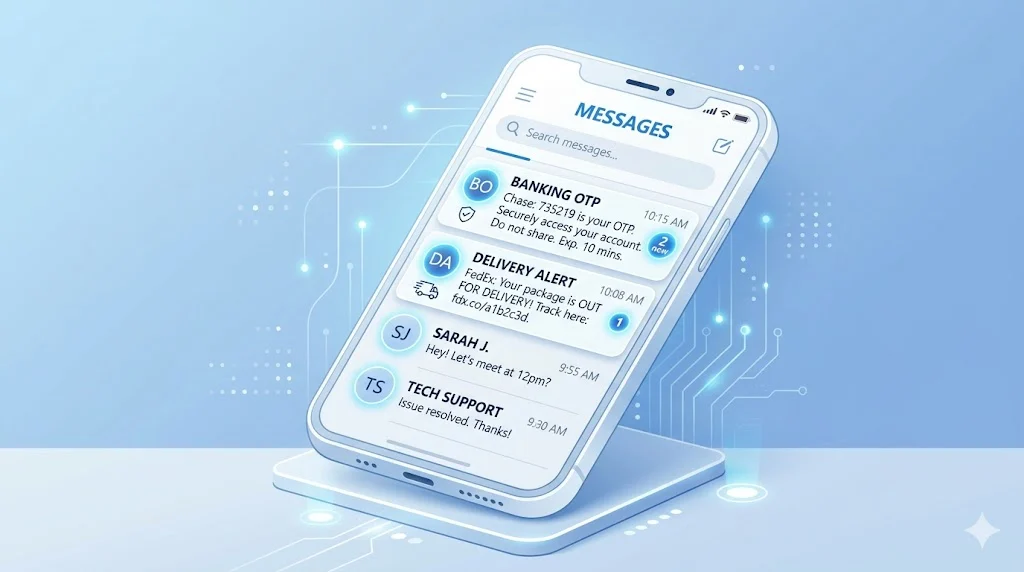
SMS is one of the oldest forms of mobile communication and played a major role in shaping how people text today. Before internet messaging apps existed, SMS was the main way people communicated through mobile phones. Even today, it is still widely used for alerts, notifications, and personal messages. Banks, companies, and service providers also rely heavily on SMS for verification codes, reminders, and updates.
Origin of SMS
SMS was developed in the early 1980s as part of mobile communication technology. The first SMS message was sent in 1992.
At that time, mobile phones had limited capabilities, so SMS was designed to allow users to send short text-based messages of up to 160 characters.
Over time, SMS became a global communication standard and is still supported by almost all mobile devices today.
How SMS Works
SMS works through mobile network systems rather than internet connections.
Here is a simple breakdown:
- You type a message on your phone
- The message is sent through a cellular network
- It passes through a service center
- It is delivered to the recipient’s phone
Unlike internet messaging apps, SMS does not require WiFi or mobile data.
SMS vs Text Message
Many people use “SMS” and “text message” interchangeably, but there is a slight difference.
| Term | Meaning | Usage |
|---|---|---|
| SMS | Technical term for messaging system | Formal or technical context |
| Text Message | Everyday term for SMS | Casual conversations |
Example:
- “I received an SMS from my bank.” (formal)
- “I got a text message.” (casual)
SMS in Real Life Usage
SMS is still widely used in many areas of daily life.
Common Uses
- Bank alerts and OTP codes
- Delivery updates
- Appointment reminders
- Emergency notifications
- Promotional messages
Examples of SMS in Text Conversations
Casual Use
- “Did you get my SMS?”
- “I’ll send you an SMS later.”
Business Use
- “Your appointment is confirmed via SMS.”
- “We will send OTP via SMS.”
Notification Use
- “You received an SMS from your bank.”
- “Package update sent via SMS.”
SMS Meaning Table With Context
| Situation | Meaning | Example |
|---|---|---|
| Personal chat | Text message | “I sent you an SMS.” |
| Banking | Verification message | “OTP sent via SMS.” |
| Business | Notification system | “You will get SMS alert.” |
| Technical | Messaging service | “SMS protocol is used.” |
SMS vs Internet Messaging Apps
Today, SMS is often compared with apps like WhatsApp, Messenger, and Telegram.
| Feature | SMS | Messaging Apps |
|---|---|---|
| Internet required | No | Yes |
| Media sharing | Limited | Advanced |
| Speed | Fast | Faster with internet |
| Cost | Sometimes charged | Usually free |
SMS is simpler, while apps offer more features.
Advantages of SMS
SMS still remains useful because of its reliability.
Key Benefits
- Works without internet
- Delivered on almost all phones
- Simple and fast
- Used for official communication
- Highly secure for OTPs
Limitations of SMS
Despite its usefulness, SMS has some limitations.
- Limited character length (usually 160 characters)
- No advanced media support
- Can cost money depending on carrier
- Less interactive than apps
SMS in Business Communication
Businesses use SMS for direct communication with customers.
Examples
- Order confirmations
- Shipping updates
- Promotional offers
- Account alerts
SMS marketing is still effective because people read messages quickly.
SMS in Security and Verification
It plays a major role in online security.
Common Uses
- OTP (One-Time Password)
- Two-factor authentication
- Login verification
- Password reset codes
Example:
- “Your OTP is 456789 sent via SMS.”
SMS in Everyday Life
Even with modern apps, SMS is still part of daily communication.
People use it when:
- Internet is not available
- Sending important alerts
- Contacting services or institutions
SMS Alternatives
Modern communication has several alternatives to SMS.
| Alternative | Description |
|---|---|
| Internet-based messaging app | |
| Messenger | Social media chat app |
| Telegram | Secure messaging platform |
| iMessage | Apple messaging service |
These apps offer more features than SMS.
SMS in Digital Culture
SMS shaped how people communicate online today. Many abbreviations used in texting culture (like LOL, BRB, and IMO) originated during the SMS era due to character limits.
Even though messaging apps are now more popular, SMS remains a foundation of mobile communication.
Common Misunderstandings About SMS
- SMS is not the same as internet chat
- SMS uses mobile networks, not internet data.
- SMS is not outdated
- It is still widely used for official communication.
- SMS is not only for texting
- It also supports alerts, notifications, and verification messages.
FAQs
What does SMS mean in texting?
SMS stands for Short Message Service, which is used to send text messages between mobile phones.
Is SMS the same as text message?
Yes, SMS is the technical term, while text message is the casual term.
Do I need internet for SMS?
No, SMS works using mobile network signals, not internet.
Why do banks use SMS?
Banks use SMS for OTPs, alerts, and security notifications.
Is SMS still used today?
Yes, SMS is still widely used for official and security purposes.
What is the character limit of SMS?
Traditional SMS has a limit of around 160 characters per message.
Can SMS send pictures or videos?
Standard SMS cannot send media, but MMS (Multimedia Messaging Service) can.
What is the difference between SMS and WhatsApp?
SMS works without internet, while WhatsApp requires internet and offers more features.
Conclusion
SMS, or Short Message Service, is one of the most important communication technologies in mobile history. It allows users to send quick text messages without needing internet access.
Even though modern messaging apps are widely used today, SMS remains essential for banking alerts, verification codes, and official communication.
Its simplicity, reliability, and universal compatibility make it a lasting part of digital communication.
Understanding SMS helps you better navigate both traditional and modern messaging systems.
Read More Related Articles:
- BTA Meaning in Slang: What Everyone Is Saying Online In 2026
- TMP Meaning in Text | Viral Internet Slang Explained In 2026
- DM Meaning in Text | Real Social Media Usage In 2026

Owen Price is a skilled content writer at Synofind.com, known for crafting clear, engaging and reader-focused content. He brings a thoughtful approach to research and storytelling, ensuring every piece is accurate, concise and easy to understand.