Last Updated on May 12, 2026
You’ve probably seen “JW” pop up in a message and paused for a second.
Maybe a friend texted you:
“JW if you’re coming tonight?”
And you thought… what does JW even mean?
It looks short. Simple. Almost too simple to guess confidently.
That’s where most people get stuck.
JW is one of those internet abbreviations that feels obvious once you know it, but confusing before that. It shows up in chats, social media comments, and DMs where speed matters more than spelling things out.
In this guide, you’ll understand everything about JW meaning in text, how people actually use it, where it shows up, and why context changes everything.
Let’s break it down in a way that actually makes sense in real conversations.
JW Meaning in Text: The Most Common Definition
When someone types “jw” in lowercase, they almost always mean:
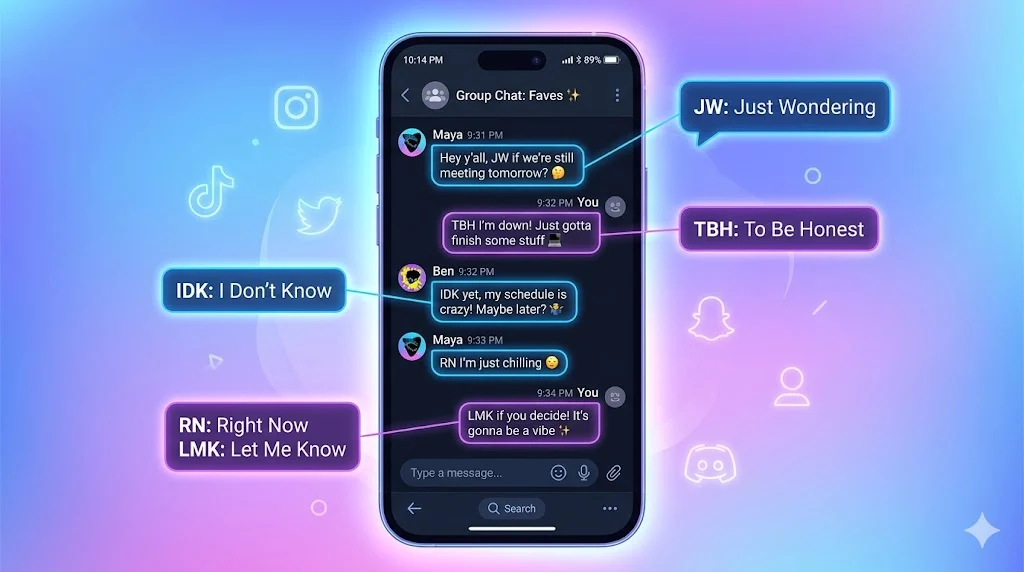
JW = Just Wondering
This is the most widely used meaning in texting and social media conversations.
It’s casual. It’s soft and it’s conversational.
People use it when they want to ask something without sounding too direct or demanding.
Think of it like this:
Instead of saying:
“Are you coming or not?”
Someone might say:
“JW if you’re coming?”
It feels lighter. Less pressure. More natural.
Why “Just Wondering” Became So Popular
JW fits perfectly into how people text today:
- Fast typing
- Short attention spans in chats
- Informal tone in messaging apps
- Mobile-first communication
People don’t want long sentences when a few letters will do.
So JW became a shortcut for curiosity.
It’s not aggressive. It’s not formal. It just floats in conversation like a soft question.
Real-Life Examples of JW in Texting
Here’s how JW actually shows up in daily messages:
- “JW if you finished the homework?”
- “JW what time we meeting?”
- “JW if you’re still awake”
- “JW where you at lol”
Notice something?
JW doesn’t demand answers. It invites them.
That’s the tone difference.
JW Meaning in Chat Apps (WhatsApp, Snapchat, Instagram)
JW behaves slightly differently depending on where you see it.
The platform changes tone, but not the meaning.
Let’s break it down.
JW Meaning in WhatsApp Chats
WhatsApp is where JW shows up most in private conversations.
People use it when texting:
- Friends
- Classmates
- Family (younger users mainly)
It fits into fast back-and-forth messaging.
Example WhatsApp Usage
- “JW if you’re coming to dinner”
- “JW did teacher give homework?”
On WhatsApp, JW feels natural because conversations are already informal.
No one expects perfect grammar there.
JW Meaning on Snapchat
Snapchat is even more casual.
Here, JW blends into quick, disappearing messages.
Users often send:
- Short questions
- Reaction replies
- Fast check-ins
Snapchat Example
- “JW where u at?”
- “JW if u saw my snap”
Snapchat encourages speed, so JW fits perfectly.
It saves time and keeps conversations flowing.
JW Meaning in Instagram DMs
Instagram DMs are a mix of casual and semi-public interaction.
JW appears in:
- Direct messages
- Story replies
- Comment sections
Instagram Example
- “JW if this is real?”
- “JW how you did that edit?”
Here, JW often shows curiosity about content rather than personal plans.
JW Slang Meaning vs Formal Meaning (Critical Difference)
This is where most confusion happens.
JW doesn’t have only one meaning.
It depends heavily on context.
Let’s separate it clearly.
JW as Slang: “Just Wondering”
This is the internet slang version.
- Lowercase: jw
- Informal chats
- Social media usage
- Casual tone
It always expresses curiosity.
JW as “Jehovah’s Witnesses”
Now here’s the serious one.
When written in uppercase:
JW = Jehovah’s Witnesses
This refers to a religious organization.
In this context:
- It is not slang
- It is not casual
- It is a proper noun
So capitalization matters a lot.
Quick Comparison Table
| Form | Meaning | Usage |
|---|---|---|
| jw | Just Wondering | Texting slang |
| JW | Jehovah’s Witnesses | Religion |
| JW? | Could be either | Depends on context |
Why Context Changes Everything
Let’s be honest.
JW alone tells you nothing.
You must read the sentence around it.
For example:
- “JW if you’re free” → Just Wondering
- “JW meeting starts at 7” → Just Wondering
- “JW members gathered today” → Jehovah’s Witnesses
Same letters.
Different worlds.
That’s how language works online.
JW Full Form in Texting Explained
The full form is simple:
JW = Just Wondering
But the interesting part is why people shorten it.
It’s not laziness.
It’s efficiency.
When you’re texting fast, even two seconds matter.
So instead of:
“I was just wondering if you are available”
You get:
“JW if you’re free”
Short. Clean. Instant.
That’s modern communication.
JW Meaning in Social Media Slang
JW belongs to a bigger category of internet slang.
It lives alongside:
- IDK (I don’t know)
- TBH (to be honest)
- NGL (not gonna lie)
These abbreviations shape how people talk online.
They make conversations:
- Faster
- More relaxed
- More expressive
Why Social Media Loves Short Forms
Here’s the truth:
Social media rewards speed.
People scroll fast. They type fast. They reply fast.
So slang like JW fits perfectly.
It reduces effort while keeping meaning intact.
When and How to Use JW Correctly
JW is easy to use, but it still has rules.
Let’s keep it practical.
When You SHOULD Use JW
Use it when:
- Talking casually with friends
- Asking light questions
- Keeping tone soft
- Messaging on social media
Good examples:
- “JW if you’re coming tonight”
- “JW what happened earlier”
- “JW if you’re online”
When You SHOULD NOT Use JW
Avoid it when:
- Writing formal emails
- Talking to teachers or bosses
- Writing professional messages
Bad example:
- “JW regarding project deadline” ❌
It sounds unprofessional and unclear.
Related Texting Abbreviations You Should Know
JW is part of a bigger slang ecosystem.
Here are common ones you’ll see daily:
- TBH = To be honest
- IDK = I don’t know
- IMO = In my opinion
- FYI = For your information
- NVM = Never mind
- BRB = Be right back
These all work like JW.
Short. Fast. Informal.
JW vs Other Chat Acronyms
Let’s compare JW with similar abbreviations.
| Acronym | Meaning | Tone | Usage |
|---|---|---|---|
| JW | Just Wondering | Curious | Questions |
| IDK | I Don’t Know | Neutral | Uncertainty |
| TBH | To Be Honest | Opinion | Honesty |
| JK | Just Kidding | Playful | Humor |
JW stands out because it expresses curiosity rather than opinion or emotion.
Why People Use JW Instead of Full Sentences
There’s a deeper reason behind this trend.
It’s not just laziness.
It’s communication evolution.
Main reasons:
- Speed in texting
- Casual tone preference
- Mobile typing convenience
- Social media influence
- Group chat culture
People don’t want long messages anymore.
They want instant understanding.
JW delivers that.
Misinterpretations of JW in Messages
JW is simple, but still gets misunderstood.
Let’s look at common mistakes.
Mistake 1: Thinking JW Always Means Religion
Some people see “JW” and immediately think Jehovah’s Witnesses.
But in casual chats, lowercase “jw” rarely means that.
Mistake 2: Ignoring Context
People sometimes panic when they see JW alone.
But meaning depends on surrounding words.
Mistake 3: Overthinking It
Sometimes JW is just JW.
No hidden meaning. No deeper code.
Just a simple question starter.
How NLP and AI Understand JW Meaning in Text
Now let’s step into something interesting.
How do machines interpret JW?
Context-Based Meaning Extraction
AI systems don’t guess blindly.
They analyze:
- Sentence structure
- Surrounding words
- Conversation history
Example:
- “JW if you’re free” → curiosity
- “JW group meeting” → organization
Semantic Ambiguity in JW
JW is a perfect example of ambiguity.
Same abbreviation. Multiple meanings.
AI solves this using probability and context mapping.
Intent Classification
Systems classify JW messages as:
- Question intent
- Informational intent
- Entity reference
This helps AI respond correctly.
FAQs
What does JW mean in chat?
It usually means Just Wondering in casual texting.
Is JW slang or formal?
It is slang. Never formal.
What does JW mean on Snapchat?
It means the same thing: Just Wondering.
Can JW mean something different in religion?
Yes. It can mean Jehovah’s Witnesses depending on context.
Is JW used in professional communication?
No. It’s too informal for professional settings.
Conclusion
Let’s wrap it simply.
JW is:
- A casual texting abbreviation
- Most commonly “Just Wondering”
- Context-dependent
- Widely used in social media chats
- Not suitable for formal communication
Here’s the simplest way to remember it:
If it sounds like a soft question in a chat, JW means “Just Wondering.”
Language online moves fast.
Abbreviations like JW exist because people want quicker conversations, not longer ones.
Once you understand JW, you’ll start noticing hundreds of similar shortcuts everywhere.
And honestly, you’ll probably start using them without even thinking about it.
That’s how digital language evolves.
Read More Related Articles:
- Tying or Tieing: Correct Spelling & Grammar In 2026
- CFS Meaning Slang: Hidden Meaning Everyone’s Using In 2026
- 300+ Other Ways to Say Trust Me (Examples and 2026 Guide)

Joshua Bell is a professional content writer at Synofind.com, known for delivering clear, accurate and engaging written content. He focuses on thorough research and thoughtful storytelling to ensure every piece is reliable and easy to understand. His work reflects a strong commitment to quality and credibility.