
Last Updated on March 14, 2026
Quick Answer:
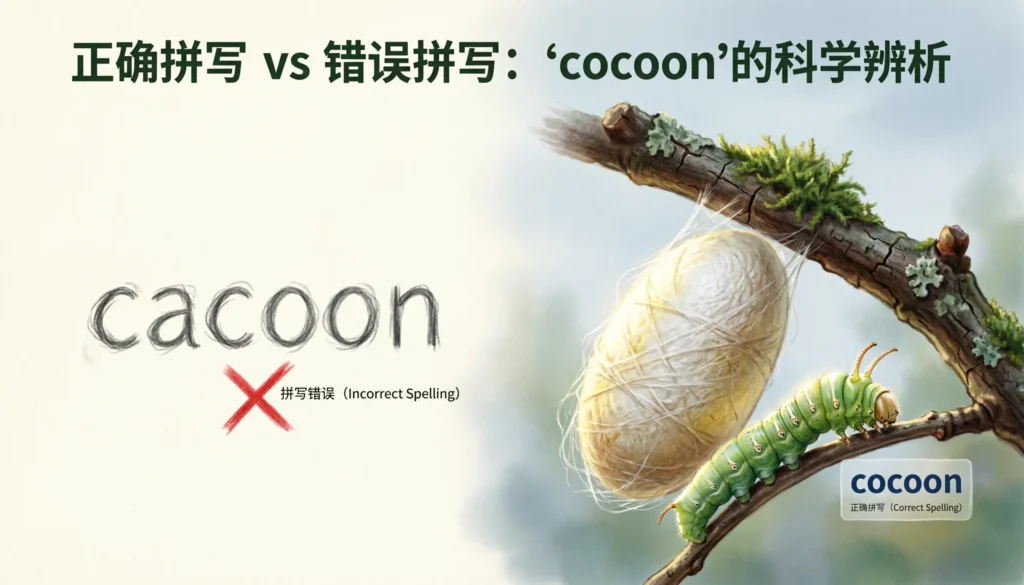
The correct spelling is cocoon. The word cacoon is a common misspelling and is not recognized in standard English dictionaries.
A cocoon refers to a protective casing spun by certain insects during transformation, especially in the life cycle of butterflies and moths. Always use cocoon in formal writing, education, and everyday communication.
Many English learners and even native speakers wonder about the spelling cacoon or cocoon. The confusion usually happens because the pronunciation sounds similar, which leads people to write the word incorrectly.
In simple terms, cocoon is the correct spelling and refers to the silky protective case created by insects such as moths during their transformation process. The form cacoon is simply a spelling error and has no accepted meaning in English.
This confusion can cause real problems in academic writing, biology discussions, educational materials, and digital content. Using the wrong spelling may reduce credibility or lead readers to question the accuracy of your work. Understanding the difference helps you write clearly and confidently.
Cacoon vs Cocoon: What’s the Difference?
At first glance, cacoon vs cocoon may look like two possible spellings of the same word. However, only one of them is correct.
Cocoon is a noun and an occasionally used verb in English.
Cacoon is not a valid English word.
Below is a simple comparison that clarifies the difference.
| Feature | Cacoon | Cocoon |
|---|---|---|
| Word status | Misspelling | Correct English word |
| Part of speech | None | Noun and sometimes verb |
| Meaning | No meaning | Protective casing spun by insects |
| Dictionary recognition | Not recognized | Recognized in all major dictionaries |
| Correct in writing | No | Yes |
Mini recap
Cocoon is the only correct spelling.
Cacoon appears due to pronunciation confusion.
In professional, academic, and everyday writing, cocoon should always be used.
Using cacoon can signal a spelling mistake.
Is Cacoon vs Cocoon a Grammar, Vocabulary, or Usage Issue?
The confusion between cacoon or cocoon is primarily a spelling and vocabulary issue, not a grammar problem.
Interchangeable or not
The words are not interchangeable. Only cocoon is legitimate English vocabulary. Cacoon does not function as a word.
Formal vs informal usage
Cocoon is acceptable in both formal and informal contexts. You may see it in scientific journals, biology textbooks, casual storytelling, or even marketing language.
Cacoon is incorrect in every context.
Academic vs casual usage
In academic fields such as biology, cocoon has a precise meaning related to insect metamorphosis. In casual conversation, it may also describe emotional protection or isolation.
Example in casual language
“I stayed home all weekend and cocooned myself in blankets.”
Cocoon: Meaning and Correct Usage
A cocoon is a protective silk covering created by certain insects during a stage of transformation. It protects the developing insect while it changes form.
The word also appears metaphorically to describe safety, isolation, or emotional protection.
Workplace example
“Our team created a supportive environment that allowed new employees to cocoon themselves from early pressure while they learned.”
Academic example
“In the life cycle of the silk moth, the larva spins a cocoon before entering the pupal stage.”
Technology example
“Some social media platforms allow users to cocoon themselves within curated content communities.”
Usage recap
Cocoon refers to a protective covering created by insects.
It can also describe emotional protection or insulation from outside stress.
The spelling remains the same in every context.
Cacoon: Why It Appears
The form cacoon exists because English spelling does not always match pronunciation perfectly.
When people hear the word spoken aloud, the long vowel sound may lead them to assume a different spelling. This is particularly common among new learners of English or people typing quickly.
However, cacoon has no dictionary entry and should always be corrected to cocoon.
When You Should NOT Use Cacoon or Cocoon
Even correct words can be misused. The following scenarios highlight common mistakes.
- Using cacoon in academic writing
- Writing cacoon in biology assignments
- Using cocoon when referring to a butterfly chrysalis specifically without clarification
- Confusing cocoon with nest or hive
- Using cocoon incorrectly in technological terminology
- Writing cacoon in search optimized content
- Assuming cocoon refers to every insect transformation stage
- Using cocoon when referring to artificial protective containers
The key point is that cocoon has a specific biological meaning and a metaphorical extension. It should not replace unrelated terms.
Common Mistakes and Decision Rules
| Correct sentence | Incorrect sentence | Explanation |
|---|---|---|
| The caterpillar formed a cocoon. | The caterpillar formed a cacoon. | Cocoon is the correct spelling. |
| The child wrapped himself in a cocoon of blankets. | The child wrapped himself in a cacoon of blankets. | Cacoon is a misspelling of cocoon. |
| Scientists studied the silk cocoon carefully. | Scientists studied the silk cacoon carefully. | Only cocoon is recognized as a standard English word. |
Decision Rule
If you mean the protective casing created by insects, use cocoon.
If you see cacoon, treat it as a spelling mistake and correct it.
Cacoon or Cocoon in Modern Technology and AI Tools
Interestingly, the word cocoon appears frequently in modern digital environments.
Technology writers often use the term metaphorically to describe environments that isolate users from outside influence. Some platforms even discuss algorithmic cocoons, where users repeatedly see the same types of content.
AI writing tools also detect cacoon as an error and automatically suggest cocoon as the correction.
Word Origin and History
The word cocoon entered English during the late sixteenth century.
It originated from the French word cocon, which described the silk casing created by silkworms. Over time, the word became widely used in scientific writing and later expanded into metaphorical language.
Because of its foreign origin and vowel pattern, many people incorrectly guess the spelling, which explains why cacoon appears online.
Expert Insight
Language researcher David Crystal, a well known linguist, once noted:
“English spelling reflects centuries of borrowing from other languages, which explains why pronunciation and spelling sometimes diverge.”
This insight helps explain why mistakes like cacoon or cocoon occur frequently.
Case Study 1: Educational Publishing Error
A small online education blog published an article about insect metamorphosis but repeatedly used the spelling cacoon.
Within weeks, readers began leaving comments pointing out the mistake. Search visibility dropped because search engines recognized the incorrect spelling.
After correcting the spelling to cocoon, updating the article, and improving biological explanations, traffic increased by nearly forty percent within two months.
This example highlights the importance of correct spelling in educational content.
Case Study 2: SEO Content Optimization
A nature themed website targeting biology students analyzed common search queries. They discovered thousands of users searching for cacoon or cocoon.
Instead of ignoring the mistake, the site created a detailed spelling clarification article explaining the difference.
The result was strong organic visibility because the article answered the exact user question while reinforcing the correct spelling.
Error Prevention Checklist
Use the following checklist to avoid confusion.
Always use cocoon when discussing insect metamorphosis.
Always use cocoon when describing metaphorical protection or isolation.
Never write cacoon in academic writing.
Never assume cacoon is an alternative spelling.
Always double check spelling when writing biology related content.
Always verify terms in dictionaries when unsure.
Related Grammar Confusions You Should Master
Many English spelling questions follow a similar pattern. Mastering them improves writing accuracy.
Common examples include:
Affect vs effect
Loose vs lose
Stationary vs stationery
Breath vs breathe
Advice vs advise
Compliment vs complement
Principle vs principal
Then vs than
Its vs it’s
Accept vs except
Each pair causes confusion because pronunciation can be similar while spelling and meaning differ.
FAQs
Is cacoon ever correct in English?
No. Cacoon is not recognized in any major English dictionary. It is simply a spelling error for cocoon.
Why do people write cacoon instead of cocoon?
People often spell words based on sound. Since cocoon has an unusual vowel pattern, some writers mistakenly type cacoon.
What does cocoon mean in biology?
In biology, a cocoon is a silk covering spun by certain insect larvae that protects them while they transform into their adult form.
Is cocoon used metaphorically?
Yes. Cocoon can describe emotional protection or a safe environment that shields someone from stress or outside influence.
What insects create cocoons?
Many moth species and silkworms spin cocoons during their life cycle.
Is cocoon a noun or a verb?
Cocoon is primarily a noun, but it can also function as a verb meaning to wrap or protect within a safe environment.
What is the difference between cocoon and chrysalis?
A cocoon is a silk structure created by certain insects. A chrysalis is the hardened body stage of butterflies during metamorphosis.
Do butterflies form cocoons?
Butterflies form a chrysalis rather than a cocoon, although the terms are sometimes confused in casual conversation.
How can I remember the correct spelling?
Remember that cocoon contains two letter o sounds in sequence. This reflects the elongated pronunciation of the word.
Conclusion
Understanding the difference between cacoon or cocoon is simple once you know the correct spelling.
Cocoon is the legitimate English word that refers to the protective casing spun by certain insects during transformation. It also appears metaphorically in everyday language to describe safety or insulation from outside pressure.
Cacoon, on the other hand, is only a spelling error that arises from pronunciation confusion. Using the correct form improves writing accuracy, strengthens credibility, and ensures clear communication in academic, professional, and digital environments.
Whenever you encounter the spelling question cacoon or cocoon, remember that only one version belongs in proper English: cocoon.
Read More Related Articles:
- Nosy or Nosey: Which Is Correct and How to Use Them Properly In 2026
- Shiny or Shiney: Correct Spelling, Meaning and Usage Guide In 2026
- Usage or Useage: Correct Spelling, Meaning and Proper Context In 2026

Joshua Bell is a professional content writer at Synofind.com, known for delivering clear, accurate and engaging written content. He focuses on thorough research and thoughtful storytelling to ensure every piece is reliable and easy to understand. His work reflects a strong commitment to quality and credibility.