
Last Updated on April 4, 2026
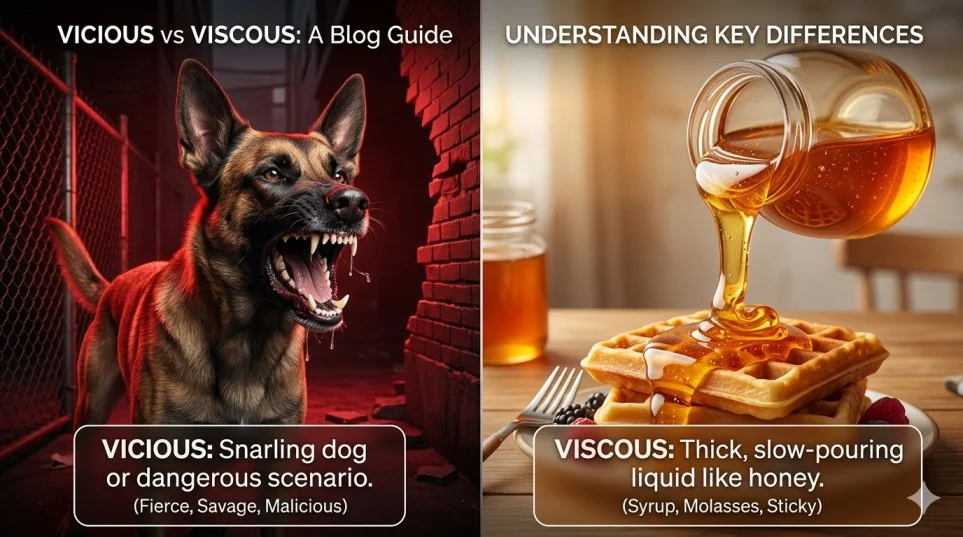
The terms vicious and viscous are often confused but mean very different things. Vicious describes something cruel, dangerous, or violent, while viscous refers to the thickness or stickiness of a liquid.
If you’ve ever wondered about vicious vs viscous, you are not alone. These two words sound similar and can trip up even experienced writers and speakers. Vicious is an adjective describing cruelty, aggression, or danger, like a vicious attack or vicious rumor. Viscous, also an adjective, describes the physical property of a liquid, such as honey being viscous or oil having a viscous texture. Confusing these words can cause embarrassing mistakes in workplace emails, academic papers, and even everyday conversation. Knowing the precise difference ensures clear communication, avoids misunderstandings, and enhances both professional and creative writing.
Vicious vs Viscous: What’s the Difference?
| Feature | Vicious | Viscous |
|---|---|---|
| Part of Speech | Adjective | Adjective |
| Meaning | Deliberately cruel, violent, or harmful | Thick, sticky, or resistant to flow |
| Common Usage | Describing behavior, actions, or attacks | Describing liquids, substances, or textures |
| Example Sentence | The dog had a vicious bite. | The syrup was so viscous it poured slowly. |
Mini Recap:
Vicious relates to cruelty or aggression, while viscous relates to liquid thickness. One deals with behavior or intent, the other with physical property. Mixing them can make your sentence nonsensical or confusing.
Is Vicious vs Viscous a Grammar, Vocabulary, or Usage Issue?
Confusion between vicious and viscous is primarily a vocabulary and usage issue rather than grammar. They are not interchangeable. Using vicious when you mean viscous, or vice versa, often makes a sentence logically incorrect.
Formal vs Informal Usage:
Vicious is common in both formal and informal writing but is often used in literature, journalism, and professional reports describing behavior, conflicts, or hazards. Viscous is mostly technical, appearing in scientific, culinary, and engineering contexts. Using viscous in casual conversation is unusual unless you are describing a physical property, like syrup, oil, or molten material.
Academic vs Casual Usage:
Academic papers on fluid dynamics, chemistry, or material science frequently use viscous correctly. Conversely, literary analysis, psychology papers, or crime reports often require vicious to describe harmful behavior or dangerous situations.
Vicious in Practical Usage
Workplace Example:
The manager warned the team about a vicious rumor circulating in the office that could damage morale.
Academic Example:
Researchers documented the vicious cycle of poverty affecting educational outcomes across multiple communities.
Technology Example:
Cybersecurity teams often track vicious malware that spreads aggressively and damages systems.
Usage Recap:
Use vicious when referring to actions, people, or situations that are intentionally harmful, aggressive, or dangerous. Avoid using it to describe anything related to physical texture or liquids.
Viscous in Practical Usage
Workplace Example:
The lab technician noted that the chemical solution was unusually viscous, making it difficult to pour into the test tubes.
Academic Example:
In physics class, students measured how a viscous fluid resists flow under different temperatures.
Technology Example:
Battery engineers must consider viscous electrolytes in lithium-ion cells for optimal performance.
Usage Recap:
Use viscous when describing thickness, stickiness, or resistance to flow. Never use viscous to describe behaviors, attitudes, or actions.
When You Should NOT Use Vicious or Viscous
- Using vicious to describe a liquid or texture. Example: “The honey was vicious” is incorrect.
- Using viscous to describe a person’s behavior. Example: “He had a viscous temper” is incorrect.
- Writing vicious in a technical or scientific context where physical properties are discussed.
- Using viscous to describe aggression, danger, or cruelty.
- Confusing the terms in emails or reports, creating unprofessional impressions.
- Using vicious when the intent is neutral, like describing thickness.
- Misplacing viscous in narrative or literary contexts unless talking about texture.
- Relying on pronunciation alone; spelling must match intended meaning.
Common Mistakes and Decision Rules
| Correct Sentence | Incorrect Sentence | Explanation |
|---|---|---|
| The snake had a vicious bite. | The snake had a viscous bite. | Vicious describes cruelty or danger; viscous is about thickness. |
| The syrup was very viscous. | The syrup was very vicious. | Viscous describes liquid properties; vicious is about aggression. |
| Cybersecurity detected a vicious virus. | Cybersecurity detected a viscous virus. | Correct: vicious for harmful malware; viscous would imply stickiness. |
| He was trapped in a vicious cycle of debt. | He was trapped in a viscous cycle of debt. | Vicious refers to a harmful repeating pattern; viscous is physical. |
Decision Rule Box:
- If you mean cruel, aggressive, or harmful, use vicious.
- If you mean thick, sticky, or resistant to flow, use viscous.
Vicious and Viscous in Modern Technology and AI Tools
In AI and tech writing, clarity matters. For example, AI-generated descriptions of chemical processes should correctly use viscous, while sentiment analysis might highlight vicious language online. Mixing these words could lead to misinterpretation, faulty code comments, or even miscommunication in professional documentation.
Authority and Trust
Etymology:
- Vicious originates from Latin vitiosus, meaning full of vice or morally corrupt.
- Viscous comes from Latin viscosus, meaning sticky or glutinous.
Expert Quotation:
Linguist Dr. Amanda Kline notes, “Confusing vicious and viscous is one of the most common mistakes in both academic and everyday writing. Precision in language reflects precision in thought.”
Case Study 1:
A chemical manufacturing company corrected a product manual where vicious was mistakenly used instead of viscous, preventing misinterpretation by production staff and avoiding potential accidents.
Case Study 2:
A publishing house edited multiple manuscripts where viscous was incorrectly written as vicious, improving readability and ensuring accurate descriptions of materials.
Author Bio:
Fayqa Shamim is a senior linguist and SEO strategist with over 10 years of experience clarifying complex language for global audiences.
Error Prevention Checklist
- Always use vicious when referring to harmful actions, dangerous situations, or malicious intent.
- Never use vicious to describe texture, liquids, or thickness.
- Always use viscous when describing sticky, thick, or slow-flowing liquids.
- Never use viscous to describe behavior, temperament, or aggression.
- Check pronunciation but prioritize context for meaning.
- Proofread technical and literary writing carefully to prevent misuse.
Related Grammar Confusions You Should Master
- Affect vs Effect
- Compliment vs Complement
- Principle vs Principal
- Elicit vs Illicit
- Stationary vs Stationery
- Altogether vs All together
- Assure vs Ensure vs Insure
- Imminent vs Eminent
- Lay vs Lie
- Accept vs Except
FAQs
1. What is the difference between vicious and viscous?
Vicious refers to cruelty or danger, while viscous describes thickness or stickiness in liquids.
2. Can you use vicious to describe food?
No, vicious should only describe harmful behavior, not physical texture.
3. Is viscous ever used metaphorically?
Rarely, but sometimes in literature to describe slow or resistant processes metaphorically.
4. How do I remember the difference between vicious and viscous?
Think “vicious” for violence and “viscous” for viscosity.
5. Are vicious and viscous interchangeable in scientific writing?
Never. Each word has a precise meaning in technical contexts.
6. Is vicious formal or informal?
It is suitable for both, depending on context, but typically formal in writing about crime, aggression, or social issues.
7. Can viscous describe non-liquid materials?
Yes, semi-solids like tar, gel, or molten metal can be viscous.
8. Is confusing these words considered a grammar mistake?
No, it is a vocabulary and usage mistake.
9. Are there synonyms that can replace vicious or viscous?
Vicious can be replaced by cruel, violent, or malevolent. Viscous can be replaced by thick, sticky, or syrupy.
10. How does AI handle vicious vs viscous?
AI tools analyze context to recommend the correct word, but human proofreading ensures accuracy.
Conclusion
Understanding vicious vs viscous is essential for clear, professional, and accurate communication. Vicious describes harmful behavior, while viscous describes sticky or thick liquids. Confusing them is common but avoidable through awareness, proofreading, and context analysis. Mastery of these terms not only improves your writing but demonstrates careful attention to meaning and precision.
Read More Related Articles:
- Nosy or Nosey: Which Is Correct and How to Use Them Properly In 2026
- Shiny or Shiney: Correct Spelling, Meaning and Usage Guide In 2026
- Usage or Useage: Correct Spelling, Meaning and Proper Context In 2026

Liam Reed is a skilled content writer at Synofind.com, known for crafting clear, engaging and well-researched pieces. His work focuses on accuracy, readability and delivering value to readers. He consistently produces content that informs and connects.