
Last Updated on April 13, 2026
Quick Answer 🔥
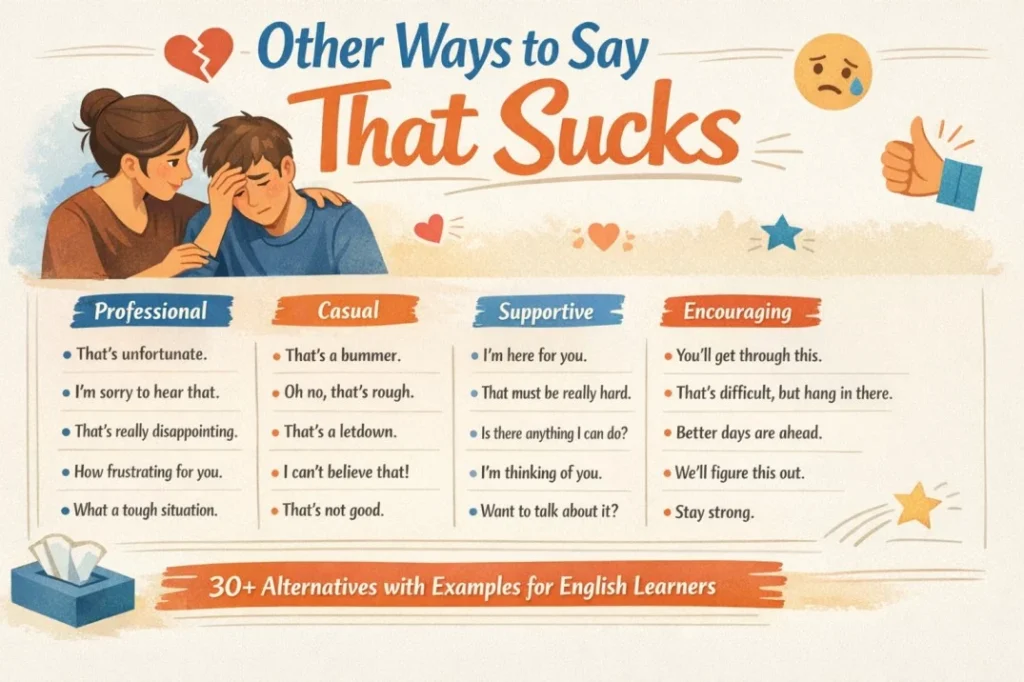
If you want other ways to say that sucks, try:
That’s unfortunate, What a bummer, That’s disappointing, I’m sorry to hear that, Tough luck.
These alternatives allow you to express sympathy, frustration, or disappointment politely and professionally.
The phrase “that sucks” is widely used in casual conversation to express disappointment, frustration, or sympathy. However, it can sound too informal or impolite in professional or formal contexts.
Learning alternatives to that sucks helps you:
- Express feelings appropriately in any context
- Avoid sounding crude or insensitive
- Match tone to your audience
Using varied expressions also helps express excitement in English when reacting empathetically or sharing experiences, making your language more versatile and confident.
“The right reaction phrase can make your English sound thoughtful and professional.”
Why You Need Alternatives
- Professional Communication: Avoid casual slang in emails or workplace conversations.
- Empathy: Show understanding politely without offending.
- Tone Variety: Adapt reactions based on friends, colleagues, or clients.
- Clarity: Avoid ambiguity—phrases like “That’s unfortunate” convey clear sympathy.
Categories of Alternatives
1. Formal / Professional Alternatives
- That’s unfortunate
- I’m sorry to hear that
- That’s disappointing
- I regret hearing that
Pro Tip: Use these in emails, client calls, and professional conversations to remain polite.
2. Neutral / Casual Alternatives
- What a bummer
- Tough luck
- That’s too bad
- That stinks
Pro Tip: Great for friends, colleagues, or informal work chats.
3. Sympathetic / Empathetic Alternatives
- I understand how frustrating that is
- That must be difficult
- I can imagine that’s upsetting
- Sounds like a rough situation
Pro Tip: Use these for emotional support, sensitive situations, or personal conversations.
4. Playful / Light-Hearted Alternatives
- Oh no, that’s rough
- That bites
- Yikes, that’s bad
- Ouch, that hurts
Pro Tip: Works with friends, family, or casual texts where humor softens disappointment.
5. Encouraging / Motivational Alternatives
- Better luck next time
- Don’t worry, you’ll recover
- Keep your chin up
- Things will get better
Pro Tip: Combines empathy with motivation, suitable for coaching, colleagues, or friends.
6. Bold / Expressive Alternatives
- That’s brutal
- What a disaster
- That’s miserable
- Absolutely dreadful
Pro Tip: Strong reaction, best for storytelling, reviews, or emphatic conversation.
7. Subtle / Understated Alternatives
- That’s not ideal
- Could be better
- That’s less than perfect
- Not the best outcome
Pro Tip: Polite and neutral for professional settings where strong language is avoided.
Common Mistakes
- Overusing “that sucks”
Example: “That sucks, that sucks, that sucks!” - Using inappropriate tone
Example: Saying “that sucks” to a client in an email. - Being too vague
Example: “Oh, that sucks.” (No empathy or context) - Mixing slang with formal writing
Example: “That sucks, please see attached report.” - Ignoring context
Example: Using “that bites” in a serious or sensitive situation.
30+ Alternatives to “That Sucks” (With Examples, Tone, and Context)
| # | Phrase | Tone | Best Use | Example Sentence | Effectiveness (1–10) | Notes |
|---|---|---|---|---|---|---|
| 1 | That’s unfortunate | Formal | Professional emails | “That’s unfortunate about the schedule change.” | 9 | Polite, versatile |
| 2 | I’m sorry to hear that | Formal | Work or personal | “I’m sorry to hear that you missed the meeting.” | 9 | Empathetic |
| 3 | That’s disappointing | Formal | Workplace, feedback | “That’s disappointing news about the project delay.” | 8 | Clear, neutral |
| 4 | I regret hearing that | Formal | Professional | “I regret hearing that your order was delayed.” | 8 | Polite, professional |
| 5 | What a bummer | Casual | Friends, informal chat | “What a bummer that the concert got canceled.” | 8 | Friendly, neutral |
| 6 | Tough luck | Casual | Friends, peers | “Tough luck on missing the deadline.” | 7 | Brief, informal |
| 7 | That’s too bad | Casual | Neutral conversation | “That’s too bad you couldn’t attend.” | 8 | Safe, casual |
| 8 | That stinks | Casual | Informal settings | “That stinks about your lost luggage.” | 7 | Slightly playful |
| 9 | I understand how frustrating that is | Sympathetic | Personal or work | “I understand how frustrating that is with the software glitch.” | 9 | Empathy-focused |
| 10 | That must be difficult | Sympathetic | Supportive | “That must be difficult for you with all the changes.” | 8 | Polite, empathetic |
| 11 | I can imagine that’s upsetting | Sympathetic | Personal, emotional | “I can imagine that’s upsetting news.” | 8 | Empathy-driven |
| 12 | Sounds like a rough situation | Sympathetic | Casual support | “Sounds like a rough situation with the traffic delays.” | 7 | Friendly, understanding |
| 13 | Oh no, that’s rough | Playful | Friends, casual chat | “Oh no, that’s rough about your broken phone.” | 7 | Light-hearted empathy |
| 14 | That bites | Playful | Friends, social media | “That bites, hope it gets fixed soon!” | 7 | Casual slang |
| 15 | Yikes, that’s bad | Playful | Casual or humorous | “Yikes, that’s bad news about the weather.” | 7 | Informal, playful |
| 16 | Ouch, that hurts | Playful | Informal situations | “Ouch, that hurts to hear about the mistake.” | 7 | Lighthearted |
| 17 | Better luck next time | Encouraging | Motivational, friends | “Better luck next time with the test results.” | 8 | Optimistic |
| 18 | Don’t worry, you’ll recover | Encouraging | Supportive | “Don’t worry, you’ll recover from the setback.” | 8 | Motivating |
| 19 | Keep your chin up | Encouraging | Friends, supportive | “Keep your chin up; things will improve.” | 8 | Friendly, positive |
| 20 | Things will get better | Encouraging | Personal encouragement | “Things will get better after this setback.” | 8 | Polite, uplifting |
| 21 | That’s brutal | Bold | Storytelling, informal | “That’s brutal about the last-minute cancellation.” | 7 | Strong, expressive |
| 22 | What a disaster | Bold | Casual storytelling | “What a disaster the event turned out to be!” | 7 | Dramatic effect |
| 23 | That’s miserable | Bold | Emphasizing frustration | “That’s miserable news about the delay.” | 7 | Strong impact |
| 24 | Absolutely dreadful | Bold | Storytelling, formal | “Absolutely dreadful that the shipment got lost.” | 8 | Dramatic, formal |
| 25 | That’s not ideal | Subtle | Professional | “That’s not ideal for our project timeline.” | 8 | Polite, understated |
| 26 | Could be better | Subtle | Work context | “Could be better with the client response.” | 7 | Neutral, subtle |
| 27 | That’s less than perfect | Subtle | Professional or social | “That’s less than perfect for the presentation slides.” | 7 | Polite critique |
| 28 | Not the best outcome | Subtle | Workplace, reporting | “Not the best outcome from the meeting.” | 7 | Professional, neutral |
| 29 | Unfortunate situation | Formal | Reports, emails | “It’s an unfortunate situation with the shipment.” | 8 | Professional, neutral |
| 30 | That’s tough | Casual | Personal or friendly | “That’s tough, hope things improve soon.” | 8 | Friendly, empathetic |
Key Insights
- Formal alternatives (effectiveness 8–9) are essential in emails or professional contexts.
- Casual alternatives (7–8) work well with friends, peers, or informal chats.
- Sympathetic phrases increase emotional intelligence and empathy.
- Playful phrases soften frustration and maintain friendliness in social conversations.
“Using context-appropriate reactions enhances your English professionalism and interpersonal impact.”
Mini Quiz / Self-Check
- Which is the most professional alternative to “that sucks”?
A. That bites
B. That’s unfortunate
C. Yikes, that’s bad
Answer: B - Best for a friend’s mishap?
A. That’s not ideal
B. What a bummer
C. I regret hearing that
Answer: B - Which is empathetic and formal?
A. I understand how frustrating that is
B. That bites
C. That’s brutal
Answer: A
Comparison Table: Top 10 Alternatives
| Phrase | Tone | Best Use |
|---|---|---|
| That’s unfortunate | Formal | Professional, emails |
| I’m sorry to hear that | Formal | Workplace, empathetic |
| That’s disappointing | Formal | Feedback, reporting |
| I understand how frustrating that is | Sympathetic | Supportive, professional |
| What a bummer | Casual | Friends, peers |
| Tough luck | Casual | Friends, informal |
| That stinks | Casual | Informal chat |
| Better luck next time | Encouraging | Motivational, supportive |
| Keep your chin up | Encouraging | Personal encouragement |
| That’s brutal | Bold | Storytelling, casual |
FAQs
1. Is “that sucks” appropriate in professional emails?
No, use formal alternatives like “That’s unfortunate” or “I’m sorry to hear that.”
2. Which alternatives are best for social media?
“What a bummer,” “That bites,” “Yikes, that’s bad.”
3. Can playful phrases work in serious situations?
No, use empathetic or formal alternatives instead.
4. How do I express sympathy without sounding casual?
Use: “I understand how frustrating that is” or “That’s disappointing.”
5. Can encouraging alternatives replace “that sucks”?
Yes, phrases like “Better luck next time” and “Keep your chin up” combine empathy and motivation.
Conclusion
Learning 30+ alternatives to “that sucks” lets you:
- Express disappointment or sympathy appropriately in any context
- Match tone to professional, social, or playful situations
- Communicate emotionally intelligent reactions
Practice these phrases in emails, chats, and conversations to enhance your English fluency and interpersonal skills.
Read More Related Articles:
- Other Ways to Say I Am Sorry to Hear That: 30 Examples In 2026
- Other Ways to Say Thank You for Taking the Time In 2026
- Other Ways to Say Thank You for Your Kind Words In 2026

Owen Price is a skilled content writer at Synofind.com, known for crafting clear, engaging and reader-focused content. He brings a thoughtful approach to research and storytelling, ensuring every piece is accurate, concise and easy to understand.