Last Updated on April 16, 2026
Quick Answer 🔥
Looking for other ways to say sounds good?
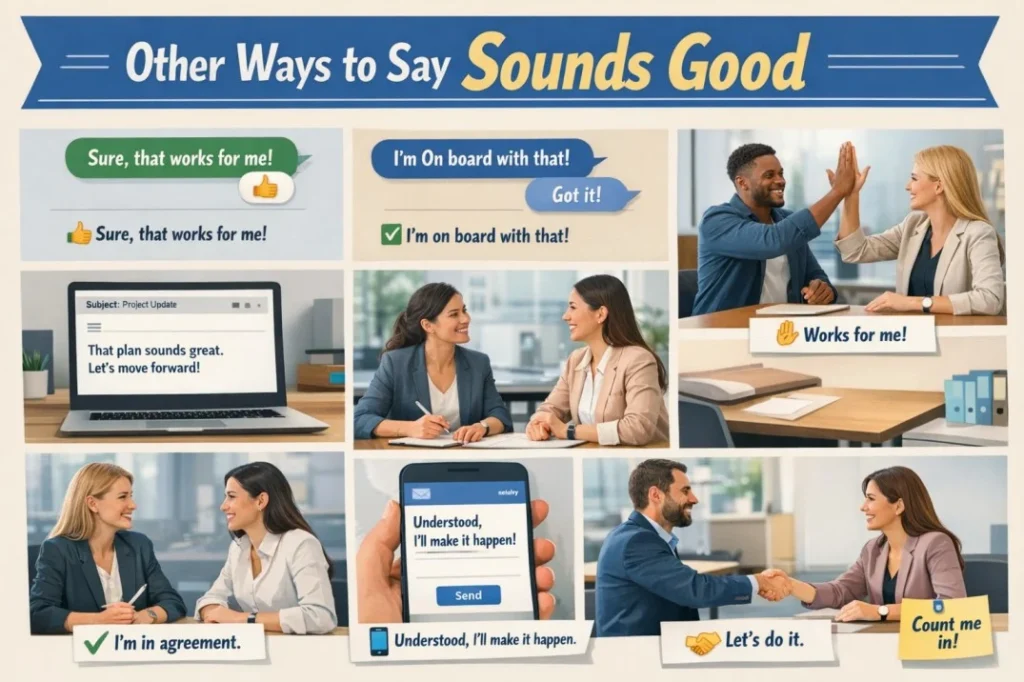
Try: That works for me, Looks great, I’m on board, Perfect, That’s fine with me.
These alternatives help you sound more professional, natural, and context-appropriate in conversations and emails.
The phrase “sounds good” is widely used in English to show agreement, approval, or acceptance. It’s simple and friendly, but it can feel repetitive or too casual in professional communication.
Learning alternatives to sounds good allows you to:
- Improve your professional communication skills
- Adjust tone for formal vs informal situations
- Sound more confident and fluent in English
Using varied expressions also helps you express excitement in English more naturally while maintaining clarity and tone.
“The right response can make your communication sound confident, professional, and engaging.”
Quick Categories
Formal alternatives to “sounds good”
- That works well
- That is acceptable
- I agree with this approach
- This is suitable
Pro Tip: Use these in emails, meetings, or client communication.
Casual alternatives
- Cool
- Works for me
- Nice
- All good
Pro Tip: Great for chats, friends, and relaxed work environments.
Professional alternatives
- I’m on board
- That aligns with my understanding
- This looks good to me
- I approve
Pro Tip: Ideal for workplace approvals and collaboration.
Informal expressions
- Perfect
- Sounds great
- Let’s do it
- Works perfectly
Pro Tip: Use for friendly tone, but avoid in formal writing.
Common Mistakes
- Using “sounds good” in formal emails
Example: “Sounds good, proceed.” - Overusing the phrase
Example: Repeating it in every response - Lack of clarity
Example: “Sounds good” (without confirming details) - Wrong tone for context
Example: Saying “Cool” in a client email - No engagement or feedback
Example: “Sounds good” instead of adding input
What Does “Sounds Good” Mean?
Definition:
“Sounds good” is an informal phrase used to agree with a suggestion, plan, or idea.
Grammar Note:
It functions as a response phrase, not a full formal sentence.
Example:
“That meeting time sounds good to me.”
When to Use “Sounds Good”
- Accepting a suggestion
- Confirming plans
- Agreeing in casual conversation
- Responding quickly in chats
Spoken vs Written:
- Spoken: Very common
- Written: Best for informal emails or messages
Formal vs Informal:
- Polite? ✔️ Yes
- Professional? ❌ No (in most cases)
Is It Professional or Polite to Say “Sounds Good”?
“Sounds good” is polite but too informal for professional settings.
Business Example:
“Sounds good, I’ll review it.” (acceptable internally, not ideal for clients)
✔️ Polite
❌ Not fully professional
Pros and Cons of Using “Sounds Good”
Pros
- Simple and natural
- Friendly tone
- Common usage
- Easy to understand
Cons
- Too informal for work
- Overused
- Limited emotional range
- Not suitable for formal writing
“Small changes in wording can make a big difference in how professional you sound.”
Other Ways to Say “Sounds Good” (With Examples)
These alternatives will help you sound more fluent, confident, and natural in different situations.
Use them according to tone, context, and audience to express approval or agreement.
30 Alternatives
- Phrase: That works for me
Meaning: Accepting a plan
Explanation: Shows agreement clearly
Example Sentence: “Friday at 3 PM? That works for me.”
Best Use: meetings, plans
Worst Use: formal reports
Tone: neutral, clear
Context Variability: casual / professional
- Phrase: Looks good to me
Meaning: Approval
Explanation: Confirms satisfaction
Example Sentence: “The design looks good to me.”
Best Use: reviews
Worst Use: legal docs
Tone: neutral, approving
Context Variability: professional
- Phrase: Perfect
Meaning: Strong agreement
Explanation: Shows enthusiasm
Example Sentence: “Perfect, let’s proceed.”
Best Use: quick replies
Worst Use: formal writing
Tone: enthusiastic, positive
Context Variability: casual
- Phrase: That’s fine with me
Meaning: Acceptable
Explanation: Neutral agreement
Example Sentence: “That timeline is fine with me.”
Best Use: discussions
Worst Use: high enthusiasm
Tone: neutral, polite
Context Variability: professional
- Phrase: I’m on board
Meaning: Full agreement
Explanation: Shows commitment
Example Sentence: “I’m on board with this strategy.”
Best Use: teamwork
Worst Use: casual chat
Tone: confident, professional
Context Variability: professional
- Phrase: Sounds great
Meaning: Positive agreement
Explanation: Slightly more enthusiastic
Example Sentence: “Sounds great, I’ll join.”
Best Use: friendly work chats
Worst Use: formal emails
Tone: friendly, positive
Context Variability: casual
- Phrase: That works well
Meaning: Effective plan
Explanation: Professional approval
Example Sentence: “That works well for our timeline.”
Best Use: business
Worst Use: casual texting
Tone: professional, neutral
Context Variability: professional
- Phrase: I agree with that
Meaning: Agreement
Explanation: Direct confirmation
Example Sentence: “I agree with that approach.”
Best Use: meetings
Worst Use: casual slang
Tone: formal, clear
Context Variability: professional
- Phrase: This looks good
Meaning: Approval
Explanation: Visual or plan-based agreement
Example Sentence: “This proposal looks good.”
Best Use: reviews
Worst Use: informal texting
Tone: neutral
Context Variability: professional
- Phrase: Works perfectly
Meaning: Ideal fit
Explanation: Strong approval
Example Sentence: “This solution works perfectly.”
Best Use: solutions
Worst Use: uncertain plans
Tone: confident
Context Variability: casual/professional
- Phrase: All good
Meaning: Everything is fine
Explanation: Casual agreement
Example Sentence: “All good from my side.”
Best Use: chats
Worst Use: clients
Tone: informal
Context Variability: casual
- Phrase: That’s acceptable
Meaning: Formal approval
Explanation: Slightly reserved
Example Sentence: “That is acceptable for now.”
Best Use: formal reviews
Worst Use: casual tone
Tone: formal
Context Variability: professional
- Phrase: I’m okay with that
Meaning: Acceptance
Explanation: Neutral response
Example Sentence: “I’m okay with that plan.”
Best Use: discussions
Worst Use: formal reports
Tone: neutral
Context Variability: casual/professional
- Phrase: That sounds great to me
Meaning: Positive agreement
Explanation: Friendly tone
Example Sentence: “That sounds great to me!”
Best Use: friendly replies
Worst Use: formal docs
Tone: warm
Context Variability: casual
- Phrase: Good with me
Meaning: Agreement
Explanation: Short casual form
Example Sentence: “Good with me, let’s go.”
Best Use: chats
Worst Use: formal
Tone: informal
Context Variability: casual
- Phrase: Let’s do it
Meaning: Strong approval
Explanation: Action-focused
Example Sentence: “Let’s do it.”
Best Use: action decisions
Worst Use: formal
Tone: energetic
Context Variability: casual
- Phrase: That aligns with my thinking
Meaning: Agreement
Explanation: Professional tone
Example Sentence: “That aligns with my thinking.”
Best Use: meetings
Worst Use: casual chat
Tone: professional
Context Variability: professional
- Phrase: I support this
Meaning: Approval
Explanation: Strong endorsement
Example Sentence: “I support this initiative.”
Best Use: leadership
Worst Use: casual
Tone: formal
Context Variability: professional
- Phrase: That’s a good plan
Meaning: Approval
Explanation: Positive feedback
Example Sentence: “That’s a good plan.”
Best Use: discussions
Worst Use: formal writing
Tone: friendly
Context Variability: casual
- Phrase: Approved
Meaning: Formal acceptance
Explanation: Direct approval
Example Sentence: “Approved. Proceed.”
Best Use: managers
Worst Use: casual
Tone: formal
Context Variability: professional
- Phrase: That makes sense
Meaning: Logical agreement
Explanation: Reason-based approval
Example Sentence: “That makes sense.”
Best Use: discussions
Worst Use: strong enthusiasm
Tone: neutral
Context Variability: all
- Phrase: I’m happy with that
Meaning: Positive agreement
Explanation: Shows satisfaction
Example Sentence: “I’m happy with that solution.”
Best Use: feedback
Worst Use: strict formal
Tone: warm
Context Variability: casual/professional
- Phrase: This works
Meaning: Acceptance
Explanation: Simple and direct
Example Sentence: “This works for me.”
Best Use: quick replies
Worst Use: formal
Tone: neutral
Context Variability: casual
- Phrase: No problem
Meaning: Agreement
Explanation: Easy acceptance
Example Sentence: “No problem, I’ll handle it.”
Best Use: casual
Worst Use: formal
Tone: informal
Context Variability: casual
- Phrase: That’s suitable
Meaning: Formal approval
Explanation: Professional tone
Example Sentence: “That’s suitable for our needs.”
Best Use: business
Worst Use: casual
Tone: formal
Context Variability: professional
- Phrase: That will do
Meaning: Acceptable
Explanation: Slightly reserved
Example Sentence: “That will do for now.”
Best Use: practical decisions
Worst Use: enthusiastic tone
Tone: neutral
Context Variability: professional
- Phrase: Fine by me
Meaning: Casual agreement
Explanation: Informal tone
Example Sentence: “Fine by me.”
Best Use: friends
Worst Use: clients
Tone: casual
Context Variability: informal
- Phrase: That checks out
Meaning: Logical approval
Explanation: Confirms correctness
Example Sentence: “That checks out.”
Best Use: analysis
Worst Use: formal docs
Tone: neutral
Context Variability: casual
- Phrase: I’m satisfied with that
Meaning: Strong approval
Explanation: Formal tone
Example Sentence: “I’m satisfied with that outcome.”
Best Use: reviews
Worst Use: casual
Tone: formal
Context Variability: professional
- Phrase: That’s agreeable
Meaning: Formal agreement
Explanation: Polished tone
Example Sentence: “That’s agreeable to me.”
Best Use: formal writing
Worst Use: casual chat
Tone: formal
Context Variability: professional
“Choosing the right alternative helps you sound more natural, confident, and professional.”
Mini Quiz / Self-Check
- Best formal alternative?
A. Cool
B. That’s agreeable
C. Let’s do it
Answer: B - Casual alternative?
A. Approved
B. All good
C. That’s suitable
Answer: B - Professional meeting response?
A. That aligns with my thinking
B. Fine by me
C. No problem
Answer: A
Comparison Table: Top Alternatives
| Phrase | Tone | Best Use |
|---|---|---|
| That works for me | Neutral | Meetings |
| Looks good to me | Neutral | Reviews |
| Perfect | Casual | Quick replies |
| I’m on board | Professional | Teamwork |
| That works well | Professional | Business |
| I agree with that | Formal | Meetings |
| Works perfectly | Neutral | Solutions |
| That aligns with my thinking | Professional | Strategy |
| Approved | Formal | Leadership |
| That’s agreeable | Formal | Writing |
FAQs
1. Is “sounds good” professional?
It’s polite but too informal for formal business communication.
2. What’s the best formal alternative?
“That works well” or “That’s agreeable.”
3. Can I use “perfect” in emails?
Only in casual or semi-formal emails.
4. What should I use in meetings?
“I agree with that” or “That aligns with my thinking.”
5. How do I sound more professional?
Use structured phrases like “I support this” or “This is suitable.”
Conclusion
Learning other ways to say sounds good helps you communicate with clarity, professionalism, and confidence. By choosing the right phrase, you can adapt to formal, casual, or professional contexts effectively.
Practice these alternatives daily to improve your fluency, tone awareness, and communication impact in both spoken and written English.
Read More Related Articles:
- Other Ways to Say Quick Learner on a Resume: 30+ Examples 2026
- Other Ways to Say Thank You for Your Approval In 2026
- Other Ways to Say Thank You for the Update In 2026

Joshua Bell is a professional content writer at Synofind.com, known for delivering clear, accurate and engaging written content. He focuses on thorough research and thoughtful storytelling to ensure every piece is reliable and easy to understand. His work reflects a strong commitment to quality and credibility.