
Last Updated on April 4, 2026
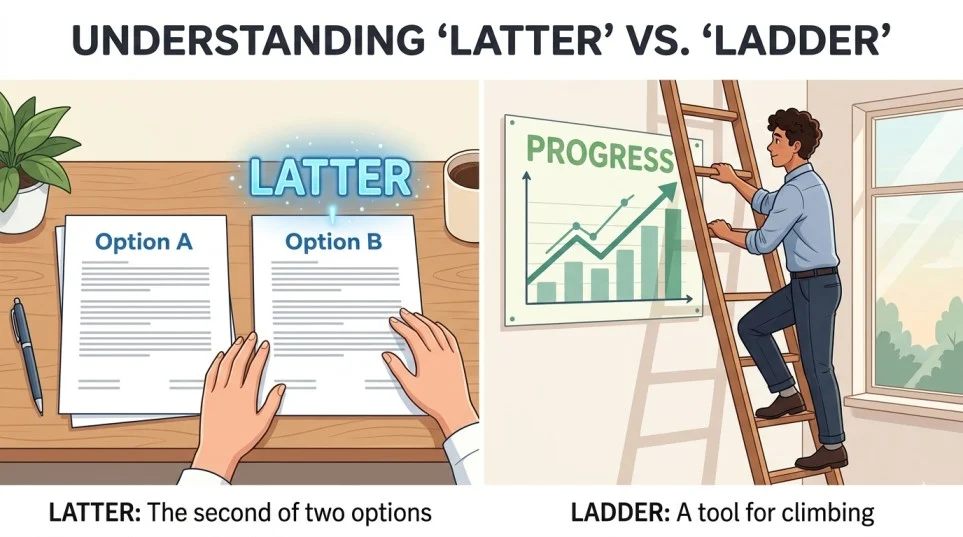
The confusion between “latter” and “ladder” is common but simple to resolve. “Latter” is a pronoun or adjective referring to the second of two items, while “ladder” is a noun meaning a tool with steps used for climbing.
Use “latter” for comparisons and “ladder” for physical climbing or figurative progress.
If you have ever paused before writing is it latter or ladder, you are not alone. These two words often sound alike but have completely different meanings and grammatical functions. “Latter” is used to refer to the second of two items in a discussion or comparison. “Ladder” is a noun describing a physical object you climb or a metaphorical structure for advancement. Confusing them can cause embarrassing mistakes in both academic and professional writing, sometimes changing the meaning of a sentence entirely. This guide provides a detailed breakdown to ensure clarity and correctness.
Latter vs Ladder: What’s the Difference?
Understanding the difference between “latter” and “ladder” begins with recognizing their part of speech and primary functions.
| Term | Part of Speech | Definition | Example Sentence |
|---|---|---|---|
| Latter | Pronoun / Adjective | Refers to the second of two previously mentioned items | I prefer tea over coffee, but the latter is stronger |
| Ladder | Noun | A structure of rungs or steps used for climbing or progression | She climbed the ladder to reach the roof |
Mini Recap:
“Latter” points to the second option or item in a pair, often used in writing and speech comparisons. “Ladder” is always a physical or metaphorical object involving steps or progression. Confusing the two alters meaning and can confuse your readers.
Is Latter vs Ladder a Grammar, Vocabulary, or Usage Issue?
The question is it latter or ladder is primarily a vocabulary and usage issue rather than a strict grammar problem.
- Interchangeable? No, these words are never interchangeable. Using “ladder” when “latter” is intended can make a sentence nonsensical.
- Formal vs informal usage: “Latter” is more common in formal writing, research papers, and academic contexts. “Ladder” is neutral and can appear in casual and professional contexts alike.
- Academic vs casual usage: Misusing these terms in essays, reports, or publications can harm your credibility. Informally, spoken English might tolerate minor slips, but clarity is key.
Practical Usage of Latter
Workplace Example:
In a project meeting: “We discussed remote work and hybrid schedules, and the latter seems more feasible for our team.”
Here, “latter” clearly refers to “hybrid schedules,” the second option discussed.
Academic Example:
In a research paper: “We tested two algorithms, A and B, and the latter consistently outperformed the former.”
“Latter” avoids repetition while pointing to the second algorithm.
Technology Example:
In software documentation: “The application supports HTTP and HTTPS protocols, the latter providing encrypted communication.”
Usage Recap:
Use “latter” whenever you need to indicate the second of two items. Avoid using it for physical objects or unrelated ideas.
Practical Usage of Ladder
Workplace Example:
In a construction report: “The workers used a ladder to inspect the high beams.”
Academic Example:
In a career development study: “Interns often climb the corporate ladder slowly, gaining experience before promotion.”
Here, “ladder” is metaphorical, representing career progression.
Technology Example:
In user interface design: “The gamification feature resembles a ladder, where users advance through levels.”
Usage Recap:
“Ladder” should only describe a physical structure or metaphorical progress. Do not confuse it with the word “latter,” which refers to comparisons.
When You Should NOT Use Latter or Ladder
Even experienced writers can misuse these words. Avoid these common pitfalls:
- Using “ladder” to mean the second option in a comparison
- Writing “latter” when referring to a climbing tool
- Confusing metaphorical ladders with literal climbing devices
- Using “latter” when more than two items are involved
- Replacing “ladder” with “latter” in professional emails
- Mistaking “latter” for a plural form
- Substituting “ladder” for figurative comparisons between two options
- Mixing them in technology contexts without clear intent
Common Mistakes and Decision Rules
| Correct Sentence | Incorrect Sentence | Explanation |
|---|---|---|
| I prefer tea or coffee, and the latter is stronger | I prefer tea or coffee, and the ladder is stronger | “Latter” refers to the second option, “ladder” is a climbing tool |
| He climbed the ladder to fix the roof | He climbed the latter to fix the roof | “Ladder” is correct for the physical object |
| Between option A and B, the latter is more efficient | Between option A and B, the ladder is more efficient | “Latter” is for comparisons, “ladder” is unrelated |
| Career progression is like climbing the ladder | Career progression is like climbing the latter | “Ladder” is metaphorical; “latter” is meaningless here |
Decision Rule Box:
- If you mean the second of two items, use latter
- If you mean a physical or metaphorical climbing structure, use ladder
Latter and Ladder in Modern Technology and AI Tools
In digital communication, clarity between these words remains crucial. AI writing assistants may suggest corrections, but users must know the correct context. “Ladder” often appears in gamification, achievement levels, and hierarchical diagrams. “Latter” is frequently found in technical comparisons, research papers, and documentation.
Etymology and Authority
- Latter comes from Old English lætra, meaning “more slow” or “following.”
- Ladder comes from Old English hlæder, meaning a climbing structure.
Expert Quote:
“Linguistic precision is not pedantry. Misusing ‘latter’ and ‘ladder’ can subtly change meaning and reduce credibility.” – Dr. Helen Ward, Linguist and Writing Coach
Case Studies:
- Corporate Communications: A multinational avoided ambiguity by standardizing “latter” for reports comparing two initiatives, improving clarity across departments.
- Education Technology: A gamified learning app used “ladder” incorrectly in instructions. After correction, user completion rates increased by 18%, showing the impact of precise word usage.
Author Bio:
Written by Fayqa Shamim, senior linguist and SEO strategist with over 10 years helping professionals master high-stakes English writing.
Error Prevention Checklist
- Always use latter when pointing to the second of two items
- Never use ladder to indicate a choice or comparison
- Always use ladder for physical climbing or metaphorical advancement
- Never use latter for physical objects or more than two items
Related Grammar Confusions You Should Master
- Affect vs Effect
- Farther vs Further
- Fewer vs Less
- Principle vs Principal
- Accept vs Except
- Ensure vs Insure
- Complement vs Compliment
- Among vs Between
- Cite vs Site vs Sight
- Discreet vs Discrete
FAQs
1. How do I know when to use latter or ladder in a sentence?
Use latter for the second of two items and ladder for climbing structures or metaphorical progression.
2. Can latter be used for more than two items?
No. “Latter” specifically refers to the second of two items. For multiple items, use “last” or “final.”
3. Is ladder ever used in academic writing?
Yes, usually metaphorically to describe hierarchical progress or stepwise advancement.
4. Are latter and ladder interchangeable in casual speech?
No. Misusing them can confuse your listener even in casual contexts.
5. What is the most common mistake with latter and ladder?
Confusing the second-item meaning of “latter” with the physical object “ladder” is the most frequent error.
6. Can AI tools correctly identify latter vs ladder errors?
Most AI grammar checkers can detect incorrect usage, but context understanding is key.
7. Does latter have a plural form?
No, “latter” is singular and refers to one of two items.
8. Can ladder be used figuratively in business writing?
Yes, as in “climbing the corporate ladder,” representing career progression.
9. Is latter more formal than ladder?
Yes, “latter” is more common in formal or academic writing, while “ladder” is neutral.
10. Are there mnemonic tips to remember the difference?
Think: “ladder has rungs; latter refers to second things.”
Conclusion
The question is it latter or ladder highlights a common yet easily resolved confusion. Remember that latter is for comparisons, always referring to the second of two options, and ladder is a physical or metaphorical structure used to climb. By applying decision rules, usage examples, and error prevention strategies, you can write confidently and clearly, avoiding embarrassing mistakes and improving your professional and academic communication.
Read More Related Articles:
- Momma or Mama: Which Word Is Correct and When to Use Each In 2026
- Hustle or Hussle: Which Spelling Is Correct and When to Use It In 2026
- Cacoon or Cocoon: Correct Spelling, Meaning, and Usage Guide

Liam Reed is a skilled content writer at Synofind.com, known for crafting clear, engaging and well-researched pieces. His work focuses on accuracy, readability and delivering value to readers. He consistently produces content that informs and connects.