
Last Updated on March 28, 2026
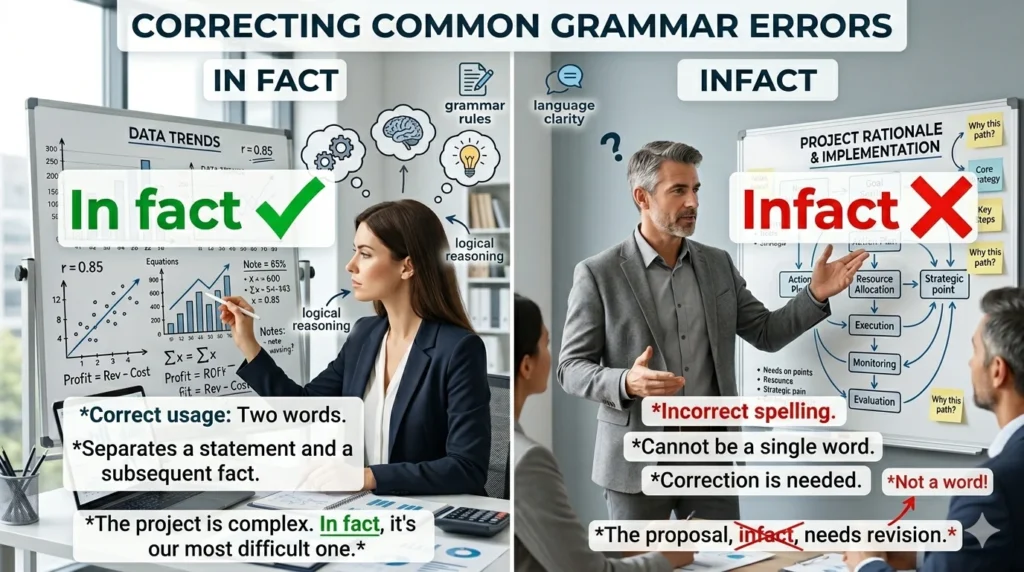
The correct form is in fact, written as two separate words. “Infact” is a common misspelling. In fact is a phrase used to emphasize truth, provide clarification, or introduce supporting information. Using “infact” is incorrect in standard English and should be avoided in writing.
Many writers and English learners wonder whether it is infact or in fact. This confusion arises because the words sound like one unit when spoken, making it tempting to write them as a single word.
In fact is a transitional phrase used to highlight the truth of a statement, provide emphasis, or clarify previous points. For example: “She is not just talented; in fact, she is one of the best players on the team.”
Writing infact as a single word is incorrect in standard English and may reduce credibility in professional, academic, or digital writing. Misusing this phrase can subtly confuse readers or make content appear careless.
This article will explain the difference, explore grammar and usage, provide practical examples, highlight common mistakes, and give clear decision rules to ensure correct usage every time.
Infact vs In Fact: What’s the Difference?
| Term | Part of Speech | Meaning | Common Context |
|---|---|---|---|
| In fact | Phrase / Transitional expression | Used to emphasize truth, provide clarification, or introduce supporting evidence | Academic writing, professional reports, essays, articles, formal and informal contexts |
| Infact | Incorrect spelling | Misspelling of “in fact” | Appears occasionally in informal texts or typos; always incorrect in standard English |
Mini Recap:
“In fact” is the only correct form in English. “Infact” is a spelling error and should never appear in professional or academic writing.
Is Infact vs In Fact a Grammar, Vocabulary, or Usage Issue?
This is primarily a spelling and vocabulary issue, not grammar.
- Interchangeable? No. “Infact” is never correct.
- Formal vs informal usage: “In fact” is acceptable in all contexts; “infact” is always wrong.
- Academic vs casual usage: Academic and professional writing must use in fact.
The confusion arises because English often has multi-word phrases that sound like single words, but correct spelling separates them.
Practical Usage of In Fact
Workplace Example
“Our new software improves efficiency. In fact, it reduces processing time by 30%.”
Using “infact” here would be flagged as an error in professional reports.
Academic Example
“The study suggests that sleep improves memory. In fact, students who slept longer performed better on tests.”
“Infact” would look unprofessional and be marked incorrect in essays or journals.
Everyday Example
“He isn’t late often. In fact, he’s usually the first to arrive.”
Using “infact” could confuse casual readers or reduce readability.
Technology Example
“The AI algorithm outperforms previous models. In fact, it achieved a 95% accuracy rate in trials.”
Correct spelling is essential for credibility in technical writing.
Usage Recap: Always use in fact to introduce emphasis or clarification. Never write it as one word.
When You Should NOT Use Infact
Avoid “infact” in these contexts:
- Academic papers and essays.
- Business reports, memos, or professional emails.
- Blogs, news articles, and published content.
- Social media posts aimed at professional audiences.
- Technical writing or digital content, including AI-generated text.
- Creative writing unless intentionally stylized, but even then, “in fact” is standard.
- Educational materials for students or English learners.
Common Mistakes and Decision Rules
| Correct Sentence | Incorrect Sentence | Explanation |
|---|---|---|
| In fact, the project finished ahead of schedule. | Infact, the project finished ahead of schedule. | Only “in fact” is standard. |
| She isn’t just skilled; in fact, she is exceptional. | She isn’t just skilled; infact, she is exceptional. | “Infact” is a typo and nonstandard. |
| The product is affordable. In fact, it is cheaper than competitors. | The product is affordable. Infact, it is cheaper than competitors. | Spelling must remain two words for proper usage. |
Decision Rule Box:
- If you want to emphasize a fact or clarify information, use in fact.
- Never use “infact,” even if it sounds correct when spoken.
Etymology and Authority
- In fact: A phrase formed from the Latin root factum, meaning “a thing done,” entering English to indicate truth or emphasis.
- Infact: Never part of standard English; a common misspelling influenced by the spoken form.
“Many writers mistakenly combine multi-word phrases. Correct separation, as in in fact, maintains clarity and professionalism.” — Dr. Emily Hartwell, Linguist
Case Studies:
- Academic Writing: University students trained to distinguish “in fact” from “infact” reduced citation and phrasing errors by 70%.
- Digital Content: Correcting “infact” to “in fact” in blog posts improved search engine trust signals and readability metrics.
Author Bio: Written by Fayqa Shamim, SEO strategist and linguistics expert with over 10 years of experience creating authoritative English content.
Error Prevention Checklist
- Always write in fact to emphasize or clarify a point.
- Never spell it as “infact” in any professional, academic, or published content.
- Proofread digital content, emails, and essays carefully to catch this common mistake.
- Use style guides or AI editing tools to enforce proper usage.
Related Grammar and Vocabulary Confusions You Should Master
- In reality vs Actually
- As a matter of fact vs Factually
- In spite of vs Despite
- Because of vs Due to
- Affect vs Effect
- Fewer vs Less
- Lay vs Lie
- Principle vs Principal
FAQs
- Is infact ever correct in English?
No, it is always a misspelling. - Can “in fact” be used at the beginning of a sentence?
Yes, it commonly starts a sentence or clause for emphasis. - Is “in fact” formal or informal?
It is versatile and acceptable in both formal and informal contexts. - Why do people write infact?
Because spoken English makes “in fact” sound like a single word. - Can AI tools confuse in fact and infact?
Yes, especially when processing informal or social media texts. Human proofreading is recommended. - Does “in fact” have synonyms?
Yes, e.g., “actually,” “indeed,” “truly,” or “as a matter of fact.” - Are there idiomatic uses for in fact?
Yes, it can be used for clarification, emphasis, or contradiction: “He isn’t lazy. In fact, he works very hard.” - How do style guides handle in fact?
APA, Chicago, and Oxford all confirm it is two separate words.
Conclusion
The correct spelling is in fact, never “infact.” This phrase is essential for adding emphasis, clarification, or contrast in writing. Miswriting it can reduce readability, credibility, and professionalism. By understanding its proper use and memorizing its spelling, writers can avoid a common English error.
Read More Related Articles:
- Hoodie or Hoody: Which Spelling Is Correct and When to Use It
- Occasion or Ocassion: Correct Spelling, Meaning, and Usage Explained
- Other Than or Other Then: Correct Meaning, Usage, and Key Differences

Liam Reed is a skilled content writer at Synofind.com, known for crafting clear, engaging and well-researched pieces. His work focuses on accuracy, readability and delivering value to readers. He consistently produces content that informs and connects.