Last Updated on May 9, 2026
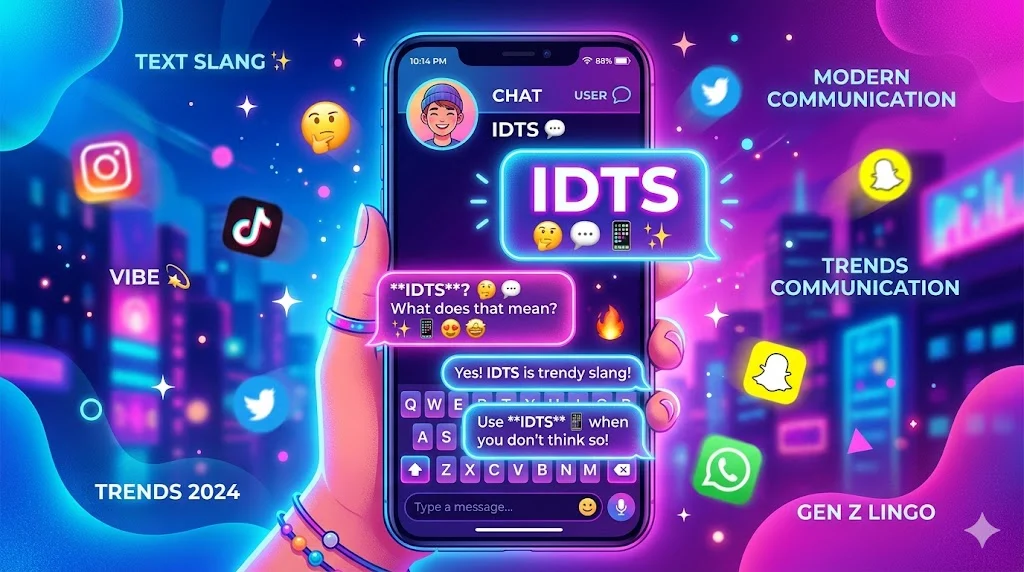
IDTS means “I Don’t Think So” in text messages and online chats. It is a casual abbreviation used to express doubt, disagreement, or uncertainty in a light and informal way.
Texting language evolves quickly, and abbreviations are now a core part of digital communication. One such expression you may often see is “IDTS.” At first glance, it might look confusing, but once you understand it, it becomes a very natural part of online chatting.
People use IDTS when they want to politely disagree or show hesitation without sounding too direct. It keeps conversations soft, short, and casual, especially on platforms like WhatsApp, Snapchat, Instagram, TikTok, and gaming chats.
In modern communication, tone matters as much as words. IDTS helps users express doubt in a friendly way without creating conflict or sounding harsh.
What Does IDTS Mean in Texting?
IDTS stands for “I Don’t Think So.” It is used when someone is unsure about something or slightly disagrees with a statement.
Instead of typing the full sentence, people shorten it to IDTS for faster communication.
Simple Meaning
IDTS = I Don’t Think So
Example
“Do you think it will rain today?”
“IDTS.”
This means: “I don’t think so.”
Origin and Rise of IDTS
IDTS became popular during the rise of SMS texting and internet chat rooms. Early mobile phones had limited typing speed, so users started shortening common phrases.
As messaging apps became widespread, slang like IDK, TBH, LOL, and IDTS became part of everyday communication.
IDTS survived because it is:
- Short and easy to type
- Expressive without being rude
- Useful in casual disagreement
- Universally understood online
Today, it is commonly used by teenagers and adults in informal digital conversations.
How IDTS Is Used in Real Conversations
IDTS is mainly used to show doubt or disagreement in a soft tone. It avoids sounding aggressive while still expressing a clear opinion.
Common usage style
“Will he come to the party?”
“IDTS, he is busy.”
Another example
“Is this the best option?”
“IDTS, there might be better ones.”
IDTS works best when you want to keep communication short and polite.
Tone Variations of IDTS
Although the meaning stays the same, IDTS can sound different depending on context.
Neutral tone
“I’m not sure about that, IDTS.”
Simple disagreement without emotion.
Casual tone
“IDTS lol”
Light and friendly.
Slightly doubtful tone
“IDTS… maybe not.”
Shows hesitation.
Soft disagreement
“IDTS but I could be wrong.”
Polite and open-minded.
Dismissive tone (rare)
“IDTS.”
Very short replies may sound cold depending on context.
Examples of IDTS in Text Messages
Here are real-world style examples showing how IDTS is used in everyday conversations.
Everyday chat examples
“I think he likes her.”
“IDTS.”
“Do you believe that story?”
“IDTS honestly.”
“Will they win the match?”
“IDTS, their team is weak.”
“Is this the right answer?”
“IDTS, check again.”
“Are we meeting tomorrow?”
“IDTS, plans might change.”
Social Media Style Examples
- “IDTS this trend will last long 😅”
- “IDTS he actually said that lol”
- “IDTS this is true 🤔”
- “IDTS I agree with that opinion”
These examples show how naturally IDTS fits into online discussions.
IDTS in Different Platforms
IDTS appears across many digital spaces where casual conversation happens.
Used in daily conversations with friends and family.
Example: “IDTS we are going out tonight.”
Snapchat
Used in quick replies.
Example: “IDTS he’s online rn.”
Used in DMs and comment discussions.
Example: “IDTS this outfit suits me.”
TikTok
Used in reactions or comment sections.
Example: “IDTS this hack actually works.”
Gaming chats
Used for quick decision-making.
Example: “IDTS we should rush now.”
Comparison of IDTS with Similar Abbreviations
Many texting abbreviations express opinions or doubt. IDTS is often confused with similar slang.
Comparison table
| Abbreviation | Meaning | Purpose |
|---|---|---|
| IDTS | I Don’t Think So | Expresses doubt/disagreement |
| IDK | I Don’t Know | Shows uncertainty |
| IMO | In My Opinion | Shares opinion |
| TBH | To Be Honest | Expresses honesty |
| NGL | Not Gonna Lie | Honest statement |
| IKR | I Know Right | Agreement |
Example comparison
“I think he will come.”
“IDTS.” → Disagreeing
“IDK.” → Not sure
“IMO no.” → Opinion-based disagreement
Is IDTS Formal or Informal?
IDTS is strictly informal and should only be used in casual communication.
Suitable situations
- Texting friends
- Social media chats
- Gaming conversations
- Informal group discussions
Not suitable for
- Emails
- Academic writing
- Business communication
- Professional reports
Formal alternative examples
Instead of IDTS, use:
- I don’t think so
- I’m not sure about that
- That doesn’t seem likely
- I have doubts about that
Labeled Table: Context-Based Usage of IDTS
| Situation | Example Sentence | Tone |
|---|---|---|
| Friend chat | “Will he come?” “IDTS.” | Casual |
| Debate | “That’s correct.” “IDTS actually.” | Neutral |
| Doubt expression | “Is this true?” “IDTS 🤔” | Curious |
| Group decision | “Should we go now?” “IDTS, wait.” | Practical |
| Online comment | “This works perfectly.” “IDTS lol” | Informal |
Why People Use IDTS Instead of Full Sentences
People prefer IDTS because it makes communication faster and smoother.
Key reasons include:
- Saves time while typing
- Keeps conversations short
- Sounds casual and natural
- Fits modern texting style
- Easy to understand globally
In fast-paced chats, shorter expressions improve communication flow.
Common Mistakes When Using IDTS
Even simple slang can be misused if not understood properly.
Using it in formal communication
Avoid IDTS in professional environments.
Incorrect:
“IDTS this report is correct.”
Better:
“I don’t think this report is correct.”
Overusing slang
Too many abbreviations reduce clarity.
Example:
“idts idk tbh lol”
This can confuse readers.
Sounding too blunt
Very short replies may feel rude.
Example:
“IDTS.”
Better:
“I don’t think so 😊”
Alternate Meanings of IDTS
In most cases, IDTS always means “I Don’t Think So.”
However, in rare technical or niche contexts, abbreviations can differ, but in texting culture, the meaning remains consistent and widely recognized.
So for everyday communication, there is no confusion.
IDTS Meaning on Snapchat, Instagram, and TikTok
Snapchat
Used in fast replies during casual chats.
Example: “IDTS he replied yet.”
Used in DMs and comment sections.
Example: “IDTS this trend is safe.”
TikTok
Used in reactions or discussions about content.
Example: “IDTS this is accurate info.”
Across all platforms, IDTS maintains the same meaning.
Polite Alternatives to IDTS
If you want a softer or more respectful tone, you can use:
- I don’t think so
- I’m not sure about that
- That doesn’t seem right
- I have my doubts
- Probably not
Example transformation
Casual: “IDTS that will work.”
Polite: “I don’t think that will work.”
FAQs
What does IDTS mean in texting?
IDTS means “I Don’t Think So.” It is used to express doubt or disagreement.
Is IDTS rude in conversation?
No, it is not rude. However, tone depends on context and how it is used.
What is the full form of IDTS?
The full form is “I Don’t Think So.”
Is IDTS and IDK the same?
No, IDTS shows disagreement while IDK shows uncertainty.
Where is IDTS commonly used?
It is commonly used on Snapchat, WhatsApp, Instagram, TikTok, and gaming chats.
Can I use IDTS in formal writing?
No, it is too informal for professional or academic communication.
How do I reply to IDTS?
You can explain your point further or provide more information.
Is IDTS still popular in 2026?
Yes, it is still widely used in casual digital conversations.
Conclusion:
IDTS is a simple yet expressive abbreviation that stands for “I Don’t Think So.” It plays an important role in online communication by allowing users to express doubt or disagreement in a soft and casual way. It is widely used across messaging apps, social media platforms, and gaming chats. Its strength lies in its simplicity and flexibility.
However, context is important. IDTS should be used only in informal conversations, while full phrases are better for professional settings. When used correctly, IDTS helps make digital communication faster, smoother, and more natural without losing meaning or tone.
Read More Related Articles:
- Other Ways to Say Sorry for Wasting Your Time In 2026
- Other Ways to Say I’m Sorry for Your Loss In 2026
- Other Ways to Say Thank You for Your Help In 2026

Joshua Bell is a professional content writer at Synofind.com, known for delivering clear, accurate and engaging written content. He focuses on thorough research and thoughtful storytelling to ensure every piece is reliable and easy to understand. His work reflects a strong commitment to quality and credibility.