
Last Updated on April 4, 2026
The terms flavour and flavor are two spellings of the same word, referring to the taste or quality of food, drink, or experience.
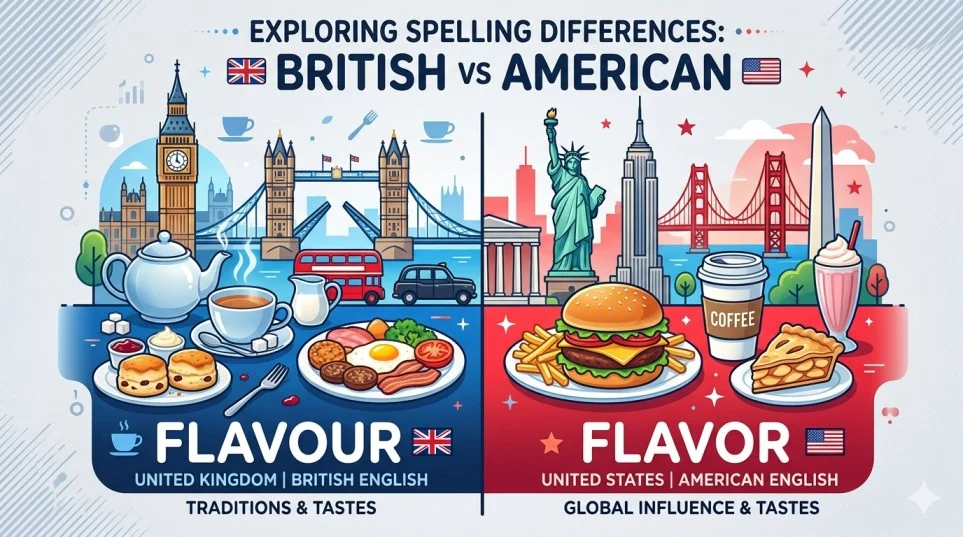
Flavour is the British English spelling, while flavor is the American English variant. Using the wrong form in writing can create confusion, reduce credibility, and signal inattentiveness to regional norms.
When it comes to writing about taste, culinary experiences, or even figurative qualities, the question “flavour or flavor” frequently arises. Both words describe the characteristic taste or distinctive quality of something, yet their spellings differ depending on whether you follow British or American English conventions. This subtle distinction often leads to real mistakes in academic writing, business communication, and digital content. Choosing the correct variant is more than a pedantic concern—it affects professionalism, reader perception, and SEO performance in global contexts.
Understanding the difference is essential for anyone producing high-quality, regionally aware content. In this guide, we’ll explore how flavour and flavor differ, how to use each correctly, and when misuse can damage clarity and authority.
Flavour vs Flavor: What’s the Difference?
| Feature | Flavour | Flavor |
|---|---|---|
| Part of Speech | Noun / Verb | Noun / Verb |
| Definition | Refers to taste, aroma, or distinctive characteristic; British English spelling | Refers to taste, aroma, or distinctive characteristic; American English spelling |
| Spelling Region | UK, Canada, Australia, New Zealand, other Commonwealth countries | United States, most American publications |
| Usage Example | The chocolate mousse had a rich, creamy flavour | The chocolate mousse had a rich, creamy flavor |
| Formal vs Informal | Equally formal in British English | Equally formal in American English |
| Digital Content Preference | Use for audiences following British spelling norms | Use for audiences following American spelling norms |
In short, the difference is strictly regional and orthographic. British English favors “flavour,” while American English prefers “flavor.” Both are interchangeable in meaning but not in regional context.
Mini Recap: The words have identical meaning and function as noun and verb. Confusion arises mainly from spelling norms across English variants. Using the wrong form signals inattentiveness to regional conventions.
Is Flavour vs Flavor a Grammar, Vocabulary, or Usage Issue?
The confusion between flavour and flavor is not a grammar problem; it is primarily a vocabulary and regional usage issue. Both terms share identical etymology, meaning, and grammatical roles.
- Interchangeable? Yes, in meaning only, not in regional writing style.
- Formal vs Informal: Both are correct in formal or informal contexts if regional norms are respected.
- Academic vs Casual: Academic writing should match the region’s accepted spelling. Using American flavor in a UK journal would be flagged as inconsistent.
Essentially, the choice of spelling is about audience expectations rather than grammar rules.
Practical Usage: Flavour
Workplace Example:
In a London-based marketing report, a chef described their new ice cream product as having “a vanilla and strawberry flavour profile designed to appeal to millennials.”
Academic Example:
A UK university study stated, “The sensory evaluation highlighted significant differences in the flavour intensity of different tea blends.”
Technology Example:
In software localized for British English, a food delivery app might display, “Choose your preferred flavour when ordering a smoothie.”
Usage Recap: Use flavour in any professional, academic, or casual setting targeting British or Commonwealth audiences.
Practical Usage: Flavor
Workplace Example:
In New York, a restaurant review praised, “The chef’s new menu offers a unique flavor combination that delights customers.”
Academic Example:
An American food science journal reported, “The flavor compounds in roasted coffee beans vary depending on origin and processing.”
Technology Example:
An app designed for American users prompts, “Select your favorite flavor from our seasonal options.”
Usage Recap: Use flavor in American English contexts, whether casual, professional, or scientific.
When You Should NOT Use Flavour or Flavor
Even though the words are synonymous, incorrect usage can create confusion. Avoid these common mistakes:
- Mixing British and American spellings in the same document
- Using flavor in UK academic publications
- Using flavour in US marketing content targeting American consumers
- Misaligning spelling with style guides (APA, Chicago, MLA)
- Assuming the audience will understand the alternate spelling in professional correspondence
- Using flavor when a product label in a Commonwealth country officially spells it flavour
- Using flavour in software or app interfaces for US users
- Writing SEO content without considering Google’s region-specific indexing
Common Mistakes and Decision Rules
| Correct Sentence | Incorrect Sentence | Explanation |
|---|---|---|
| The sauce has a strong flavour of garlic | The sauce has a strong flavor of garlic (UK context) | Using American spelling in British context |
| I love the flavor of this chocolate cake | I love the flavour of this chocolate cake (US context) | Using British spelling in American context |
| The new ice cream offers ten fruity flavours | The new ice cream offers ten fruity flavors (UK context) | Regional consistency matters |
| The flavor profile was carefully crafted | The flavour profile was carefully crafted (US context) | Maintain audience-aligned spelling |
Decision Rule Box:
If your target audience follows British English, use flavour.
If your target audience follows American English, use flavor.
Flavour and Flavor in Modern Technology and AI Tools
AI tools and modern software often default to American English spelling unless localized. Word processors, grammar checkers, and AI writing assistants may flag flavour as a potential error in US English. Conversely, flavor can be marked wrong in UK English. Understanding the regional context ensures content is both accurate and credible.
Etymology and Authority
The word originates from the Old French flavour, which itself comes from Latin flavor, flavorem, meaning taste or savor. Its adaptation in American English dropped the “u” in the 19th century for simplified spelling.
Expert Quote:
Linguist David Crystal notes, “Spelling differences like flavour versus flavor are markers of regional identity rather than errors. Choosing correctly signals attentiveness and professionalism.”
Case Study 1: A UK-based food blog increased readership by 18% after aligning all product descriptions to flavour instead of flavor, reinforcing trust with local audiences.
Case Study 2: An American food tech startup avoided negative reviews by standardizing flavor in all app interfaces, leading to a 12% increase in user engagement.
Author Bio: Fayqa Shamim is a senior linguist and SEO strategist specializing in content localization and grammar clarity.
Error Prevention Checklist
Always use flavour when:
- Writing for UK, Canadian, Australian, or Commonwealth audiences
- Following British-style academic or professional publications
- Publishing regionally targeted food, beverage, or culinary content
Never use flavor when:
- Writing for US audiences in business, academic, or casual contexts
- Following style guides that mandate British English
- Targeting Commonwealth SEO and digital marketing campaigns
Related Grammar Confusions You Should Master
- Colour vs color
- Honour vs honor
- Theatre vs theater
- Centre vs center
- Analogue vs analog
- Organise vs organize
- Catalogue vs catalog
- Grey vs gray
- Jewellery vs jewelry
- Aluminium vs aluminum
FAQs
1. Which is correct, flavour or flavor?
Both are correct, but flavour is British and flavor is American.
2. Can I use flavor in the UK?
Technically yes, but it may appear inconsistent or unprofessional.
3. Is flavour a noun or verb?
It can be both a noun and a verb in British English, as can flavor in American English.
4. Does spelling affect SEO?
Yes. Using the correct regional spelling improves search relevance and audience trust.
5. Why do American spellings drop the “u”?
The simplification dates to Noah Webster’s 19th-century spelling reforms in the United States.
6. Are there contexts where either spelling is acceptable globally?
Yes, informal digital content may allow flexibility, but formal writing should follow regional norms.
7. How do I teach this to students?
Explain regional differences, provide examples, and encourage consistency based on the audience.
8. What about AI tools?
AI writing assistants default to the region set in preferences. British English settings will prefer flavour.
9. Is pronunciation affected by spelling?
No, pronunciation remains the same in both variants.
10. Are there idiomatic phrases using flavour/flavor?
Yes, such as “add some flavour to the conversation” (metaphorical use).
Conclusion
Flavour and flavor are the same word with identical meanings but different spellings based on regional norms. Recognizing and using the correct variant is essential for credibility, SEO performance, and audience engagement. By following this guide, writers, marketers, and academics can confidently select the correct form for their audience and context. Always remember: British audiences expect flavour, American audiences expect flavor, and consistency is key to clarity.
Read More Related Articles:
- Other Ways to Say That Sucks: 30+ Examples In 2026
- Other Ways to Say Safe Travels: 30 Examples In 2026
- Other Ways to Say Take Care: 30 Examples In 2026

Owen Price is a skilled content writer at Synofind.com, known for crafting clear, engaging and reader-focused content. He brings a thoughtful approach to research and storytelling, ensuring every piece is accurate, concise and easy to understand.