
Last Updated on April 1, 2026
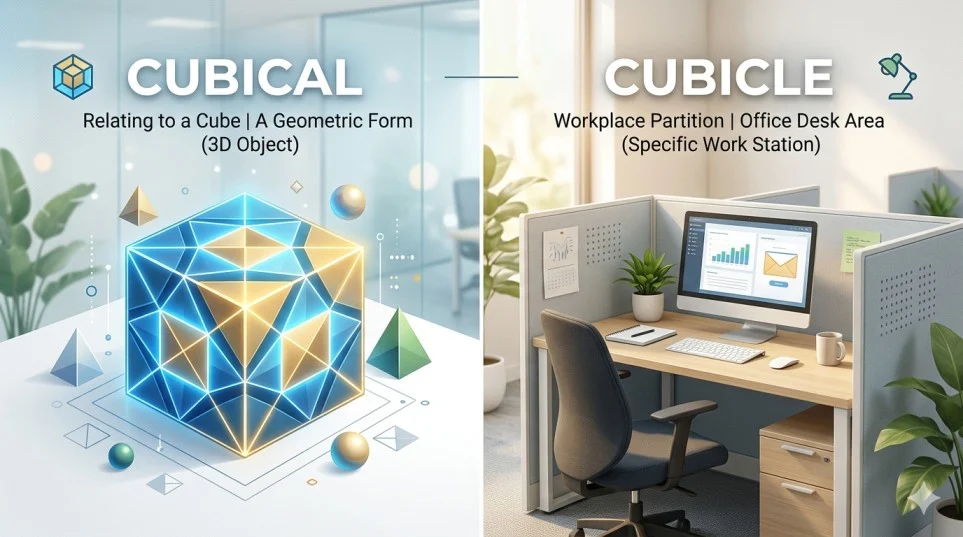
Cubical and cubicle are often confused but have distinct meanings. A cubical is something that has the shape of a cube, typically in mathematics or geometry. A cubicle is a small partitioned workspace, often used in offices. Using one for the other can cause both grammatical and practical mistakes in communication.
The terms cubical vs cubicle are commonly misused, even by native English speakers. A cubical refers to a three-dimensional cube-like shape or volume, frequently in mathematics, design, or architecture. In contrast, a cubicle is a small enclosed space, such as an office workstation or booth.
Confusing these words can lead to misunderstandings in professional writing, academic contexts, and everyday conversations. For instance, calling your office cubicle a “cubical” could confuse colleagues or clients, while using “cubicle” in geometry could sound awkward or incorrect. Understanding the difference is essential for clear, precise communication.
Cubical vs Cubicle: What’s the Difference?
| Feature | Cubical | Cubicle |
|---|---|---|
| Part of Speech | Adjective or noun | Noun |
| Meaning | Having the shape of a cube | A small enclosed or partitioned space, often for work |
| Usage | Mathematics, architecture, 3D design | Office layouts, study booths, small private spaces |
| Examples | A cubical container, cubical volume | Office cubicle, study cubicle, bathroom cubicle |
Mini Recap: Cubical relates to shape or form, particularly cubes. Cubicle refers to a partitioned space for work, study, or privacy. They are not interchangeable.
Is Cubical vs Cubicle a Grammar, Vocabulary, or Usage Issue?
This confusion is primarily a vocabulary and usage issue, not grammar. Both words are valid, but their contexts are entirely different.
- Interchangeable? No. Using cubical to describe a workspace or cubicle to describe a cube shape is incorrect.
- Formal vs Informal: Cubicle is common in everyday and formal workplace contexts. Cubical is mostly formal, used in scientific, mathematical, or architectural writing.
- Academic vs Casual: Cubical appears in textbooks, research papers, and geometry lessons. Cubicle appears in office management manuals, interior design guides, or casual workplace discussions.
Understanding when to use each ensures clarity in communication, especially in technical or professional writing.
Practical Usage: Cubical
Workplace Example
An office designer may specify, “We need a cubical room for the equipment storage,” meaning the room has equal length, width, and height.
Academic Example
In a geometry textbook: “The formula for the volume of a cubical prism is side³.”
Technology Example
In 3D modeling software: “Create a cubical object with 5-meter sides for the virtual simulation.”
Usage Recap: Use cubical when describing shapes, volumes, or objects. Never use it to refer to office spaces or partitions.
Practical Usage: Cubicle
Workplace Example
“My workstation is located in a small cubicle near the window,” referring to a partitioned office space.
Academic Example
In a library or study hall: “Students often prefer a quiet cubicle to focus on assignments.”
Technology Example
In virtual office software: “Assign each remote team member to a digital cubicle for private collaboration.”
Usage Recap: Use cubicle when referring to enclosed, partitioned spaces for work, study, or privacy. Avoid using it in mathematical or geometric contexts.
When You Should NOT Use Cubical or Cubicle
Confusion often leads to awkward or incorrect sentences. Avoid these common misuses:
- Calling an office workspace a cubical
- Referring to a cube-shaped object as a cubicle
- Writing “cubical office” when describing a small partitioned office space
- Using “cubicle volume” in a geometry context
- Mixing cubical and cubicle in technical manuals or CAD software
- Saying “I am sitting in a cubical” at work
- Using cubicle to describe any geometric shape
- Writing “cubical partition” when you mean office partition
Common Mistakes and Decision Rules
| Correct Sentence | Incorrect Sentence | Explanation |
|---|---|---|
| The math problem involves a cubical container. | The math problem involves a cubicle container. | Cubical describes shape, not workspace. |
| She works in a small office cubicle. | She works in a small office cubical. | Cubicle refers to a workspace, not geometric form. |
| Architects designed a cubical pavilion. | Architects designed a cubicle pavilion. | Cubical refers to cube shape; cubicle is partitioned space. |
| The student reserved a library cubicle. | The student reserved a library cubical. | Cubicle is correct for enclosed study space. |
Decision Rule Box:
- If you mean a cube or cube-shaped object, use cubical
- If you mean a partitioned workspace or enclosed area, use cubicle
Cubical and Cubicle in Modern Technology and AI Tools
In software, AI, and modern technology, the distinction remains critical. For instance, in virtual reality environments, a cubical object may represent a 3D shape in a simulation, while a cubicle represents a workspace for user avatars. AI-driven office planning tools often generate layouts with multiple cubicles to optimize space, whereas CAD programs calculate cubical volumes for design precision. Confusing these can result in design errors or workflow inefficiencies.
Etymology and Expert Insight
- Cubical: From Latin cubicus, meaning cube-like.
- Cubicle: From Latin cubiculum, meaning a small room for sleeping or private space.
Expert Quote:
“Precision in language, especially in professional contexts, avoids unnecessary confusion. Cubical and cubicle are simple, yet critical, distinctions.” – Dr. Ellen Carter, Linguist and Editor
Case Study 1: A software company mislabeling virtual workspaces as “cubical stations” received repeated user complaints. Correcting it to “cubicle stations” improved clarity and reduced onboarding confusion.
Case Study 2: An architecture firm describing storage units as “cubicles” instead of “cubical” caused project delays. Correcting to “cubical units” clarified design instructions and saved 20 hours of rework.
Author Bio: Fayqa Shamim, senior SEO strategist and linguist, specializes in high-authority educational content on language and professional writing.
Error Prevention Checklist
- Always use cubical when referring to shapes, volumes, or 3D forms
- Always use cubicle when referring to enclosed workspaces or small private areas
- Never call a cube-shaped object a cubicle
- Never refer to office partitions as cubical
Related Grammar Confusions You Should Master
- Affect vs Effect
- Principle vs Principal
- Accept vs Except
- Complement vs Compliment
- Stationary vs Stationery
- Elicit vs Illicit
- Discreet vs Discrete
- Allusion vs Illusion
- Imply vs Infer
- Lay vs Lie
FAQs
1. What is the difference between cubical and cubicle in English?
Cubical refers to something shaped like a cube, while cubicle is a small enclosed space.
2. Can you use cubical for office spaces?
No. Cubical is reserved for geometric or shape-related contexts.
3. Are cubicle and cubical interchangeable in writing?
No, they serve completely different purposes and are not interchangeable.
4. How do I know when to use cubicle instead of cubical?
If you are referring to a workspace, private booth, or partition, use cubicle.
5. Is cubical commonly used in casual English?
Not often. It is more common in academic, scientific, or design contexts.
6. Can cubicle describe a digital workspace?
Yes. Digital platforms often use “cubicle” to denote private or partitioned virtual areas.
7. What is the plural form of cubical and cubicle?
Cubicals (for multiple cube-shaped objects) and cubicles (for multiple partitioned spaces).
8. How do you avoid misusing cubical vs cubicle?
Follow the Decision Rule: shape = cubical; partitioned space = cubicle.
9. Are there synonyms for cubicle in office English?
Yes, booth, partitioned workspace, workspace pod, or workstation.
10. Can cubical refer to architecture or building design?
Yes, typically to describe rooms or structures shaped like a cube.
Conclusion
Understanding cubical vs cubicle ensures precision in communication, whether in professional, academic, or technological contexts. Cubical is for shapes and volumes, cubicle is for partitioned spaces. Confusing them can cause grammatical errors, professional misunderstandings, and even practical mistakes. Using these terms correctly reflects both linguistic mastery and professional attention to detail.
Read More Related Articles:
- Fourty or Forty: Which Spelling Is Correct In 2026
- Truely or Truly: Correct Spelling, Meaning & Usage Explained In 2026
- Flavour or Flavor: Difference for Accurate Usage In 2026

Joshua Bell is a professional content writer at Synofind.com, known for delivering clear, accurate and engaging written content. He focuses on thorough research and thoughtful storytelling to ensure every piece is reliable and easy to understand. His work reflects a strong commitment to quality and credibility.