
Last Updated on April 1, 2026
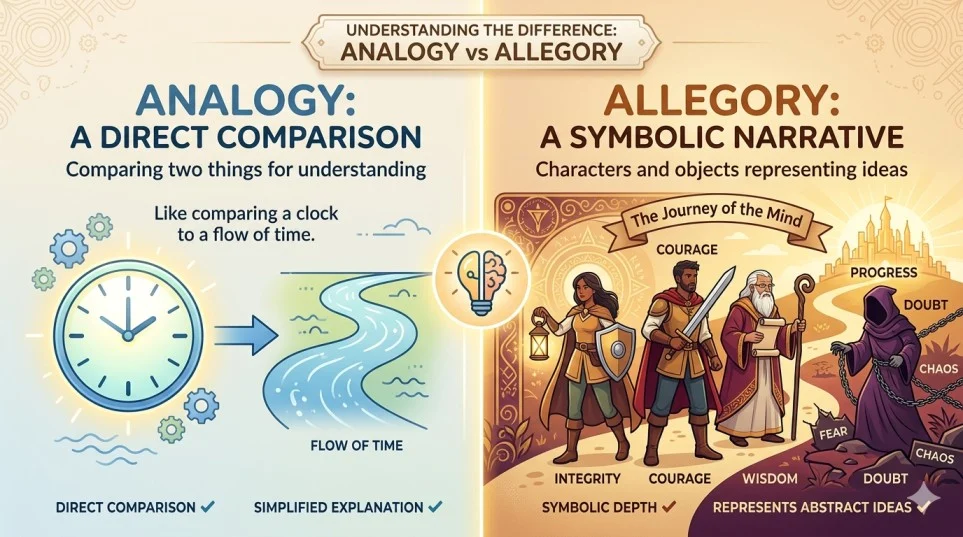
An analogy is a comparison between two things to explain or clarify a concept, while an allegory is a narrative in which characters, events, or symbols represent broader ideas or moral lessons. Confusing them can lead to misinterpretation in writing, teaching, and communication, making your arguments less clear and persuasive.
Many writers, students, and professionals struggle with the terms analogy vs allegory. Both involve comparison, but they serve very different purposes. An analogy is a tool to explain a concept by comparing it to something familiar. An allegory is a story or visual representation where every character, object, or event symbolizes a larger idea or moral. Misusing one for the other can distort meaning, create confusion, and even undermine credibility in academic or professional contexts. Understanding the difference is crucial for precise communication, effective teaching, and persuasive storytelling.
Analogy vs Allegory: What’s the Difference?
Definitions and Part of Speech
Analogy (noun): A comparison between two different things to highlight a similarity in structure, function, or relationship, often used to explain or clarify an idea.
Allegory (noun): A narrative, poem, or visual work in which characters, events, or symbols represent broader concepts, morals, or political ideas.
| Feature | Analogy | Allegory |
|---|---|---|
| Part of Speech | Noun | Noun |
| Purpose | Explain or clarify a concept | Convey a moral, political, or symbolic message |
| Format | Single sentence or comparison | Extended narrative, story, or artwork |
| Examples | “Life is like a box of chocolates” | George Orwell’s Animal Farm |
| Usage Context | Academic, workplace, explanatory writing | Literary, philosophical, cultural storytelling |
Mini Recap: Analogy simplifies understanding through comparison. Allegory communicates complex ideas through symbolic narratives. One explains, the other illustrates.
Is Analogy vs Allegory a Grammar, Vocabulary, or Usage Issue?
Many people wonder if this is just a vocabulary mix-up. The reality is more nuanced.
- Not interchangeable: Using “allegory” when you mean “analogy” can distort meaning.
- Formal vs informal usage: Analogies are widely accepted in both formal and casual contexts. Allegories are typically formal or literary.
- Academic vs casual usage: Analogy is common in textbooks, lectures, or presentations. Allegory appears in literature, philosophical essays, or political commentary.
Takeaway: Confusing them is a usage issue, not grammar. Correct usage ensures clarity, precision, and credibility.
Practical Usage of Analogy
Workplace Example
When presenting a new software workflow, you might say: “Think of this process like a factory assembly line, where each task passes smoothly to the next.” This analogy makes a complex workflow immediately understandable.
Academic Example
A biology teacher might explain DNA replication: “DNA is like a zipper; each side pairs perfectly with the other.” The analogy bridges abstract scientific concepts with familiar experiences.
Technology Example
Explaining cloud computing to non-technical staff: “Using cloud storage is like renting a locker in a secure facility rather than storing files in your home.”
Usage Recap: Analogy clarifies, simplifies, and bridges the gap between abstract ideas and everyday understanding.
Practical Usage of Allegory
Workplace Example
A company might use an allegorical story to teach ethics: “Imagine a kingdom where fairness is ignored; the downfall of the kingdom mirrors the consequences of unethical decisions in real business.”
Academic Example
In literature classes, Orwell’s Animal Farm illustrates political corruption and revolution. Students see the characters as symbolic representations of historical figures and concepts.
Technology Example
Tech illustrators or UX designers may create allegorical visuals, such as a metaphorical maze representing user navigation challenges.
Usage Recap: Allegory communicates deeper meanings through symbolism. It’s narrative-driven and often multi-layered.
When You Should NOT Use Analogy or Allegory
- When literal facts are required, not comparisons
- When precise definitions are needed in technical documentation
- When brevity is critical and an extended metaphor distracts
- When the audience lacks cultural context for the symbolism
- When humor or sarcasm could be misinterpreted
- When misrepresenting scientific or statistical data
- When clarity is prioritized over interpretive depth
- When using legal, contractual, or regulatory language
Common Mistakes and Decision Rules
| Correct Sentence | Incorrect Sentence | Explanation |
|---|---|---|
| “Explaining a concept, life is like a tree with branches.” | “Explaining a concept, life is an allegory with branches.” | Analogy is correct; allegory implies symbolic narrative, not direct comparison. |
| “Animal Farm illustrates the dangers of totalitarianism.” | “Animal Farm is an analogy of totalitarianism.” | Allegory is correct; it’s a symbolic story, not a direct comparison. |
| “Cloud computing is like renting a locker.” | “Cloud computing is an allegory of renting a locker.” | Analogy clarifies; allegory would require an extended narrative or story. |
Decision Rule Box:
- If you mean comparison to explain, use analogy
- If you mean symbolic story or representation, use allegory
Analogy and Allegory in Modern Technology and AI Tools
AI writing assistants and educational platforms often generate analogies to clarify technical concepts, while allegories appear in gamified learning or virtual storytelling. For instance, AI can produce an analogy comparing network security to a castle defense, whereas an allegorical AI-generated story might depict a kingdom under siege to teach cybersecurity principles. Both tools enhance understanding, but the choice depends on the desired outcome: clarity or narrative depth.
Authority and Trust
Etymology
- Analogy derives from Greek analogia, meaning proportion or correspondence
- Allegory comes from Greek allegoria, meaning to speak otherwise or convey a hidden meaning
Expert Quotation
Dr. Lisa Thompson, linguistics scholar, states: “Analogies bridge comprehension gaps instantly, whereas allegories invite reflection and interpretation over time.”
Case Studies
- Corporate Training: A Fortune 500 company increased comprehension of compliance rules by 35% using analogy-based explanations instead of dense policy documents.
- Literary Education: High school students improved moral reasoning scores by 27% after analyzing allegorical texts like Lord of the Flies and identifying symbolic themes.
Author Bio: Fayqa Shamim, senior linguist and SEO strategist, specializes in language clarity, educational content, and precision writing.
Error Prevention Checklist
- Always use analogy when explaining or simplifying concepts
- Never use allegory for single-sentence comparisons
- Avoid analogies in highly technical instructions if precision is paramount
- Avoid allegories in casual text unless the audience understands symbolic meaning
- Check context: workplace vs literary vs technological applications
Related Grammar Confusions You Should Master
- Simile vs Metaphor
- Hyperbole vs Exaggeration
- Idiom vs Cliché
- Symbol vs Icon
- Literal vs Figurative Language
- Parable vs Fable
- Trope vs Motif
- Metonymy vs Synecdoche
- Irony vs Sarcasm
- Analogy vs Comparison
FAQs
1. What is the difference between analogy and allegory in literature?
Analogy compares concepts for understanding, while allegory is a story where characters and events symbolize broader ideas.
2. Can an analogy be an allegory?
Not usually. An analogy is brief and explanatory; an allegory is extended and symbolic.
3. Are analogies more common in academic writing than allegories?
Yes. Analogies clarify abstract concepts, whereas allegories are mainly literary or philosophical.
4. Is allegory considered formal language?
Typically, yes. Allegory is formal or literary and often appears in educational or cultural contexts.
5. Can allegories be used in business communication?
Yes, in storytelling to illustrate ethics, strategy, or organizational behavior.
6. How do AI tools generate analogies?
They identify relationships between concepts and produce comparisons to simplify complex topics.
7. How is allegory used in modern technology?
In gamification, virtual storytelling, or educational simulations, allegories illustrate principles symbolically.
8. What’s a simple test to decide between analogy and allegory?
If your goal is explanation, use analogy. If your goal is symbolism, use allegory.
9. Can an analogy be visual instead of textual?
Yes, diagrams, charts, or infographics can serve as visual analogies.
10. Are allegories always fictional?
Mostly, though real events can be presented allegorically to emphasize moral or symbolic meaning.
Conclusion
Mastering analogy vs allegory is essential for precise communication, whether in academic writing, corporate presentations, or creative storytelling. Analogies clarify and educate, while allegories symbolize and provoke reflection. Avoiding common pitfalls, knowing practical examples, and applying decision rules ensures clarity, credibility, and persuasive power in any context.
Read More Related Articles:
- Pronounciation or Pronunciation: Which Spelling Is Correct In 2026
- Since vs Sense: Mastering the Difference and Correct Usage In 2026
- Afterward vs Afterwards: Complete Guide In 2026

Owen Price is a skilled content writer at Synofind.com, known for crafting clear, engaging and reader-focused content. He brings a thoughtful approach to research and storytelling, ensuring every piece is accurate, concise and easy to understand.