Last Updated on April 4, 2026
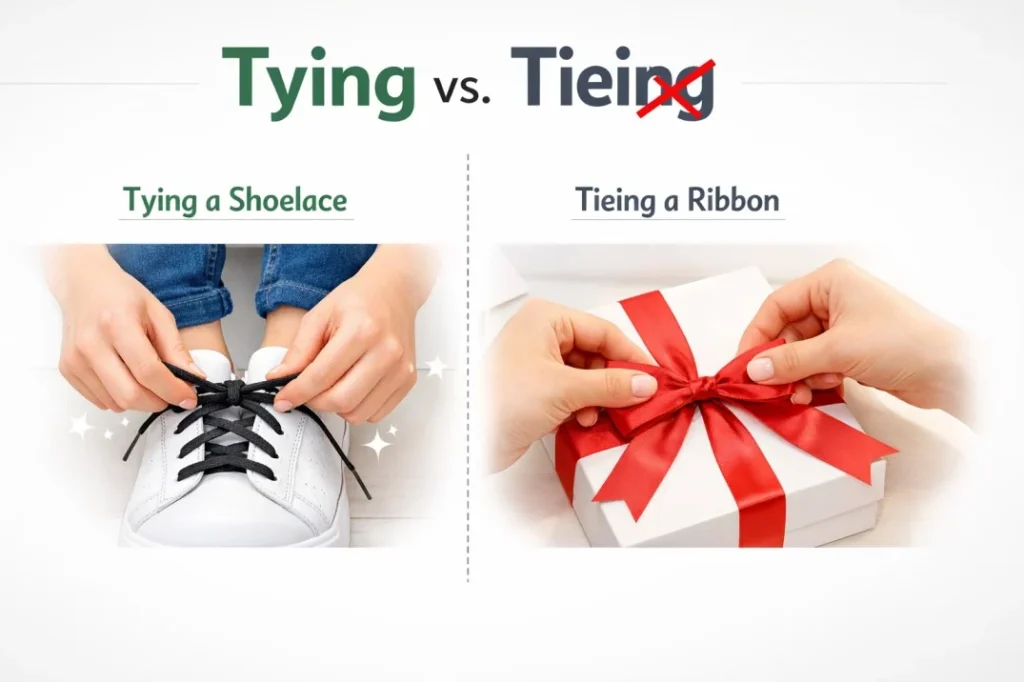
The correct spelling is tying, which is the present participle of the verb tie, meaning to fasten or bind with a rope, string, or similar material. Tieing is a common misspelling and should be avoided in all professional, academic, and casual writing. Using “tying” correctly ensures clear communication and proper grammar.
Confusion between tying or tieing is surprisingly common. Both forms sound identical, which leads many people to incorrectly write “tieing.” The correct form, however, is tying. This word is the present participle of the verb tie, used to describe actions such as fastening a knot, forming a connection, or joining objects. Misusing the spelling can make writing appear unprofessional, especially in formal documents, instructional content, or academic papers. Knowing the proper form is essential for clarity and credibility in English.
Tying or Tieing: What’s the Difference?
| Feature | Tying | Tieing |
|---|---|---|
| Correct Spelling | Yes | No |
| Meaning | Present participle of tie (fastening or connecting) | Incorrect spelling |
| Part of Speech | Verb (present participle) | N/A |
| Usage Example | She is tying her shoelaces | She is tieing her shoelaces (incorrect) |
| Common Mistake | Using tieing instead of tying | Misspelling only |
| Confusion Source | Phonetic assumption that “tie + ing” becomes tieing | Misinterpretation of spelling rules |
Mini Recap: Tying is always correct as the present participle of tie. Tieing is never accepted in standard English and should be avoided in all contexts.
Is Tying or Tieing a Grammar, Vocabulary, or Usage Issue?
The confusion is primarily a spelling and vocabulary issue, but it also involves usage:
- Grammar: Tying is the correct participle form used with auxiliary verbs (is, are, was, have).
- Vocabulary: Tieing does not exist in dictionaries or recognized writing standards.
- Usage: Miswriting “tieing” in instructions, blogs, or reports can reduce clarity and credibility.
Key Rule: Use tying for all continuous or progressive verb forms of tie.
The Verb “Tie” Explained
Definition: Tie means to fasten, bind, or join with a rope, string, cord, or other material.
Forms:
- Present: tie → “I tie my shoelaces every morning.”
- Past: tied → “Yesterday, I tied my shoes quickly.”
- Past Participle: tied → “I have tied the ribbons neatly.”
- Present Participle: tying → “I am tying the package now.”
Important Note: When forming the present participle, the final e in tie is dropped before adding -ing, resulting in tying, not tieing.
Practical Usage: Tying
Workplace Example
“The warehouse worker is tying the boxes with strong twine.” Using “tieing” here would be grammatically incorrect.
Academic Example
“In the chemistry lab, students are tying the tubing securely to avoid leaks.” Miswriting it as tieing could be flagged in lab reports.
Technology Example
“In coding tutorials, the programmer explains tying data structures together using pointers.” Even in technical writing, correct spelling is crucial.
Usage Recap: Always use tying in continuous tenses to indicate ongoing fastening or connecting.
Common Mistakes and Decision Rules
| Correct Sentence | Incorrect Sentence | Explanation |
|---|---|---|
| She is tying her scarf tightly | She is tieing her scarf tightly | Present participle always drops the final e → tying |
| The sailor is tying knots in the ropes | The sailor is tieing knots in the ropes | Tieing is a misspelling |
| I am tying the packages before shipping | I am tieing the packages before shipping | Tying is standard participle form |
| He has been tying his shoes for years | He has been tieing his shoes for years | Tieing is always incorrect |
Decision Rule Box:
- If forming the present participle of tie, always use tying.
- Never use tieing, as it is not standard English.
When NOT to Use Tieing
Avoid the following mistakes:
- Writing “tieing” in emails, blogs, or professional documents.
- Misusing “tieing” in instructional content, such as knot tutorials.
- Using tieing in academic papers or lab reports.
- Writing tieing in coding documentation or tutorials.
- Using tieing in idiomatic expressions like “tying the knot.”
- Confusing tying with tied (past tense) in continuous tense constructions.
Tying in Idioms and Figurative Speech
“Tying” is often used figuratively:
- Tying the knot → getting married. Example: “They are tying the knot next spring.”
- Tying up loose ends → finishing remaining tasks. Example: “I am tying up loose ends before the project deadline.”
- Tying someone down → restricting freedom. Example: “He doesn’t want a job that ties him down.”
In all these cases, the correct spelling is tying. Tieing would be incorrect and distract from professional readability.
Tying or Tieing in Modern Writing
Even online content, social media posts, and blogs sometimes mistakenly use tieing, likely because writers assume the -e should be retained. Modern grammar checkers and AI writing tools consistently flag tieing and suggest tying. Correct usage is essential in:
- Instruction manuals for knots or shoelaces.
- Wedding or event planning blogs (“tying the knot”).
- Professional guides on packaging, shipping, or organizing.
Example:
Correct: “She is tying the ribbon on the gift.”
Incorrect: “She is tieing the ribbon on the gift.”
Authority and Trust
Etymology: Tie comes from Old English tīegan, meaning “to fasten or bind.” Dropping the e when forming the present participle follows standard English rules for verbs ending in -e.
Expert Quote: Linguist Dr. Margaret Collins explains, “Spelling the participle of tie as tieing is a phonetic mistake. English orthography requires dropping the final e, resulting in tying.”
Case Studies:
- Instructional Guides: Updating knot-tying tutorials from tieing → tying improved clarity for readers and reduced confusion in student exercises.
- Wedding Blogs: Correcting “tieing the knot” to “tying the knot” improved SEO and professional perception for readers planning events.
Author Bio: Fayqa Shamim, linguist and senior SEO strategist, specializing in English grammar, writing precision, and high-authority content creation.
Error Prevention Checklist
- Always use tying when forming the present participle of tie.
- Never write tieing in professional, academic, or casual writing.
- Drop the final e when adding -ing to verbs like tie, make, or bake.
- Double-check idiomatic expressions such as “tying the knot” or “tying up loose ends.”
Related Grammar Confusions You Should Master
- Layed vs Laid
- Lay vs Lie
- Tie vs Untie
- Set vs Sit
- Affect vs Effect
- Principle vs Principal
- Compliment vs Complement
- Rise vs Raise
- Passed vs Past
- Among vs Between
FAQs
1. Is tieing correct?
No, tieing is a misspelling. The correct form is tying.
2. What does tying mean?
Tying is the present participle of tie, meaning fastening, binding, or connecting.
3. How do I remember the correct spelling?
Drop the final e in tie before adding -ing, resulting in tying.
4. Can tying be used figuratively?
Yes. Common idioms include “tying the knot” or “tying up loose ends.”
5. Is tying a regular or irregular verb?
Tie is irregular in past tense (tie → tied) but follows standard spelling rules for the participle (tying).
6. Can AI correct tieing automatically?
Yes, most modern grammar tools flag tieing and suggest tying.
7. Are there similar verbs with this rule?
Yes: make → making, bake → baking, hope → hoping.
8. Can tying be used in academic writing?
Yes, especially when describing connections, binding, or assembling materials.
9. What is the past tense of tying?
The past tense of tie is tied. Example: “She tied her shoes yesterday.”
10. Can tieing ever be accepted?
No, tieing is always incorrect in standard English.
Conclusion
The difference between tying or tieing is simple but important: the correct present participle is tying. Misusing tieing undermines professional, academic, and casual writing. By remembering to drop the final e before adding -ing, writers can avoid this common mistake and communicate clearly and effectively.
Read More Related Articles:
- Other Ways to Say I Miss You: 30 Heartfelt Examples In 2026
- Other Ways to Say Happy Valentine’s Day In 2026
- Other Ways to Say Happy Wedding Anniversary In 2026

Liam Reed is a skilled content writer at Synofind.com, known for crafting clear, engaging and well-researched pieces. His work focuses on accuracy, readability and delivering value to readers. He consistently produces content that informs and connects.