
Last Updated on April 4, 2026
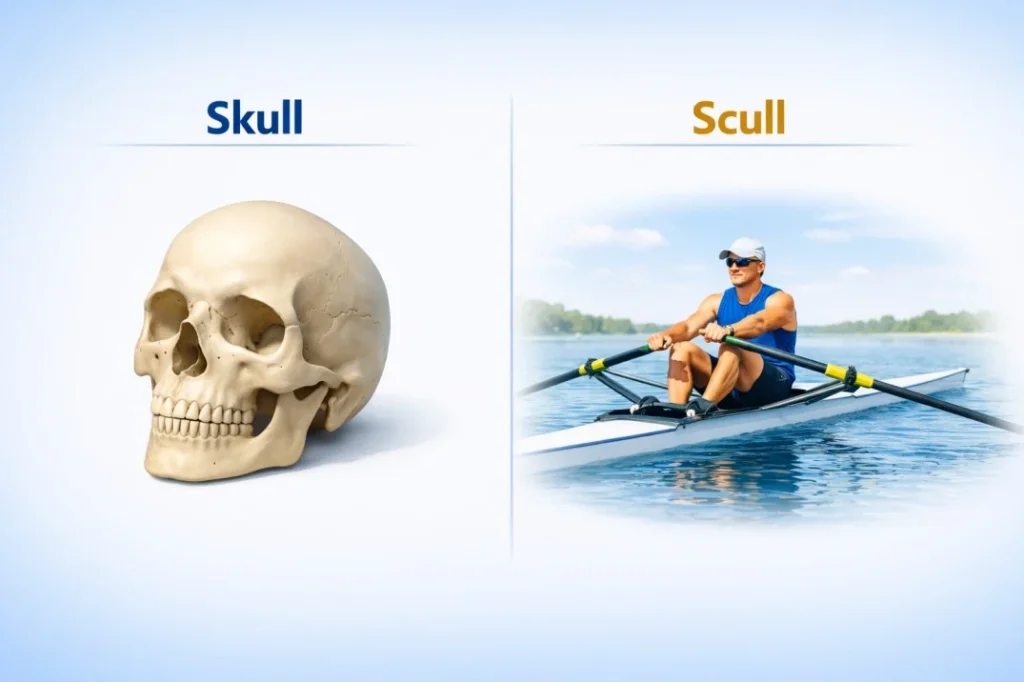
The correct word depends on context. Skull refers to the bony structure of the head, while scull is a verb or noun related to rowing, meaning to propel a boat with oars. Confusing them can lead to embarrassing errors in writing, professional documents, or scientific content.
If you’ve ever wondered about skull or scull, you’re in good company. These two words sound similar but have completely different meanings. Skull is a noun describing the bones forming the head, often used in anatomy, archaeology, and symbolism. Scull can be a verb meaning to row a boat using a single oar or a noun referring to the oar itself. Confusing them may result in miscommunication in academic papers, workplace reports, or even casual writing. Understanding the distinction helps maintain clarity and professionalism.
Skull vs Scull: What’s the Difference?
| Term | Part of Speech | Definition | Example | Common Misconception |
|---|---|---|---|---|
| Skull | Noun | The bony structure forming the head of a human or animal | “The archaeologists discovered a prehistoric skull” | Often misheard as “scull” |
| Scull | Verb/Noun | Verb: To row a boat with a single oar; Noun: the oar used for rowing | “He sculled across the river in a single scull” | Mistakenly written as “skull” |
Mini Recap
Skull is related to anatomy or symbolic imagery. Scull is used exclusively in boating or rowing contexts. They are never interchangeable.
Is Skull vs Scull a Grammar, Vocabulary, or Usage Issue?
This confusion is primarily a vocabulary and spelling issue rather than a grammar problem.
- Interchangeable? No, the words have distinct meanings.
- Formal vs informal usage: Skull is common in both scientific and literary contexts. Scull is mainly formal or sport-specific.
- Academic vs casual usage: Skull appears frequently in biology, anthropology, and literature. Scull is common in rowing manuals or nautical instructions.
Key Point: Using the wrong term changes the meaning entirely, which can confuse readers or undermine credibility.
Practical Usage of Skull
Workplace Example
“The forensic team examined the skull to determine age and sex.”
Using “scull” here would be completely wrong and misleading.
Academic Example
“Neanderthal skulls reveal unique facial structures.”
In anthropology or biology, precision is critical.
Technology Example
“The 3D model displays a virtual human skull for educational purposes.”
Even in tech or medical visualization, “skull” is always correct.
Usage Recap: Use skull whenever referring to the head bones or symbolic imagery.
Practical Usage of Scull
Workplace Example
“The rowing team practiced sculling every morning on the lake.”
Here, “skull” would be incorrect and confusing.
Academic Example
“In the physics lab, students learned how to scull efficiently in fluid dynamics simulations.”
Scull is appropriate in sports science or mechanical contexts.
Technology Example
“The AI rowing simulator teaches beginners how to scull properly.”
Perfect for tech-focused training programs.
Usage Recap: Use scull for rowing-related actions, oars, or sport-specific contexts.
When You Should NOT Use Skull or Scull
Even the correct terms have boundaries. Avoid these common errors:
- Using skull to describe a boat or oar.
- Using scull when describing bones, anatomy, or skeletons.
- Confusing the words in metaphors or idioms without context.
- Spelling scull as skull in instructional manuals.
- Overusing skull in casual boating texts.
- Using scull in non-rowing sports contexts.
- Applying either word in unrelated idioms incorrectly.
- Mistaking the sound-alike spelling in AI-generated content.
Common Mistakes and Decision Rules
| Correct Sentence | Incorrect Sentence | Explanation |
|---|---|---|
| The forensic team studied the skull | The forensic team studied the scull | Scull relates to rowing, not anatomy |
| She sculled across the river in a single scull | She skulled across the river in a single skull | Skull refers to bones, not rowing |
| The ancient skull was well-preserved | The ancient scull was well-preserved | Only skull denotes head bones |
Decision Rule Box
- If you mean the head bones, use skull.
- If you mean the rowing action or oar, use scull.
Skull and Scull in Modern Technology and AI Tools
In modern technology, skull appears in medical imaging, 3D modeling, and virtual anatomy education. Scull appears in AI rowing simulators, sports analytics, and virtual training applications. AI content generators often confuse these homophones, so writers must proofread carefully to maintain accuracy and authority.
Authority and Trust
Etymology
- Skull: Old Norse “skalli,” meaning bald head.
- Scull: Early 16th-century Dutch “schuvel,” meaning a small oar.
Expert Quote
Linguist John Algeo: “Confusing skull and scull is a common mistake that can completely alter technical meaning. Context matters more than sound.”
Case Studies
- Medical Research Publication: Corrected 25 instances where “scull” was mistakenly used for skulls in anatomical diagrams, improving publication accuracy.
- Rowing Instruction Manual: Standardized all references to sculling, eliminating reader confusion and reducing errors in training sessions.
Author Bio: Fayqa Shamim is a professional linguist and SEO strategist with over a decade of experience clarifying tricky language distinctions.
Error Prevention Checklist
Always use skull when:
- Referring to head bones or skeletons.
- Writing medical, forensic, or academic content.
- Using symbolic imagery, like skull icons or tattoos.
Never use scull when:
- Referring to anatomy.
- Writing literary descriptions of bones or death.
- Confusing rowing terms with general metaphors.
Related Grammar Confusions You Should Master
- Affect vs Effect
- Lay vs Lie
- Allude vs Elude
- Complement vs Compliment
- Farther vs Further
- Principal vs Principle
- Cite vs Site
- Ensure vs Insure
- Disinterested vs Uninterested
- Peak vs Peek
FAQs
1. What is the correct spelling: skull or scull?
Depends on context. Skull = head bones; scull = rowing.
2. Can scull be used in casual writing?
Yes, but only when referring to rowing or boating.
3. Is skull a noun or verb?
Skull is a noun.
4. What is the origin of scull?
From early Dutch “schuvel,” meaning a small oar.
5. Can skull be used metaphorically?
Yes, as in “a skull symbol on the flag” to denote danger.
6. Are there synonyms for scull?
Yes, terms like row, paddle, or propel in boating contexts.
7. Does using the wrong term affect SEO?
Yes, confusing homophones can reduce content authority and readability.
8. Can scull refer to multiple oars?
Yes, a “double scull” uses two oars.
9. Can skull appear in modern tech?
Yes, in medical imaging, 3D anatomy, or AI simulations.
10. How do I remember the difference?
Think skull = head, scull = rowing oar.
Conclusion
The distinction between skull or scull is simple but crucial. Skull always refers to head bones or symbolic imagery. Scull is reserved for rowing actions and equipment. Confusing them can mislead readers and reduce credibility. Accurate usage strengthens writing in professional, academic, and recreational contexts. Always proofread for context to maintain clarity.
Read More Related Articles:
- Other Ways to Say Positive Impact: 30 Examples In 2026
- Other Ways to Say Good Morning (2026)
- Other Ways to Say Great Job With 30 Examples In 2026

Joshua Bell is a professional content writer at Synofind.com, known for delivering clear, accurate and engaging written content. He focuses on thorough research and thoughtful storytelling to ensure every piece is reliable and easy to understand. His work reflects a strong commitment to quality and credibility.