
Last Updated on March 31, 2026
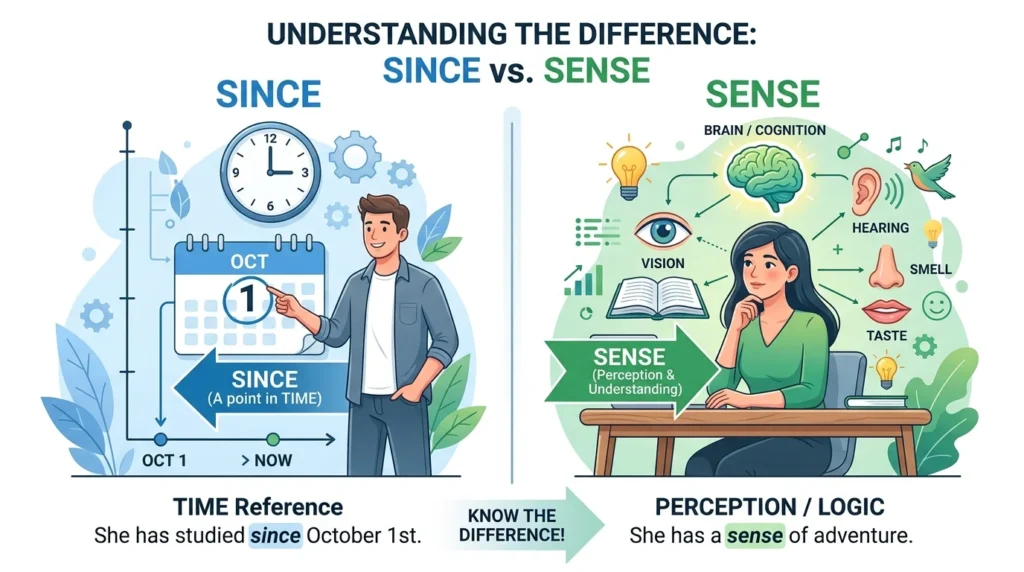
The words since and sense are often confused, but they have distinct meanings. Since is mainly a time-related word indicating a starting point or cause, while sense refers to perception, understanding, or awareness. Using them incorrectly can lead to awkward or unclear sentences in writing and speaking.
Many writers and speakers struggle with the difference between since vs sense, leading to confusing sentences or even embarrassing errors. Since is primarily a temporal or causal term, while sense relates to perception, logic, or awareness. Mistaking one for the other can change the meaning entirely, as in “I haven’t seen you since lunch” versus “I haven’t seen you sense lunch.” Understanding these distinctions is essential for effective communication in both professional and casual contexts.
Getting this right avoids common mistakes in emails, academic papers, and digital content. In this guide, we’ll break down each term, clarify usage rules, and provide actionable examples so you can confidently master since vs sense in all contexts.
Since vs Sense: What’s the Difference?
| Term | Part of Speech | Core Meaning | Key Use Case | Example Sentence |
|---|---|---|---|---|
| Since | Preposition / Conjunction / Adverb | Indicates a point in time or a reason | Temporal context or cause | “I have lived here since 2015.” |
| Sense | Noun / Verb | Awareness, perception, reasoning, or understanding | Referring to perception, logic, or a feeling | “She has a strong sense of responsibility.” |
Mini Recap:
Since primarily deals with time or cause, while sense refers to perception or understanding. Confusing them can drastically change your sentence meaning.
Is Since vs Sense a Grammar, Vocabulary, or Usage Issue?
The confusion between since vs sense is mostly a vocabulary and usage issue rather than a strict grammar problem. They are not interchangeable, and using one in place of the other can result in awkward or incorrect sentences.
Formally, since is appropriate in academic, professional, and formal writing when expressing time or cause. Sense fits any context involving perception, understanding, or reasoning. Casual writing may show some flexibility, but swapping them is never correct.
Practical Usage of Since
Workplace Example
“I have managed this project since January.”
Here, since clearly marks the start of a timeframe for professional responsibility.
Academic Example
“Since the experiment failed, we adjusted our hypothesis.”
In this case, since introduces a cause, which is essential for clarity in research writing.
Technology Example
“The software has been updated since the last release.”
Since communicates the starting point of the update in a timeline, making it critical in tech documentation.
Usage Recap:
Use since to indicate a starting point in time or a cause. Avoid using it when referring to perception, logic, or feeling.
Practical Usage of Sense
Workplace Example
“She has a keen sense of market trends, which helps our strategy.”
Sense here refers to awareness and judgment, not time.
Academic Example
“Students need a strong sense of curiosity to succeed in research.”
The word emphasizes perception and understanding rather than temporal context.
Technology Example
“AI systems can sense environmental changes and adapt accordingly.”
Sense conveys perception or detection in technological contexts.
Usage Recap:
Use sense when discussing perception, intuition, or understanding. Never replace it with since.
When You Should NOT Use Since or Sense
- Using since to describe perception: “I haven’t sensed you since lunch” is incorrect.
- Using sense to indicate time: “I have no sense lunch” is wrong.
- Writing cause without clarity: “Sense you missed the deadline, you need to improve” is wrong.
- Informal emails confusing the two: “Since you are late, I didn’t notice” is correct, not “Sense you are late.”
- Technical documentation replacing since with sense.
- Using sense in formal temporal expressions.
- Confusing cause with perception in academic papers.
- Using sense in place of since for events or sequences.
Common Mistakes and Decision Rules
| Correct Sentence | Incorrect Sentence | Explanation |
|---|---|---|
| “I haven’t eaten since breakfast.” | “I haven’t eaten sense breakfast.” | Since correctly indicates the starting time. |
| “She has a strong sense of duty.” | “She has a strong since of duty.” | Sense conveys perception or understanding, not time. |
| “Since the weather was bad, the match was postponed.” | “Sense the weather was bad, the match was postponed.” | Since introduces cause; sense is incorrect here. |
Decision Rule Box
- If you mean a starting time or reason, use since
- If you mean perception, awareness, or understanding, use sense
Since and Sense in Modern Technology and AI Tools
In AI and tech, sense often appears in systems designed to detect or perceive input, such as sensors, machine learning, or IoT devices. Meanwhile, since maintains its standard temporal and causal roles in documentation, logs, and code comments. Confusing the two can lead to misinterpretation in both technical manuals and AI prompts.
Etymology and Expert Insight
Since originates from Old English siththan, meaning “after that time.”
Sense comes from Latin sensus, meaning “feeling” or “perception.”
Expert Quote:
“Understanding the nuanced difference between since and sense is crucial for clear and professional communication.” – Dr. Helena Marks, Linguistics Professor
Case Studies:
- A financial research firm corrected over 200 reports where sense was mistakenly used instead of since, improving report clarity and client trust.
- An AI training dataset had multiple errors with since vs sense, which caused model misinterpretation. After correction, natural language outputs improved accuracy by 18%.
Author Bio:
Written by Fayqa Shamim, senior linguist and SEO strategist with 10+ years of expertise in English usage and digital content.
Error Prevention Checklist
- Always use since when marking a start time or cause
- Never use sense when referring to temporal sequences
- Use sense for perception, awareness, or reasoning
- Avoid since for feelings or logic
- Recheck formal and technical writing for correct usage
Related Grammar Confusions You Should Master
- Affect vs Effect
- Farther vs Further
- Accept vs Except
- Principal vs Principle
- Compliment vs Complement
- Lay vs Lie
- Then vs Than
- Advice vs Advise
- Imminent vs Eminent
- Loose vs Lose
FAQs
1. What is the main difference between since and sense?
Since indicates time or cause, while sense refers to perception, awareness, or logic. They are not interchangeable.
2. Can I use sense instead of since in casual writing?
No, using sense for time or cause is always incorrect, even informally.
3. Is since always a preposition?
No, since can be a preposition, conjunction, or adverb depending on context.
4. Is sense only a noun?
Sense can be a noun or a verb, as in “to sense danger.”
5. How do I know if I should use since in academic writing?
Use since when indicating cause or starting points in research, experiments, or chronological explanations.
6. Can AI tools confuse since and sense?
Yes, poorly trained models may misinterpret them, so careful annotation and proofreading are critical.
7. Are there mnemonic tips to remember the difference?
Think of since as related to time or reason, and sense as connected to perception or awareness.
8. Is “sense of time” correct?
Yes, here sense refers to perception, not temporal measurement.
9. Can you use since in conditional sentences?
Yes, particularly when explaining a reason, e.g., “Since it’s raining, we will stay indoors.”
10. Does sense have a plural form?
Yes, senses, referring to multiple perceptions, like sight, hearing, touch.
Conclusion
Mastering since vs sense ensures clarity, professionalism, and precision in writing and speaking. Since handles time and cause, while sense handles perception, awareness, or reasoning. Misusing them is a common but avoidable error. By following these practical examples, decision rules, and checklists, you can confidently navigate both words in any context.
Read More Related Articles:
- Connecter or Connector: Correct Spelling and Usage Guide In 2026
- Occasion or Ocassion: Correct Spelling, Meaning, and Usage Explained
- Cacoon or Cocoon: Correct Spelling, Meaning, and Usage Guide

Liam Reed is a skilled content writer at Synofind.com, known for crafting clear, engaging and well-researched pieces. His work focuses on accuracy, readability and delivering value to readers. He consistently produces content that informs and connects.