
Last Updated on April 4, 2026
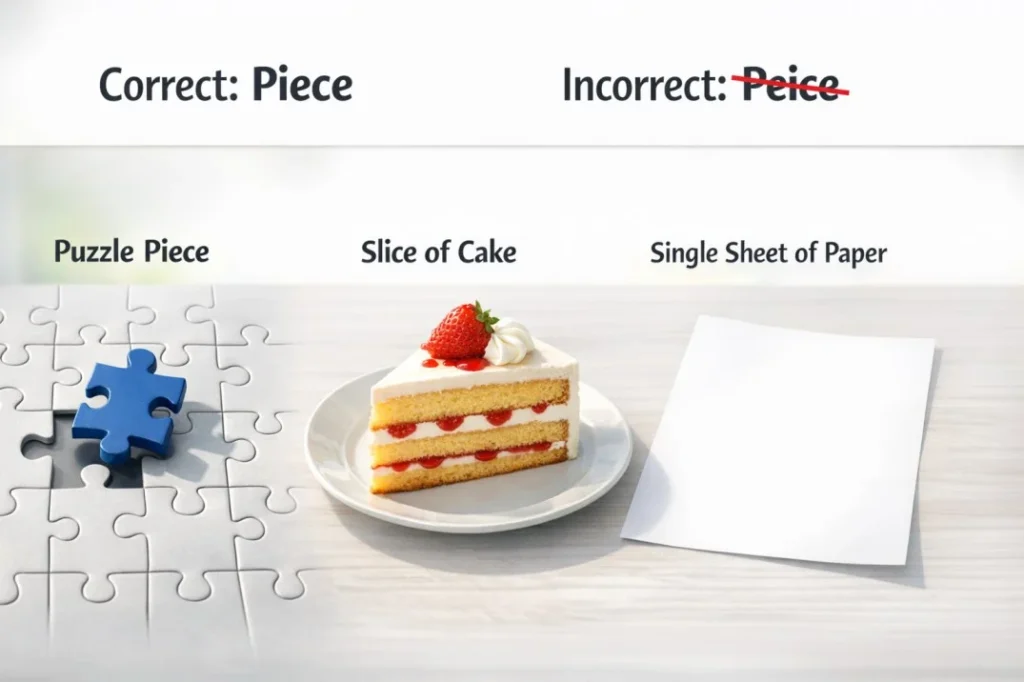
The correct spelling is piece, which refers to a portion, part, or item of something. Peice is a common misspelling influenced by pronunciation but is incorrect in all formal and informal writing. Knowing the correct usage ensures clarity, credibility, and professional communication.
Confusion between piece or peice is a frequent error in English, often caused by the pronunciation of the word. Piece is the standard term, referring to a part of something larger, a single item, or a portion of an object. Peice, however, is a misspelling that has no accepted usage. Misusing this word can lead to embarrassing errors in emails, academic writing, creative content, or professional documents. Understanding the correct spelling and meaning is crucial for anyone aiming to communicate clearly, avoid misunderstandings, and maintain authority in writing.
Piece vs Peice: What’s the Difference?
| Term | Part of Speech | Definition | Example | Common Misconception |
|---|---|---|---|---|
| Piece | Noun | A part or portion of a whole; a single item or object | “I would like a piece of cake” | Sometimes misspelled as “peice” |
| Peice | N/A | Incorrect spelling | None | Phonetically influenced error; not correct in writing |
Mini Recap
Always use piece when referring to a portion, fragment, or individual item. Peice is a persistent misspelling and should never appear in professional, academic, or casual writing.
Is Piece vs Peice a Grammar, Vocabulary, or Usage Issue?
This confusion is primarily a vocabulary and spelling issue, not grammar.
- Interchangeable? No. “Peice” is never correct.
- Formal vs informal usage: “Piece” is universally acceptable in formal, informal, and academic contexts.
- Academic vs casual usage: Spelling errors such as “peice” are unacceptable in research papers, essays, and official documentation.
Key Point: The challenge arises from pronunciation, but the standard spelling is always piece.
Practical Usage of Piece
Workplace Example
“Please send me a piece of the report for review.”
Using “peice” here would be incorrect and undermine professionalism.
Academic Example
“The archaeologists discovered a piece of ancient pottery.”
Precision is essential in academic writing; “peice” is never acceptable.
Technology Example
“The software provides a piece of the data set for testing purposes.”
Even in technical writing, “piece” communicates clearly and correctly.
Usage Recap: Always use piece when referring to a part, portion, or single item.
When You Should NOT Use Piece or Peice
Avoid these common errors:
- Using peice instead of piece in any context.
- Confusing piece with peace, which has a different meaning (calmness or harmony).
- Overusing piece when synonyms like “part,” “section,” or “fragment” may be clearer.
- Using peice in professional documents, emails, or publications.
- Misplacing piece in idiomatic expressions, changing meaning.
- Using peice in creative content, which reduces perceived credibility.
- Confusing “piece of advice” with “peace of advice” or other homophones.
- Using peice in automated content, social media posts, or AI-generated writing.
Common Mistakes and Decision Rules
| Correct Sentence | Incorrect Sentence | Explanation |
|---|---|---|
| She ate a piece of chocolate | She ate a peice of chocolate | “Peice” is misspelled |
| The artist painted a piece of the mural | The artist painted a peice of the mural | Only “piece” is correct |
| We need one piece of the puzzle | We need one peice of the puzzle | Avoid phonetic spelling; “peice” is never correct |
Decision Rule Box
- If you mean a part, portion, or individual item, use piece.
- Avoid peice, which is a misspelling in all contexts.
Piece in Modern Technology and AI Tools
In digital contexts, piece appears frequently in data processing, coding, and AI systems:
- Piece of data: AI systems often segment datasets into pieces for processing.
- Piece of content: Content management systems divide articles, media, or modules into pieces.
- Piece of code: Programmers refer to reusable snippets as pieces of code.
Using the correct spelling ensures clarity and maintains trust in technical documentation, online content, and professional writing. AI-generated content must be proofread to prevent “peice” from appearing, which could confuse readers.
Authority and Trust
Etymology
- Piece comes from Old French “piece,” meaning a fragment or part of something.
- Peice is a modern phonetic error with no historical or formal basis.
Expert Quote
Linguist John Algeo: “Homophones like piece and peice often trip writers. Remembering the correct spelling prevents professional errors and preserves credibility.”
Case Studies
- Academic Research Paper: Corrected multiple instances of “peice” to “piece,” improving readability and editorial approval.
- Business Presentation: Replacing “peice” with “piece” in slides enhanced clarity and professional impression.
Author Bio: Fayqa Shamim is a linguist and SEO strategist with over 10 years of experience clarifying homophones and spelling mistakes in professional writing.
Error Prevention Checklist
Always use piece when:
- Referring to a portion, fragment, or single item.
- Writing academic, professional, or technical content.
- Using idioms like “a piece of advice” or “a piece of cake.”
Never use peice when:
- Writing essays, reports, or formal documents.
- Using homophones that could change meaning.
- Typing social media, web content, or AI-generated content without proofreading.
Related Grammar Confusions You Should Master
- Piece vs Peace
- Brake vs Break
- Allude vs Elude
- Lay vs Lie
- Affect vs Effect
- Complement vs Compliment
- Principal vs Principle
- Cite vs Site
- Disinterested vs Uninterested
- Peak vs Peek
FAQs
1. What is the correct spelling: piece or peice?
The correct spelling is piece.
2. Can peice ever be correct?
No, it is always a misspelling.
3. What does piece mean?
It refers to a portion, part, fragment, or single item of something.
4. Can piece be used in idiomatic expressions?
Yes, such as “a piece of cake” or “a piece of advice.”
5. Is piece a noun or verb?
Piece is primarily a noun but can also appear in phrasal verbs like “piece together” (to assemble).
6. Are there synonyms for piece?
Yes, part, fragment, portion, segment, or slice.
7. How can I remember the difference?
Think: piece = part, peice = wrong spelling.
8. Can piece be used metaphorically?
Yes, such as “a piece of the puzzle” to mean a contributing factor.
9. Does misusing piece and peice affect SEO?
Yes, spelling errors can reduce credibility and search authority.
10. Is piece still used today?
Absolutely, in everyday writing, academic texts, technical documentation, and idiomatic speech.
Conclusion
The difference between piece or peice is straightforward but critical. Always use piece to refer to a portion, part, or item, whether in formal, technical, or casual writing. Avoid peice, which is an incorrect spelling. Mastering this word ensures clarity, professionalism, and trustworthiness in all written communication. Proofreading and attention to spelling preserve authority and reader confidence.
Read More Related Articles:
- Other Ways to Say Just to Clarify: 30 Examples In 2026
- Other Ways to Say Talk to You Soon: 30 Examples In 2026
- Other Ways to Say I Appreciate Your Help In 2026

Owen Price is a skilled content writer at Synofind.com, known for crafting clear, engaging and reader-focused content. He brings a thoughtful approach to research and storytelling, ensuring every piece is accurate, concise and easy to understand.