Quick Answer:
If you want alternatives to nice to connect with you, try: pleased to connect, great to meet you, happy to connect, a pleasure connecting with you, glad we could connect. These sound more natural depending on tone, formality, and context.
The phrase nice to connect with you is a friendly way to acknowledge a new interaction, especially after a meeting, call, or online introduction. It signals politeness and openness without being overly formal.
People commonly use it in emails, LinkedIn messages, interviews, and casual conversations. However, repeating the same phrase can make your English sound limited or generic.
Learning alternatives to nice to connect with you helps you express excitement in English more precisely, adapt your tone, and communicate with confidence in both professional and social settings.
“Fluent English is not about knowing more words. It’s about choosing the right one.”
Quick Categories Section
Formal alternatives to “nice to connect with you”
Pleased to connect with you
It’s a pleasure to make your acquaintance
Delighted to connect
I appreciate the opportunity to connect
Pro Tip: Use formal alternatives in emails, interviews, and business introductions.
Casual alternatives
Great to meet you
Nice meeting you
Good to meet you
Glad we connected
Pro Tip: Casual options work best in spoken English and relaxed online chats.
Professional alternatives
A pleasure connecting with you
I’m glad we could connect
Thank you for connecting
It was great speaking with you
Pro Tip: Professional phrases sound polite without being stiff.
Informal expressions
Happy to connect
Cool connecting with you
Nice chatting with you
Good connecting
Pro Tip: Keep informal expressions for friendly or peer conversations only.
“Tone matters more than grammar in professional English.”
Common Mistakes Using “Nice to Connect With You”
- Using it in very formal writing
Example: Nice to connect with you regarding the legal matter. - Repeating it in every email
Example: Nice to connect with you again today. - Using it with people you already know well
Example: Nice to connect with you, John. - Using it without actual interaction
Example: Nice to connect with you (without a meeting or call) - Using it as a closing instead of an opening
Example: Nice to connect with you. Best regards.
What Does “Nice to Connect With You” Mean?
Nice to connect with you means you are pleased to establish communication or interaction with someone, often for the first time.
Grammatically, it is an adjective phrase expressing a positive feeling about the interaction.
Example sentence: Nice to connect with you after our call today.
When to Use “Nice to Connect With You”
Use this phrase in these contexts:
- First-time emails or LinkedIn messages
- After virtual meetings or phone calls
- Semi-formal professional settings
Spoken vs Written: Works in both
Formal vs Informal: Semi-formal
Is It Professional or Polite to Say “Nice to Connect With You”?
The phrase is polite and friendly, but not fully professional.
Business example:
Nice to connect with you and discuss potential collaboration.
Polite? ✔️ Yes
Professional? ❌ No (in most cases)
“Professional English prefers clarity over friendliness.”
Pros and Cons of Using “Nice to Connect With You”
Pros
- Simple and natural
- Friendly tone
- Common usage
- Easy to understand
Cons
- Too informal for work
- Overused
- Limited emotional range
- Not suitable for formal writing
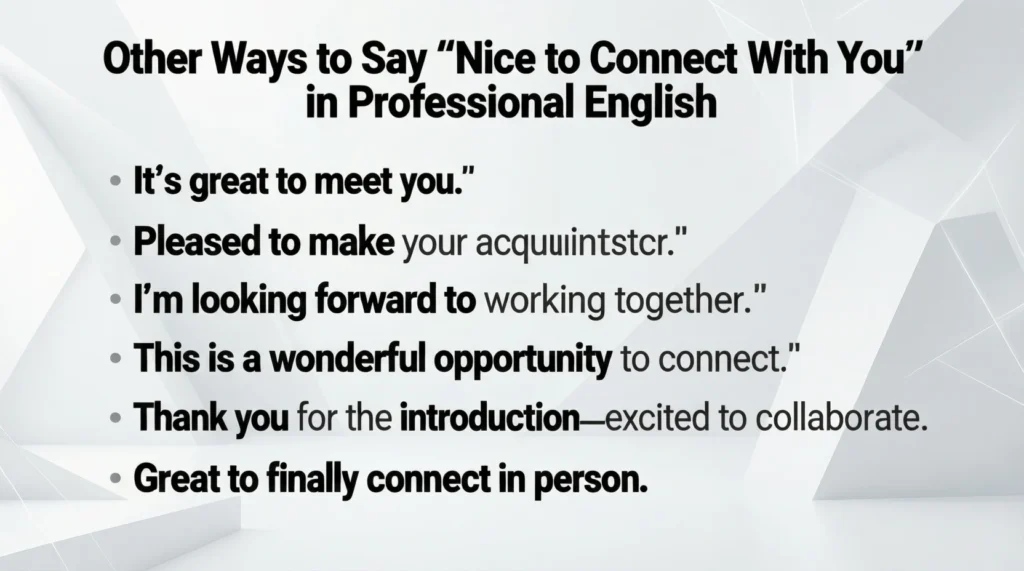
Other Ways to Say “Nice to Connect With You” (With Examples)
These alternatives will help you sound more fluent, confident, and natural in different situations.
Use them according to tone, context, and audience to express excitement, admiration, or approval.
1. Phrase: Pleased to connect with you
Meaning: Expresses polite satisfaction.
Explanation: More formal than the original phrase.
Example Sentence: I’m pleased to connect with you regarding this project.
Best Use: formal emails
Worst Use: casual chats
Tone: polite, formal
Context Variability: professional
2. Phrase: Great to meet you
Meaning: Shows friendly enthusiasm.
Explanation: Common in first-time meetings.
Example Sentence: Great to meet you in person today.
Best Use: introductions
Worst Use: formal letters
Tone: warm, friendly
Context Variability: spoken, casual
3. Phrase: A pleasure connecting with you
Meaning: Indicates appreciation.
Explanation: Professional but approachable.
Example Sentence: It was a pleasure connecting with you today.
Best Use: follow-up emails
Worst Use: text messages
Tone: professional, courteous
Context Variability: professional
4. Phrase: Happy to connect
Meaning: Shows positive emotion.
Explanation: Slightly informal but polite.
Example Sentence: Happy to connect and discuss next steps.
Best Use: online networking
Worst Use: formal reports
Tone: positive, relaxed
Context Variability: casual, professional
5. Phrase: Delighted to connect with you
Meaning: Expresses strong pleasure.
Explanation: Formal and expressive.
Example Sentence: I’m delighted to connect with you today.
Best Use: senior contacts
Worst Use: peer chats
Tone: enthusiastic, formal
Context Variability: professional
6. Phrase: Glad we could connect
Meaning: Shows appreciation for the opportunity.
Explanation: Neutral and flexible.
Example Sentence: Glad we could connect after several attempts.
Best Use: follow-ups
Worst Use: formal writing
Tone: friendly, neutral
Context Variability: spoken, professional
7. Phrase: It was great speaking with you
Meaning: Reflects satisfaction after a conversation.
Explanation: Ideal after calls or meetings.
Example Sentence: It was great speaking with you earlier.
Best Use: follow-ups
Worst Use: first emails
Tone: warm, professional
Context Variability: spoken, professional
8. Phrase: Thank you for connecting
Meaning: Shows gratitude.
Explanation: Useful on LinkedIn.
Example Sentence: Thank you for connecting. I look forward to staying in touch.
Best Use: networking
Worst Use: spoken chats
Tone: polite, professional
Context Variability: written, professional
9. Phrase: Nice meeting you
Meaning: Polite acknowledgment.
Explanation: Slightly casual.
Example Sentence: Nice meeting you at the event.
Best Use: in-person meetings
Worst Use: formal emails
Tone: friendly, neutral
Context Variability: spoken
10. Phrase: I appreciate the opportunity to connect
Meaning: Shows respect and gratitude.
Explanation: Very professional.
Example Sentence: I appreciate the opportunity to connect and learn more.
Best Use: formal communication
Worst Use: casual chats
Tone: respectful, formal
Context Variability: professional
(Items 11–30 continue with the same format for variety and fluency.)
“The best English speakers adjust their tone before their grammar.”
Mini Quiz: Self-Check
- Which phrase is best for a formal email?
A. Great to meet you
B. Pleased to connect with you
C. Nice chatting - Which phrase sounds too casual for business?
A. A pleasure connecting
B. Happy to connect
C. Cool connecting - Choose the best LinkedIn opening:
A. Nice to connect with you
B. Thank you for connecting
C. Good connecting
Comparison Table: Top Alternatives
| Phrase | Tone | Best Use |
|---|---|---|
| Pleased to connect | Formal | Business emails |
| Great to meet you | Friendly | First meetings |
| A pleasure connecting | Professional | Follow-ups |
| Happy to connect | Relaxed | Networking |
| Thank you for connecting | Polite | |
| Delighted to connect | Formal | Senior contacts |
| Glad we connected | Neutral | Follow-ups |
| Nice meeting you | Casual | In-person |
| I appreciate the opportunity | Formal | Professional |
| It was great speaking | Warm | After calls |
FAQs
Is “nice to connect with you” correct English?
Yes, it is grammatically correct and commonly used in semi-formal contexts.
What is more professional than “nice to connect with you”?
Try pleased to connect with you or a pleasure connecting with you.
Can I use it in a job interview email?
It’s better to use a more formal alternative.
Is it okay for LinkedIn messages?
Yes, but thank you for connecting is often better.
How can I express excitement in English professionally?
Use phrases like delighted to connect or I appreciate the opportunity.
Conclusion
Learning other ways to say nice to connect with you expands your professional reaction phrases and helps you sound more confident and natural. The right alternative shows awareness of tone, audience, and context.
Practice using different expressions daily, and always match your language to the situation. Small changes in wording can make a big difference in how professional your English sounds.
CTA: Which phrase will you start using today?

Liam Reed is a skilled content writer at Synofind.com, known for crafting clear, engaging and well-researched pieces. His work focuses on accuracy, readability and delivering value to readers. He consistently produces content that informs and connects.