Quick Answer
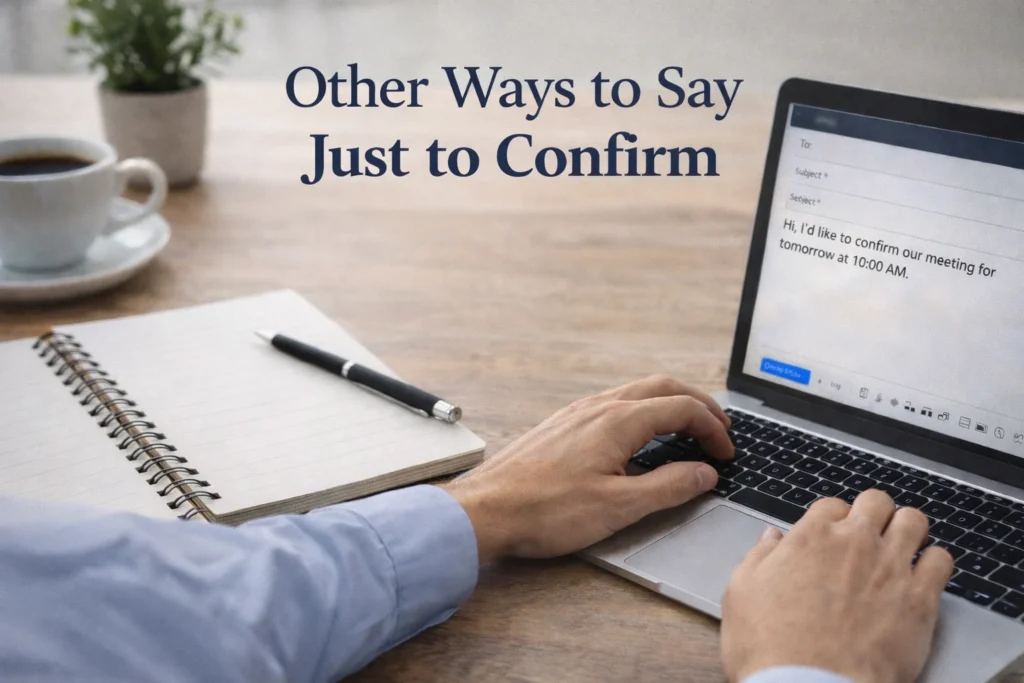
If you’re looking for other ways to say just to confirm, try: To confirm, Just to clarify, Can you verify, I’d like to confirm, For confirmation.
These alternatives help you sound more professional, natural, and context-aware in both spoken and written English.
The phrase “just to confirm” is commonly used when you want to double-check information. It helps ensure accuracy and avoid misunderstandings.
People use it in emails, meetings, phone calls, and casual conversations. However, it can sometimes sound repetitive or slightly informal in professional communication.
Learning strong alternatives to “just to confirm” improves fluency and helps you choose the right tone. It also builds confidence when using professional reaction phrases or trying to express excitement in English more precisely.
“The right confirmation phrase can make your English sound polished and confident.”
Quick Categories
Formal Alternatives to “Just to Confirm”
- To confirm
- I would like to confirm
- Kindly confirm
- For confirmation
Pro Tip: In formal writing, remove “just” to sound more confident and direct.
Casual Alternatives
- Just checking
- Checking in
- Quick check
- Can you double-check
Pro Tip: Casual options work well in spoken English or friendly workplace chats.
Professional Alternatives
- Could you please confirm
- Please verify
- I’d like to verify
- For clarification
Pro Tip: In business emails, choose structured and polite wording.
Informal Expressions
- Just making sure
- Is that right?
- Am I correct?
- Just to be sure
Pro Tip: Informal expressions in English are best for conversations, not formal emails.
“Small wording changes create big differences in professionalism.”
Common Mistakes When Using “Just to Confirm”
- Overusing it in every email
Example: Just to confirm, just to confirm the meeting time… - Using it in very formal documents
Example: Just to confirm, the contract states… - Adding unnecessary apology words
Example: Sorry, just to confirm again… - Using it aggressively
Example: Just to confirm, you didn’t send it. - Using it when no confirmation is needed
Example: Just to confirm, hello.
“Avoid overusing one phrase. Variety builds fluency.”
What Does “Just to Confirm” Mean?
“Just to confirm” means you want to verify that information is correct.
Grammatically, it’s an introductory phrase used before asking a clarifying question.
Example:
Just to confirm, the meeting is at 3 PM.
When to Use “Just to Confirm”
- Before meetings
- In follow-up emails
- During project discussions
- When checking dates or details
- After receiving unclear information
Spoken: Very common
Written: Acceptable, but repetitive
Formal: Slightly informal
Informal: Very common
Is It Professional or Polite to Say “Just to Confirm”?
It is polite, but not always fully professional.
Business Example:
Just to confirm, will the report be ready tomorrow?
Polite? ✔️ Yes
Professional? ❌ No in highly formal communication
For professional settings, consider stronger professional reaction phrases.
Pros and Cons of Using “Just to Confirm”
Pros
- Simple and natural
- Friendly tone
- Common usage
- Easy to understand
Cons
- Too informal for work
- Overused
- Limited emotional range
- Not suitable for formal writing
Other Ways to Say “Just to Confirm” (With Examples)
These alternatives to just to confirm will help you sound more fluent, confident, and natural in different situations.
Use them according to tone, context, and audience.
1. Phrase: To confirm
Meaning: Used to verify information.
Explanation: More direct and professional.
Example Sentence: To confirm, the deadline is Friday.
Best Use: Business email
Worst Use: Casual chat
Tone: Direct, neutral
Context Variability: professional, written
2. Phrase: I would like to confirm
Meaning: Politely verify details.
Explanation: Formal and structured.
Example Sentence: I would like to confirm our appointment.
Best Use: Formal email
Worst Use: Text message
Tone: Polite, formal
Context Variability: professional
3. Phrase: Could you please confirm
Meaning: Asking someone to verify.
Explanation: Polite and widely accepted.
Example Sentence: Could you please confirm the schedule?
Best Use: Workplace
Worst Use: Personal chat
Tone: Respectful, professional
Context Variability: professional
4. Phrase: Kindly confirm
Meaning: Formal request for verification.
Explanation: Common in corporate writing.
Example Sentence: Kindly confirm receipt of this email.
Best Use: Corporate email
Worst Use: Friendly talk
Tone: Formal, structured
Context Variability: written
5. Phrase: For confirmation
Meaning: Used to clarify details.
Explanation: Slightly formal phrasing.
Example Sentence: I am writing for confirmation of the date.
Best Use: Documentation
Worst Use: Spoken talk
Tone: Neutral, formal
Context Variability: professional
6. Phrase: Just to clarify
Meaning: To remove confusion.
Explanation: Focuses on understanding.
Example Sentence: Just to clarify, are we meeting online?
Best Use: Discussions
Worst Use: Legal writing
Tone: Friendly, clear
Context Variability: spoken, professional
7. Phrase: I’d like to verify
Meaning: Confirm accuracy.
Explanation: Sounds analytical and professional.
Example Sentence: I’d like to verify the figures.
Best Use: Reports
Worst Use: Casual text
Tone: Formal, precise
Context Variability: professional
8. Phrase: Please verify
Meaning: Request confirmation.
Explanation: Short and direct.
Example Sentence: Please verify the attached details.
Best Use: Instructions
Worst Use: Friendly chat
Tone: Direct, professional
Context Variability: written
9. Phrase: Just checking
Meaning: Casual confirmation.
Explanation: Informal tone.
Example Sentence: Just checking, did you get my email?
Best Use: Colleagues
Worst Use: Clients
Tone: Casual, friendly
Context Variability: spoken
10. Phrase: Checking in
Meaning: Follow-up confirmation.
Explanation: Used after previous message.
Example Sentence: Checking in about the proposal.
Best Use: Follow-ups
Worst Use: Formal contract
Tone: Warm, casual
Context Variability: spoken, semi-professional
11. Phrase: Can you verify
Meaning: Asking someone to check if information is correct.
Explanation: Slightly direct but professional in tone.
Example Sentence: Can you verify the client’s contact details?
Best Use: Workplace emails
Worst Use: Formal contracts
Tone: Direct, professional
Context Variability: professional, spoken
12. Phrase: May I confirm
Meaning: Politely asking to verify something.
Explanation: More formal and respectful.
Example Sentence: May I confirm the time of our appointment?
Best Use: Client communication
Worst Use: Casual texting
Tone: Polite, formal
Context Variability: professional, spoken
13. Phrase: Am I correct
Meaning: Checking if your understanding is right.
Explanation: Often used in discussions or meetings.
Example Sentence: Am I correct that the deadline is Monday?
Best Use: Meetings
Worst Use: Legal documents
Tone: Neutral, conversational
Context Variability: spoken, semi-professional
14. Phrase: Just making sure
Meaning: Informally verifying details.
Explanation: Casual and friendly alternative.
Example Sentence: Just making sure, we’re meeting at 2 PM?
Best Use: Colleagues
Worst Use: Formal reports
Tone: Casual, friendly
Context Variability: spoken
15. Phrase: Could you verify
Meaning: Requesting someone to check accuracy.
Explanation: Professional and slightly more formal than “can you verify.”
Example Sentence: Could you verify the figures before submission?
Best Use: Reports
Worst Use: Friendly chat
Tone: Polite, professional
Context Variability: professional
16. Phrase: For clarification
Meaning: Used to request clearer understanding.
Explanation: Focuses on removing confusion.
Example Sentence: For clarification, will the session be recorded?
Best Use: Meetings
Worst Use: Casual talk
Tone: Neutral, professional
Context Variability: written, professional
17. Phrase: I want to confirm
Meaning: Stating your intention to verify information.
Explanation: Slightly direct and less formal.
Example Sentence: I want to confirm the shipping address.
Best Use: Internal emails
Worst Use: Client proposals
Tone: Direct, neutral
Context Variability: professional, spoken
18. Phrase: Confirming that
Meaning: Used to restate and verify details.
Explanation: Often appears in follow-up messages.
Example Sentence: Confirming that the event starts at 10 AM.
Best Use: Email follow-ups
Worst Use: Casual conversation
Tone: Neutral, structured
Context Variability: written
19. Phrase: Let me confirm
Meaning: Indicating you will verify information.
Explanation: Used before checking details yourself.
Example Sentence: Let me confirm the availability and get back to you.
Best Use: Phone calls
Worst Use: Formal documentation
Tone: Helpful, neutral
Context Variability: spoken, professional
20. Phrase: I need to confirm
Meaning: Expressing necessity to verify details.
Explanation: Slightly firm tone.
Example Sentence: I need to confirm the final numbers.
Best Use: Internal discussion
Worst Use: Polite client emails
Tone: Direct, firm
Context Variability: professional
21. Phrase: As a confirmation
Meaning: Used to formally reference confirmation.
Explanation: More common in written communication.
Example Sentence: As a confirmation, the meeting is scheduled for Friday.
Best Use: Documentation
Worst Use: Spoken English
Tone: Formal, structured
Context Variability: written
22. Phrase: Please confirm receipt
Meaning: Requesting acknowledgment of receiving something.
Explanation: Common in business emails.
Example Sentence: Please confirm receipt of the attached invoice.
Best Use: Corporate email
Worst Use: Casual messaging
Tone: Professional, direct
Context Variability: professional
23. Phrase: Seeking confirmation
Meaning: Formally requesting verification.
Explanation: Sounds structured and official.
Example Sentence: We are seeking confirmation of your attendance.
Best Use: Formal invitation
Worst Use: Friendly conversation
Tone: Formal, official
Context Variability: written
24. Phrase: I’d appreciate confirmation
Meaning: Politely asking for verification.
Explanation: Softer and respectful.
Example Sentence: I’d appreciate confirmation by tomorrow.
Best Use: Client email
Worst Use: Urgent instructions
Tone: Polite, professional
Context Variability: professional
25. Phrase: Confirming details
Meaning: Verifying specific information.
Explanation: Often used in subject lines or short messages.
Example Sentence: Confirming details for tomorrow’s presentation.
Best Use: Email subject
Worst Use: Casual talk
Tone: Neutral, structured
Context Variability: written
26. Phrase: Just to be sure
Meaning: Informally double-checking.
Explanation: Friendly and conversational.
Example Sentence: Just to be sure, the meeting is online, right?
Best Use: Colleagues
Worst Use: Formal report
Tone: Casual, warm
Context Variability: spoken
27. Phrase: Is that correct
Meaning: Asking if information is accurate.
Explanation: Direct and simple.
Example Sentence: The total is $500, is that correct?
Best Use: Discussions
Worst Use: Legal text
Tone: Neutral, direct
Context Variability: spoken, professional
28. Phrase: Double-checking
Meaning: Verifying something again.
Explanation: Casual but clear.
Example Sentence: Double-checking the delivery address.
Best Use: Team chat
Worst Use: Official notice
Tone: Casual, clear
Context Variability: spoken, semi-professional
29. Phrase: Before we proceed
Meaning: Confirming before taking action.
Explanation: Professional and cautious tone.
Example Sentence: Before we proceed, could you confirm the budget?
Best Use: Business meeting
Worst Use: Informal chat
Tone: Professional, careful
Context Variability: professional
30. Phrase: To ensure accuracy
Meaning: Verifying for correctness.
Explanation: Formal and precise.
Example Sentence: To ensure accuracy, please review the attached file.
Best Use: Reports
Worst Use: Casual talk
Tone: Formal, precise
Context Variability: written, professional
“Professional English is about tone control, not vocabulary size.”
Mini Quiz: Self Check
- Which is most professional?
A) Just checking
B) Kindly confirm
C) Is that right? - Which is best for casual talk?
A) I would like to confirm
B) Just making sure
C) For confirmation - True or False: “Just to confirm” is ideal for legal contracts.
Answers: 1-B, 2-B, 3-False
Comparison Table: Top Alternatives
| Phrase | Tone | Best Use |
|---|---|---|
| To confirm | Neutral | Business email |
| Kindly confirm | Formal | Corporate |
| Could you please confirm | Polite | Workplace |
| I would like to confirm | Formal | Client emails |
| Please verify | Direct | Instructions |
| Just checking | Casual | Colleagues |
| For clarification | Professional | Meetings |
| May I confirm | Formal | Presentations |
| Just to clarify | Friendly | Discussion |
| To ensure accuracy | Formal | Reports |
FAQs
What are the best formal alternatives to “just to confirm”?
Use “Kindly confirm,” “I would like to confirm,” or “To ensure accuracy.”
Is “just to confirm” rude?
No, it is polite but slightly informal.
Can I use “just to confirm” in business emails?
Yes, but professional alternatives may sound stronger.
What is the most professional option?
“To confirm” or “Could you please confirm.”
How can I improve professional communication?
Learn multiple professional reaction phrases and practice tone awareness daily.
Conclusion
Learning other ways to say just to confirm helps you communicate more clearly and professionally. Small vocabulary improvements create noticeable confidence.
Practice these alternatives in daily emails and conversations. The key is choosing the right tone for the situation.
If this guide helped you, save it and practice one new phrase today.
Read More Related Articles:
- Other Ways to Say Thank You for Your Help In 2026
- Other Ways to Say Sorry for the Short Notice: 30+ Examples In 2026
- Other Ways to Say Nice to Connect With You in Professional English (2026)

Joshua Bell is a professional content writer at Synofind.com, known for delivering clear, accurate and engaging written content. He focuses on thorough research and thoughtful storytelling to ensure every piece is reliable and easy to understand. His work reflects a strong commitment to quality and credibility.