Quick Answer:
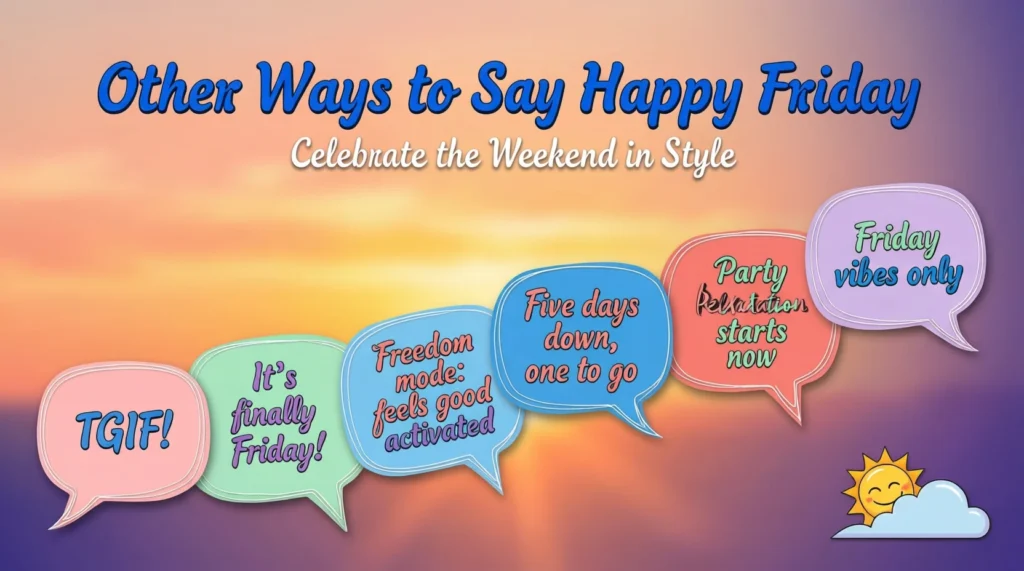
Looking for other ways to say happy friday? Try these popular alternatives: Have a great Friday, Enjoy your Friday, Happy end of the week, Wishing you a great weekend, Cheers to Friday. These options help match tone, context, and audience more accurately.
The phrase “happy friday” is a friendly expression people use to celebrate the end of the workweek and welcome the weekend. It often signals positivity, relief, and excitement.
You’ll hear it most often in casual conversations, messages, emails, and social media posts. While common, it is not always the best fit for professional or formal settings.
Learning alternatives to happy friday helps you express excitement in English more naturally and choose phrases that sound appropriate, confident, and fluent in different situations.
Pull Quote: “Small changes in wording can instantly improve your tone and professionalism.”
Quick Categories
Formal alternatives to “happy friday”
Have a pleasant Friday
Wishing you a productive Friday
Best wishes for your Friday
I hope your Friday goes well
Pro Tip: Use formal alternatives in written communication or when addressing clients or senior colleagues.
Casual alternatives
Have a great Friday
Enjoy your Friday
Hope you’re having a good Friday
Cheers to Friday
Pro Tip: Casual phrases work best in friendly emails, chats, and relaxed team environments.
Professional alternatives
Wishing you a successful end to the week
Best wishes as the week concludes
Have a great end to your week
Looking ahead to a strong finish this week
Pro Tip: Professional alternatives sound polite without being overly familiar.
Informal expressions
TGIF
Finally Friday
Friday vibes
Weekend loading
Pro Tip: Informal expressions are best for social media or conversations with close colleagues.
Pull Quote: “Professional English is about choosing the right tone, not sounding complicated.”
Common Mistakes When Using “Happy Friday”
- Using it in formal business emails
Example: Happy Friday, respected board members. - Overusing it in every message
Example: Happy Friday again, just following up. - Using it with serious or negative news
Example: Happy Friday, unfortunately the project failed. - Assuming it fits all cultures or workplaces
Example: Happy Friday in a very formal corporate setting. - Using it in academic or legal writing
Example: Happy Friday, please find the legal notice attached.
What Does “Happy Friday” Mean?
Definition:
“Happy Friday” is a casual greeting used to express happiness that Friday has arrived and the weekend is near.
Grammar Note:
It is an informal phrase, not a complete sentence, commonly used as a greeting.
Example:
Happy Friday! Any plans for the weekend?
When to Use “Happy Friday”
- Friendly emails
- Team chats
- Social media posts
- Informal workplace conversations
Spoken vs Written: Common in both
Formal vs Informal: Informal
Is It Professional or Polite to Say “Happy Friday”?
“Happy Friday” is polite but informal. It creates friendliness, not professionalism.
Business Example:
Wishing you a successful end to the week.
Polite? ✔️ Yes
Professional? ❌ No (in most cases)
Pros and Cons of Using “Happy Friday”
Pros
- Simple and natural
- Friendly tone
- Common usage
- Easy to understand
Cons
- Too informal for work
- Overused
- Limited emotional range
- Not suitable for formal writing
Pull Quote: “Friendly language builds rapport, but context decides credibility.”
Other Ways to Say “Happy Friday” (With Examples)
These other ways to say happy friday help you sound fluent and confident across situations.
Use them thoughtfully to express excitement in English with the right tone and clarity.
1. Phrase: Have a great Friday
Meaning: A friendly wish for a pleasant day.
Explanation: Neutral and widely acceptable.
Example Sentence: Have a great Friday and enjoy your plans.
Best Use: Casual chats
Worst Use: Legal emails
Tone: Friendly, neutral
Context Variability: casual, professional, spoken
2. Phrase: Enjoy your Friday
Meaning: Encouraging someone to enjoy the day.
Explanation: Slightly warmer than “have a great Friday.”
Example Sentence: Enjoy your Friday and relax a bit.
Best Use: Friendly emails
Worst Use: Formal notices
Tone: Warm, positive
Context Variability: casual, spoken
3. Phrase: Wishing you a great weekend
Meaning: Focuses on the weekend ahead.
Explanation: Common in professional settings.
Example Sentence: Wishing you a great weekend ahead.
Best Use: Work emails
Worst Use: Urgent messages
Tone: Polite, professional
Context Variability: professional, written
4. Phrase: Happy end of the week
Meaning: Celebrates the week’s conclusion.
Explanation: Neutral and slightly formal.
Example Sentence: Happy end of the week to everyone.
Best Use: Team updates
Worst Use: Social slang
Tone: Neutral, calm
Context Variability: professional, spoken
5. Phrase: Cheers to Friday
Meaning: Celebratory acknowledgment of Friday.
Explanation: Informal and upbeat.
Example Sentence: Cheers to Friday after a long week.
Best Use: Team chats
Worst Use: Client emails
Tone: Cheerful, informal
Context Variability: casual, spoken
6. Phrase: Hope your Friday is going well
Meaning: Polite check-in.
Explanation: Sounds considerate and calm.
Example Sentence: Hope your Friday is going well.
Best Use: Professional emails
Worst Use: Announcements
Tone: Polite, neutral
Context Variability: professional, written
7. Phrase: Best wishes for Friday
Meaning: Formal goodwill expression.
Explanation: Slightly traditional tone.
Example Sentence: Best wishes for Friday and beyond.
Best Use: Formal emails
Worst Use: Chats
Tone: Formal, polite
Context Variability: professional
8. Phrase: Looking forward to the weekend
Meaning: Expresses anticipation.
Explanation: Personal and conversational.
Example Sentence: Looking forward to the weekend already.
Best Use: Casual talk
Worst Use: Client updates
Tone: Relaxed, friendly
Context Variability: casual, spoken
9. Phrase: Wishing you a smooth Friday
Meaning: Calm, professional wish.
Explanation: Often used in work contexts.
Example Sentence: Wishing you a smooth Friday at work.
Best Use: Professional emails
Worst Use: Social posts
Tone: Professional, calm
Context Variability: professional
10. Phrase: TGIF
Meaning: Thank goodness it’s Friday.
Explanation: Slang and informal.
Example Sentence: TGIF after this busy week.
Best Use: Friends
Worst Use: Workplace emails
Tone: Playful, casual
Context Variability: informal, spoken
11. Phrase: Finally Friday
Meaning: Expresses relief that the week has ended.
Explanation: Highlights the feeling of reaching the end of a long or busy week.
Example Sentence: Finally Friday after a packed schedule.
Best Use: Casual talk
Worst Use: Formal writing
Tone: Relieved, informal
Context Variability: casual, spoken
12. Phrase: Happy Friday everyone
Meaning: A group greeting marking Friday.
Explanation: Often used in team chats or announcements.
Example Sentence: Happy Friday everyone, great work this week.
Best Use: Team messages
Worst Use: One-on-one formal emails
Tone: Friendly, inclusive
Context Variability: casual, professional, spoken
13. Phrase: Enjoy the end of the week
Meaning: Encourages relaxation as the week concludes.
Explanation: Neutral and suitable for semi-professional settings.
Example Sentence: Enjoy the end of the week and take some rest.
Best Use: Work emails
Worst Use: Social slang
Tone: Calm, polite
Context Variability: professional, written
14. Phrase: Wishing you a relaxing Friday
Meaning: Expresses hope for a calm and stress-free day.
Explanation: Gentle and considerate in tone.
Example Sentence: Wishing you a relaxing Friday ahead.
Best Use: Professional emails
Worst Use: Urgent updates
Tone: Warm, polite
Context Variability: professional, written
15. Phrase: Hope you have a pleasant Friday
Meaning: A polite wish for a nice day.
Explanation: Slightly formal and respectful.
Example Sentence: Hope you have a pleasant Friday.
Best Use: Client communication
Worst Use: Casual chats
Tone: Polite, formal
Context Variability: professional
16. Phrase: Friday at last
Meaning: Celebrates the arrival of Friday.
Explanation: Informal and conversational.
Example Sentence: Friday at last, it’s been a long week.
Best Use: Spoken English
Worst Use: Business writing
Tone: Casual, relieved
Context Variability: informal, spoken
17. Phrase: Sending Friday vibes
Meaning: Shares positive Friday energy.
Explanation: Modern and informal expression.
Example Sentence: Sending Friday vibes your way.
Best Use: Social media
Worst Use: Formal emails
Tone: Light, upbeat
Context Variability: casual, informal
18. Phrase: Have a wonderful Friday
Meaning: Warm and positive Friday wish.
Explanation: Polished but still friendly.
Example Sentence: Have a wonderful Friday and weekend.
Best Use: Professional messages
Worst Use: Legal documents
Tone: Warm, professional
Context Variability: professional, spoken
19. Phrase: Cheers to the weekend
Meaning: Celebrates the upcoming weekend.
Explanation: Focuses more on what comes after Friday.
Example Sentence: Cheers to the weekend after a busy week.
Best Use: Team chats
Worst Use: Client emails
Tone: Cheerful, informal
Context Variability: casual, spoken
20. Phrase: Happy almost-weekend
Meaning: Lighthearted way to mark Friday.
Explanation: Emphasizes anticipation rather than the day itself.
Example Sentence: Happy almost-weekend to you.
Best Use: Casual messages
Worst Use: Formal writing
Tone: Playful, informal
Context Variability: casual, spoken
21. Phrase: Wishing you a restful end to the week
Meaning: Encourages rest and recovery.
Explanation: Calm and professional wording.
Example Sentence: Wishing you a restful end to the week.
Best Use: Work emails
Worst Use: Social posts
Tone: Professional, thoughtful
Context Variability: professional, written
22. Phrase: Have a positive Friday
Meaning: Encourages a good mindset.
Explanation: Neutral and motivational.
Example Sentence: Have a positive Friday ahead.
Best Use: Workplace messages
Worst Use: Informal slang contexts
Tone: Encouraging, neutral
Context Variability: professional, spoken
23. Phrase: Best of luck this Friday
Meaning: Wishes success on Friday activities.
Explanation: Useful when tasks or deadlines are involved.
Example Sentence: Best of luck this Friday with your presentation.
Best Use: Professional encouragement
Worst Use: Casual greetings
Tone: Supportive, professional
Context Variability: professional
24. Phrase: Hope your Friday flies by
Meaning: Suggests an easy, fast day.
Explanation: Informal and conversational.
Example Sentence: Hope your Friday flies by today.
Best Use: Friendly chats
Worst Use: Formal emails
Tone: Casual, friendly
Context Variability: casual, spoken
25. Phrase: Ending the week on a high note
Meaning: Emphasizes a positive conclusion.
Explanation: Suitable for motivational or professional contexts.
Example Sentence: Let’s end the week on a high note.
Best Use: Team motivation
Worst Use: Personal chats
Tone: Motivational, professional
Context Variability: professional, spoken
26. Phrase: Have a peaceful Friday
Meaning: Wishes calm and balance.
Explanation: Soft and considerate expression.
Example Sentence: Have a peaceful Friday ahead.
Best Use: Polite communication
Worst Use: Energetic promotions
Tone: Calm, polite
Context Variability: professional, written
27. Phrase: Enjoy your well-earned Friday
Meaning: Acknowledges hard work during the week.
Explanation: Encouraging and appreciative.
Example Sentence: Enjoy your well-earned Friday.
Best Use: Team messages
Worst Use: Formal notices
Tone: Appreciative, warm
Context Variability: professional, spoken
28. Phrase: Wrapping up the week nicely
Meaning: Indicates smooth completion of the week.
Explanation: Neutral and descriptive.
Example Sentence: Looks like we’re wrapping up the week nicely.
Best Use: Workplace updates
Worst Use: Casual greetings
Tone: Neutral, professional
Context Variability: professional
29. Phrase: Friday greetings
Meaning: Simple acknowledgment of Friday.
Explanation: Short and neutral greeting.
Example Sentence: Friday greetings to everyone.
Best Use: Announcements
Worst Use: Personal chats
Tone: Neutral, formal
Context Variability: professional
30. Phrase: Weekend is calling
Meaning: Expresses excitement for the weekend.
Explanation: Informal and expressive phrase.
Example Sentence: Weekend is calling after today.
Best Use: Casual conversation
Worst Use: Business emails
Tone: Playful, informal
Context Variability: informal, spoken
Mini Quiz: Self-Check
- Which phrase is most professional?
A. TGIF
B. Cheers to Friday
C. Wishing you a successful end to the week - Which phrase is best for a client email?
A. Finally Friday
B. Hope your Friday is going well
C. Friday vibes - Which tone does “Cheers to Friday” express?
A. Formal
B. Neutral
C. Informal
Comparison Table: Top Alternatives
| Phrase | Tone | Best Use |
|---|---|---|
| Have a great Friday | Friendly | Casual emails |
| Enjoy your Friday | Warm | Messages |
| Wishing you a great weekend | Professional | Work emails |
| Happy end of the week | Neutral | Team updates |
| Hope your Friday is going well | Polite | Client emails |
| Wishing you a smooth Friday | Professional | Corporate use |
| Cheers to Friday | Informal | Team chat |
| Looking forward to the weekend | Casual | Conversations |
| Best wishes for Friday | Formal | Formal emails |
| TGIF | Slang | Friends only |
FAQs
1. Is “happy friday” grammatically correct?
Yes, but it is informal and used mainly as a greeting.
2. Can I say “happy friday” at work?
Only in casual environments. Professional alternatives are safer.
3. What are professional reaction phrases instead of “happy friday”?
Try “Wishing you a successful end to the week.”
4. Are there formal alternatives to happy friday?
Yes, such as “Best wishes for Friday.”
5. How can I sound less repetitive on Fridays?
Rotate different other ways to say happy friday based on context.
Conclusion
Mastering other ways to say happy friday helps you communicate with confidence, accuracy, and cultural awareness. Small wording changes can elevate your English instantly.
Practice using different alternatives daily and stay mindful of tone. Strong English is not just about meaning, but about sounding right in every situation.
CTA: Try using a new Friday phrase in your next email or conversation.

Owen Price is a skilled content writer at Synofind.com, known for crafting clear, engaging and reader-focused content. He brings a thoughtful approach to research and storytelling, ensuring every piece is accurate, concise and easy to understand.