
Quick Answer 🔥
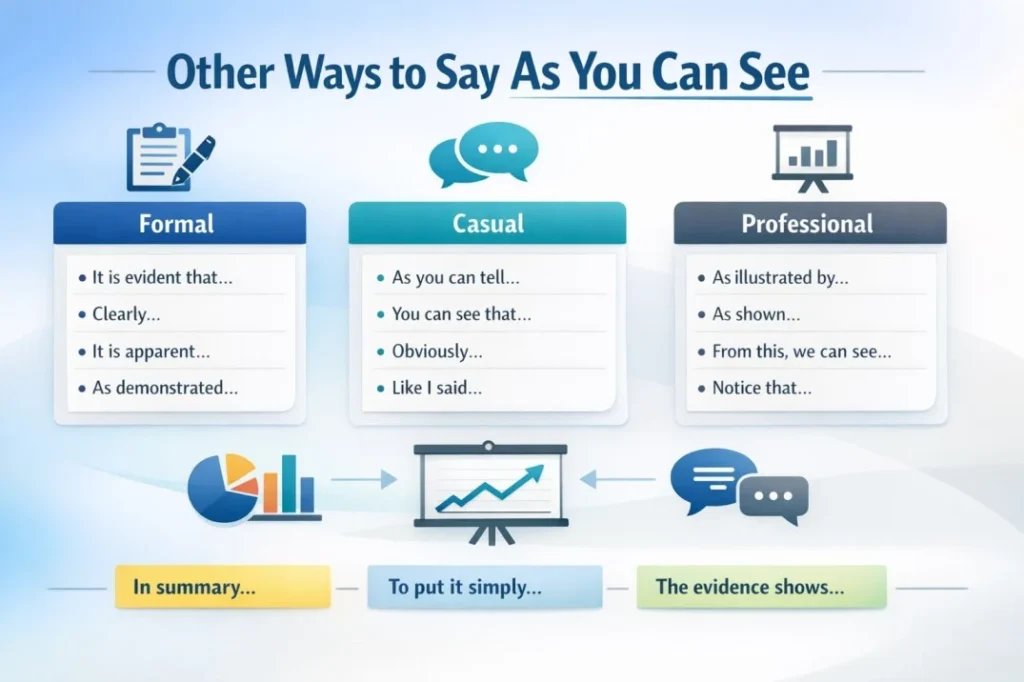
Looking for other ways to say “as you can see”? Try:
Clearly, As shown, As illustrated, As demonstrated, As evident.
These alternatives help you sound more professional, natural, and less repetitive in both writing and speaking.
The phrase “as you can see” is commonly used to draw attention to something visible or obvious—whether in presentations, emails, essays, or conversations.
While it’s useful, overusing it can make your communication sound repetitive or slightly informal, especially in professional or academic contexts.
Learning better alternatives to “as you can see” helps you:
- Improve clarity and tone
- Sound more professional and polished
- Avoid repetition in writing
- Enhance your presentation and communication skills
“Strong communication comes from variety, clarity, and the right tone.”
Quick Categories
Formal alternatives
- As demonstrated
- As illustrated
- As shown
- As indicated
Pro Tip: Best for reports, essays, and presentations.
Casual alternatives
- Clearly
- You can tell
- It’s obvious
- See here
Pro Tip: Use in conversations and informal writing.
Professional alternatives
- As evidenced
- As outlined
- As presented
- As observed
Pro Tip: Ideal for business emails and reports.
Academic alternatives
- As can be observed
- As reflected
- As depicted
- As highlighted
Pro Tip: Perfect for essays and research papers.
Common Mistakes
- Overusing “as you can see”
- Using it in formal writing repeatedly
- Not varying sentence structure
- Using casual phrases in professional work
- Adding unnecessary filler phrases
What Does “As You Can See” Mean?
It means the information is visible, obvious, or already presented clearly.
Example:
“As you can see, the results improved significantly.”
When to Use It
- Presentations
- Reports
- Emails
- Visual explanations
Polite? ✔️ Yes
Professional? ⚠️ Sometimes (better alternatives exist)
Pros and Cons
Pros
- Simple and clear
- Easy to understand
- Widely used
- Works in speech
Cons
- Overused
- Slightly informal
- Weak in formal writing
- Can sound repetitive
“Replacing overused phrases instantly improves your writing quality.”
Other Ways to Say “As You Can See” (With Examples)
1. Phrase: Clearly
Meaning: Something is obvious
Explanation: Direct and concise
Example Sentence: “Clearly, the results show improvement.”
Best Use: General writing
Worst Use: Overuse in essays
Tone: Neutral
Context Variability: universal
2. Phrase: As shown
Meaning: Already presented visually
Explanation: Common in reports
Example Sentence: “As shown in the chart, sales increased.”
Best Use: Data explanation
Worst Use: Casual talk
Tone: Professional
Context Variability: formal
3. Phrase: As illustrated
Meaning: Explained visually or with examples
Explanation: Slightly formal
Example Sentence: “As illustrated above, the trend is rising.”
Best Use: Academic writing
Worst Use: Casual speech
Tone: Formal
Context Variability: academic
4. Phrase: As demonstrated
Meaning: Proven or shown clearly
Explanation: Strong and formal
Example Sentence: “As demonstrated in the experiment, results are consistent.”
Best Use: Reports
Worst Use: Informal contexts
Tone: Formal
Context Variability: professional
5. Phrase: As evident
Meaning: Easily noticeable
Explanation: Concise and formal
Example Sentence: “As evident from the data, growth is steady.”
Best Use: Essays
Worst Use: Casual chat
Tone: Formal
Context Variability: academic
6. Phrase: It is clear that
Meaning: Something is obvious
Explanation: Slightly longer form
Example Sentence: “It is clear that performance improved.”
Best Use: Writing
Worst Use: Repetition
Tone: Neutral
Context Variability: universal
7. Phrase: As can be seen
Meaning: Visible to the reader
Explanation: Passive form
Example Sentence: “As can be seen, the pattern repeats.”
Best Use: Formal writing
Worst Use: Casual talk
Tone: Formal
Context Variability: academic
8. Phrase: As observed
Meaning: Noticed or recorded
Explanation: Analytical tone
Example Sentence: “As observed, the reaction slowed.”
Best Use: Reports
Worst Use: Casual
Tone: Professional
Context Variability: formal
9. Phrase: As indicated
Meaning: Pointed out or shown
Explanation: Common in reports
Example Sentence: “As indicated in the graph, profits rose.”
Best Use: Business writing
Worst Use: Informal use
Tone: Professional
Context Variability: formal
10. Phrase: As highlighted
Meaning: Emphasized
Explanation: Focuses attention
Example Sentence: “As highlighted earlier, the issue persists.”
Best Use: Presentations
Worst Use: Casual
Tone: Professional
Context Variability: formal
11. Phrase: As outlined
Meaning: Previously explained
Explanation: Structured tone
Example Sentence: “As outlined above, the plan is clear.”
Best Use: Reports
Worst Use: Casual
Tone: Professional
Context Variability: formal
12. Phrase: As presented
Meaning: Already shown
Explanation: Neutral tone
Example Sentence: “As presented, the results are accurate.”
Best Use: Reports
Worst Use: Informal
Tone: Neutral
Context Variability: professional
13. Phrase: As reflected
Meaning: Shown indirectly
Explanation: Analytical tone
Example Sentence: “As reflected in the data, trends are positive.”
Best Use: Academic
Worst Use: Casual
Tone: Formal
Context Variability: academic
14. Phrase: As depicted
Meaning: Shown visually
Explanation: Image-related
Example Sentence: “As depicted in the diagram, the process flows.”
Best Use: Visual explanation
Worst Use: Casual
Tone: Formal
Context Variability: academic
15. Phrase: As evidenced
Meaning: Supported by proof
Explanation: Strong and formal
Example Sentence: “As evidenced by results, the method works.”
Best Use: Research
Worst Use: Informal
Tone: Formal
Context Variability: academic
16. Phrase: You can tell
Meaning: Easy to notice
Explanation: Informal
Example Sentence: “You can tell the difference immediately.”
Best Use: Conversation
Worst Use: Formal writing
Tone: Casual
Context Variability: informal
17. Phrase: It’s obvious
Meaning: Very clear
Explanation: Direct and informal
Example Sentence: “It’s obvious the plan succeeded.”
Best Use: Speech
Worst Use: Academic
Tone: Casual
Context Variability: informal
18. Phrase: Take a look
Meaning: Direct attention
Explanation: Instructional
Example Sentence: “Take a look at this chart.”
Best Use: Presentations
Worst Use: Formal essays
Tone: Neutral
Context Variability: casual
19. Phrase: Notice that
Meaning: Draw attention
Explanation: Slightly instructive
Example Sentence: “Notice that the values increase.”
Best Use: Teaching
Worst Use: Formal reports
Tone: Neutral
Context Variability: semi-formal
20. Phrase: Here you can see
Meaning: Direct visual reference
Explanation: Very similar
Example Sentence: “Here you can see the difference.”
Best Use: Presentations
Worst Use: Formal writing
Tone: Neutral
Context Variability: casual
21. Phrase: As is clear
Meaning: Obviously true
Explanation: Formal tone
Example Sentence: “As is clear, the results align.”
Best Use: Academic
Worst Use: Casual
Tone: Formal
Context Variability: academic
22. Phrase: As is apparent
Meaning: Easily noticeable
Explanation: Formal
Example Sentence: “As is apparent, changes occurred.”
Best Use: Essays
Worst Use: Informal
Tone: Formal
Context Variability: academic
23. Phrase: As we can observe
Meaning: Joint observation
Explanation: Inclusive tone
Example Sentence: “As we can observe, trends improve.”
Best Use: Teaching
Worst Use: Casual
Tone: Semi-formal
Context Variability: academic
24. Phrase: As noted
Meaning: Previously mentioned
Explanation: Concise
Example Sentence: “As noted earlier, results vary.”
Best Use: Reports
Worst Use: Casual
Tone: Professional
Context Variability: formal
25. Phrase: As mentioned
Meaning: Already said
Explanation: Common
Example Sentence: “As mentioned above, sales increased.”
Best Use: Writing
Worst Use: Overuse
Tone: Neutral
Context Variability: universal
26. Phrase: From this, it is clear
Meaning: Logical conclusion
Explanation: Analytical
Example Sentence: “From this, it is clear that growth is steady.”
Best Use: Essays
Worst Use: Casual
Tone: Formal
Context Variability: academic
27. Phrase: This shows that
Meaning: Indicates clearly
Explanation: Simple
Example Sentence: “This shows that the method works.”
Best Use: General
Worst Use: Repetition
Tone: Neutral
Context Variability: universal
28. Phrase: This indicates that
Meaning: Suggests
Explanation: Analytical tone
Example Sentence: “This indicates that changes occurred.”
Best Use: Reports
Worst Use: Casual
Tone: Professional
Context Variability: formal
29. Phrase: This demonstrates that
Meaning: Clearly proves
Explanation: Strong
Example Sentence: “This demonstrates that the system is effective.”
Best Use: Formal writing
Worst Use: Casual
Tone: Formal
Context Variability: academic
30. Phrase: This makes it clear that
Meaning: Leaves no doubt
Explanation: Emphasis
Example Sentence: “This makes it clear that improvement is needed.”
Best Use: Essays
Worst Use: Informal
Tone: Neutral
Context Variability: formal
“Choosing the right alternative depends on tone, audience, and purpose.”
Mini Quiz
- Best formal option?
A. You can tell
B. As demonstrated
C. It’s obvious
Answer: B
Comparison Table
| Phrase | Tone | Best Use |
|---|---|---|
| Clearly | Neutral | General |
| As shown | Professional | Reports |
| As illustrated | Formal | Academic |
| It’s obvious | Casual | Conversation |
| As evidenced | Formal | Research |
Conclusion
Using other ways to say “as you can see” helps you sound more professional, clear, and engaging. Instead of repeating one phrase, you can adapt your language based on context—whether it’s formal writing, presentations, or casual conversation.
Practice these alternatives to improve your fluency, writing quality, and communication confidence.
Read More Related Articles:
- Other Ways to Say How Was Your Day With Examples 2026
- Other Ways to Say I Believe in You: 30 Examples In 2026
- Other Ways to Say I Respect Your Decision: 30+ Examples In 2026

Joshua Bell is a professional content writer at Synofind.com, known for delivering clear, accurate and engaging written content. He focuses on thorough research and thoughtful storytelling to ensure every piece is reliable and easy to understand. His work reflects a strong commitment to quality and credibility.