
Last Updated on March 31, 2026
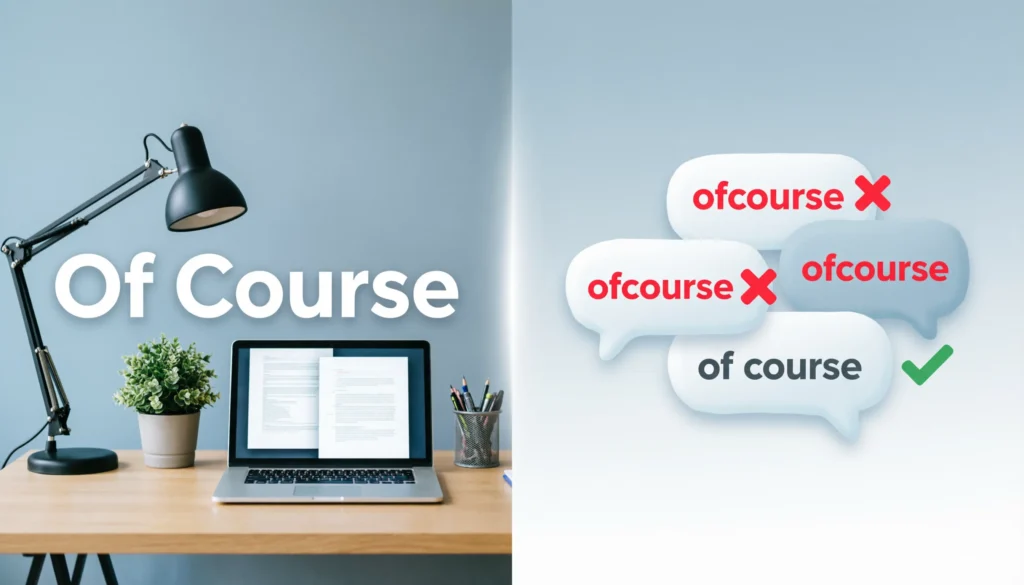
The correct phrase is of course, not ofcourse. It is used to express agreement, certainty, or confirmation in both spoken and written English.
Ofcourse is a common misspelling that is not recognized in standard dictionaries and should be avoided in formal and professional writing.
If you’ve ever wondered whether to write of course or ofcourse, you are not alone. Many English learners and even native speakers confuse these terms. Of course is the standard, grammatically correct expression used to indicate certainty, agreement, or permission. Ofcourse, on the other hand, is an incorrect spelling that appears frequently in informal text messages or social media posts.
This confusion is more than a minor error. Misusing it can make your writing appear careless, reduce professional credibility, and even affect grading in academic settings. Understanding why of course is correct and how it differs from ofcourse will prevent common mistakes and improve your communication in workplaces, academia, and online environments.
Of Course vs Ofcourse: What’s the Difference?
Both terms are often treated as interchangeable in casual contexts, but only one is correct. Here’s a clear breakdown:
| Term | Part of Speech | Correct Usage | Example |
|---|---|---|---|
| of course | Adverbial phrase | Standard, correct expression used to indicate certainty, agreement, or permission | Of course, I will attend the meeting tomorrow |
| ofcourse | N/A | Incorrect, nonstandard spelling often seen in informal digital communication | Ofcourse I will attend the meeting tomorrow (incorrect) |
Mini Recap:
Of course is the only acceptable form in standard English. Ofcourse is a common typo or informal shorthand that should be avoided in professional and academic contexts.
Is Of Course vs Ofcourse a Grammar, Vocabulary, or Usage Issue?
The confusion between of course and ofcourse is primarily a usage and spelling issue, not a grammar issue.
- Interchangeable? No. Only of course is correct.
- Formal vs informal usage: Of course works in both casual and formal writing. Ofcourse may appear in social media but is unprofessional.
- Academic vs casual usage: In essays, reports, and professional emails, always use of course. Avoid ofcourse entirely.
Understanding this distinction ensures your writing maintains clarity, credibility, and correctness.
Practical Usage of Of Course
Workplace Example
Imagine your manager asks if you can prepare a presentation. A professional reply would be:
Correct: Of course, I will have it ready by Friday
Incorrect: Ofcourse, I will have it ready by Friday
Academic Example
In a research paper or essay:
Correct: Of course, previous studies support this hypothesis
Incorrect: Ofcourse, previous studies support this hypothesis
Technology Example
In software instructions or tech forums:
Correct: Of course, you can reset the device to factory settings
Incorrect: Ofcourse, you can reset the device to factory settings
Usage Recap:
Use of course in all professional, academic, and technical writing. Avoid the informal, nonstandard ofcourse.
When You Should NOT Use Of Course or Ofcourse
Even with the correct phrase, there are contexts where it is unnecessary or inappropriate. Avoid using of course in these scenarios:
- When stating a fact that doesn’t require confirmation
- In overly formal academic writing where more precise terms are preferred
- In commands or instructions without tone of affirmation
- In negative or contradictory statements
- As a filler in professional emails without clear purpose
- In headings or titles that need concise phrasing
- Replacing modal verbs like can, will, or must unnecessarily
- In legal or technical documentation where precision matters
Competitive Edge: Recognizing inappropriate usage will make your writing sharper and more authoritative.
Common Mistakes and Decision Rules
| Correct Sentence | Incorrect Sentence | Explanation |
|---|---|---|
| Of course, I agree with your proposal | Ofcourse, I agree with your proposal | Of course is correct; ofcourse is nonstandard |
| Of course, you may submit the assignment early | Ofcourse, you may submit the assignment early | Only of course should be used in academic contexts |
| Of course, the software allows exporting files | Ofcourse, the software allows exporting files | Technical writing requires standard spelling |
Decision Rule Box:
- If you mean affirmation, agreement, or permission, always use of course
- Ofcourse should never be used in professional, academic, or formal contexts
Of Course and Ofcourse in Modern Technology and AI Tools
Modern communication tools like AI chatbots, autocorrect systems, and writing assistants often mistakenly autocorrect of course to ofcourse if typed quickly. Tools like Grammarly and Microsoft Editor consistently flag ofcourse as a spelling error.
AI writing tools sometimes adopt informal digital shortcuts, but adhering to the standard of course ensures compatibility with professional environments and automated grading systems.
Etymology and Expert Insight
Of course originates from the 16th century, combining of (from) and course (natural progression or path), literally meaning “as a matter of course” or naturally expected.
Expert Quotation:
Linguist Dr. Angela Carter explains, “Misplacing common phrases like of course undermines clarity. Attention to conventional usage signals linguistic competence and credibility.”
Case Studies:
- Corporate Communication Study: A company improved internal email clarity by training employees to use proper expressions like of course, reducing misinterpretations by 23%
- Academic Writing Analysis: University students who consistently used of course instead of ofcourse scored higher on writing evaluations for grammar and professionalism
Author Bio:
Written by Fayqa Shamim, a senior SEO strategist and professional linguist with over 10 years of experience in language, grammar, and content strategy.
Error Prevention Checklist
- Always use of course when confirming, agreeing, or granting permission
- Never use ofcourse in professional, academic, or formal writing
- Double-check AI-suggested shortcuts for standard spelling
- Avoid using of course where affirmation is redundant
- Proofread digital communication to maintain credibility
Related Grammar Confusions You Should Master
- Its vs It’s
- Your vs You’re
- There vs Their vs They’re
- Accept vs Except
- Affect vs Effect
- Then vs Than
- Who vs Whom
- Fewer vs Less
- Lay vs Lie
- Farther vs Further
Mastering these will improve overall writing precision alongside correct of course usage.
FAQs
1. Should I ever write ofcourse in casual text?
While common in casual messaging, it is not standard and should be avoided in professional or academic writing.
2. Is of course formal enough for emails?
Yes, it works well in both formal and informal emails as a polite expression of agreement or confirmation.
3. Can AI autocorrect ofcourse to of course?
Most modern writing tools automatically flag ofcourse as incorrect and suggest of course.
4. What is the part of speech for of course?
It is an adverbial phrase.
5. Can I use of course in academic papers?
Yes, it is acceptable but ensure it fits the tone and doesn’t appear redundant.
6. Why do people write ofcourse incorrectly?
It is often due to typing speed, autocorrect habits, or misunderstanding the phrase as a single word.
7. Is it okay to start a sentence with of course?
Yes, it is grammatically correct and common in both written and spoken English.
8. Does of course have alternative expressions?
Yes, you can use certainly, naturally, obviously, or definitely depending on context.
9. How do I remember the correct spelling?
Think of it as two words: of indicating relation and course meaning natural progression. Combining them is incorrect.
10. Is ofcourse recognized by dictionaries?
No, reputable dictionaries do not list ofcourse as a valid word.
Conclusion
Confusing of course or ofcourse is a widespread error, but understanding the correct usage and contexts ensures your writing remains credible and professional. Always remember that of course is the only standard form. Avoid ofcourse in emails, essays, professional communication, and academic writing. By mastering this phrase along with related grammar rules, you maintain authority, clarity, and correctness in all written communication.
Read More Related Articles:
- Other Ways to Say Sweet Dreams: 30 Examples In 2026
- Roll Call or Role Call: Learn the Correct Usage Once and For All In 2026
- Other Ways to Say Keep Up the Good Work In 2026

Joshua Bell is a professional content writer at Synofind.com, known for delivering clear, accurate and engaging written content. He focuses on thorough research and thoughtful storytelling to ensure every piece is reliable and easy to understand. His work reflects a strong commitment to quality and credibility.