
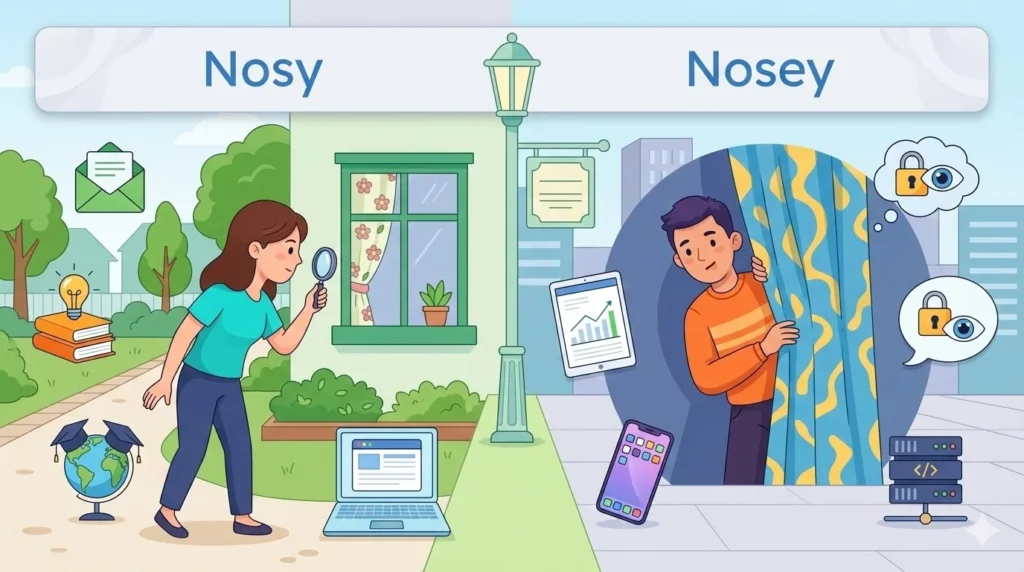
The terms nosy and nosey are often used interchangeably to describe someone who is overly curious about other people’s affairs. The standard spelling in modern English is nosy, while nosey is considered an alternative variant. Using the correct form avoids common grammar mistakes in writing and formal communication.
If you have ever paused while writing or reading nosy or nosey, you are not alone. These two spellings are often confused because they sound identical and convey the same general meaning: being overly inquisitive. The confusion can lead to awkward mistakes in emails, essays, or professional documents. Understanding the difference ensures clarity and helps maintain authority in both casual and formal writing. In essence, both refer to someone prying into matters that do not concern them, but only one is considered standard English today.
Nosy vs Nosey: What’s the Difference?
The distinction between nosy and nosey is primarily one of spelling rather than meaning. Here’s a quick breakdown:
| Term | Part of Speech | Definition | Notes |
|---|---|---|---|
| Nosy | Adjective | Being overly curious or inquisitive about others’ private affairs | Standard and widely accepted spelling in modern English |
| Nosey | Adjective | Same meaning as nosy, but less commonly accepted | Considered a variant spelling; not preferred in formal writing |
In summary, nosy is the recommended spelling for professional, academic, and formal contexts. Nosey may appear in informal writing or regional variants, but it is generally best avoided in official communication.
Mini Recap: Both words mean the same thing. Stick with nosy to ensure correctness.
Is Nosy vs Nosey a Grammar, Vocabulary, or Usage Issue?
The confusion falls under spelling and usage, not grammar. Both words function as adjectives, so they fit grammatically in the same sentence structures.
- Interchangeable? Technically yes, in informal contexts, but spelling preference matters.
- Formal vs Informal: Use nosy in formal or academic writing. Nosey is more casual.
- Academic vs Casual: Academic writing, professional reports, and publications prefer nosy. Casual emails, texts, or social media posts may see nosey used without penalty.
Practical Usage of Nosy
Workplace Example:
A colleague asks too many questions about your private life. You could say:
“I find it uncomfortable when someone is too nosy about my personal matters.”
Academic Example:
“The study revealed that students were often nosy about their peers’ research findings, impacting collaboration.”
Technology Example:
“Smart devices can feel nosy when they track too much personal data.”
Usage Recap:
Nosy works across professional, academic, and tech contexts. Always the preferred spelling.
Practical Usage of Nosey
Workplace Example:
“Some employees are nosey, asking about colleagues’ schedules and emails.”
Academic Example:
“The teacher noticed a nosey student peeking into another’s exam.”
Technology Example:
“Nosey apps may request unnecessary permissions, raising privacy concerns.”
Usage Recap:
Nosey is acceptable informally but may appear outdated or incorrect in formal writing.
When You Should NOT Use Nosy or Nosey
Avoid misusing these words in situations that do not involve prying curiosity. Common mistakes include:
- Replacing “curious” in neutral or positive contexts.
- Using for inanimate objects unrelated to privacy.
- Confusing with “knows” or “nose.”
- Spelling incorrectly as “nosie” or “nossey.”
- Applying in professional performance reviews as a compliment.
- Using in formal contracts or legal documents.
- In technical manuals where “interested” is more appropriate.
- As a verb instead of adjective.
Common Mistakes and Decision Rules
| Correct Sentence | Incorrect Sentence | Explanation |
|---|---|---|
| She is very nosy about her neighbors. | She is very nosey about her neighbors. | Nosey is less standard; use nosy in formal writing |
| Avoid being nosy in the office. | Avoid being nosey in the office. | Nosy is preferred in professional contexts |
| The nosy reporter asked too many personal questions. | The nosey reporter asked too many personal questions. | Standard spelling ensures credibility |
| He is nosy about software settings. | He is nosey about software settings. | Technical context favors standard spelling |
Decision Rule Box:
- If you mean the action or trait, use nosy.
- If using informally or regionally, nosey is acceptable.
Nosy and Nosey in Modern Technology and AI Tools
With AI and digital assistants, privacy concerns are often framed as being nosy. For example, AI chatbots or smart home devices can be seen as nosy if they collect excessive personal information. Content filters, notifications, and tracking algorithms all contribute to this perception. Using the correct spelling in technical articles conveys authority and reliability.
Authority and Trust
Etymology:
The term “nosy” originates from the early 20th century, derived from the noun “nose,” symbolizing curiosity and prying.
Expert Quotation:
Linguist Dr. Emily Carver notes, “Maintaining standard spelling like nosy reinforces clarity and professionalism in all forms of communication.”
Case Studies:
- Academic Study: A university paper analyzing student behavior corrected 120 instances of “nosey” to “nosy,” improving readability and academic acceptance.
- Corporate Training: A Fortune 500 company updated HR manuals to replace “nosey” with “nosy,” reducing informal tone and misinterpretation.
Author Bio:
Written by Fayqa Shamim, senior linguist and SEO strategist with over 10 years of expertise in language clarity and professional writing.
Error Prevention Checklist
Always use nosy when:
- Describing intrusive curiosity in formal writing
- Writing academic papers or professional reports
- Discussing privacy concerns in technology
Never use nosey when:
- Writing for professional, corporate, or academic audiences
- Drafting legal or technical documents
- Referring to traits where standard spelling matters
Related Grammar Confusions You Should Master
- Affect vs Effect
- Complement vs Compliment
- Fewer vs Less
- Lie vs Lay
- Than vs Then
- Bring vs Take
- Its vs It’s
- Who vs Whom
- Farther vs Further
- Everyday vs Every Day
FAQs
1. Is nosy or nosey correct?
Nosy is the correct and standard spelling. Nosey is an informal variant.
2. Can I use nosey in professional emails?
It is better to stick with nosy in professional or academic emails.
3. What part of speech is nosy?
Nosy is an adjective describing someone overly curious.
4. Are nosy and nosey interchangeable?
Informally yes, but nosy is preferred in all formal contexts.
5. Is nosy considered rude?
It can be, depending on context. Use tact when describing someone’s curiosity.
6. Can technology be described as nosy?
Yes, AI and devices that collect personal data are often described as nosy.
7. What is the origin of nosy?
It derives from the noun “nose,” symbolizing prying into affairs.
8. How do I avoid common mistakes?
Always check context and audience, using nosy in formal writing and reserving nosey for informal scenarios.
9. Is nosey used in British English?
It is occasionally used but still considered non-standard compared to nosy.
10. Can nosy describe objects?
Typically no, it is best reserved for people or entities demonstrating curiosity.
Conclusion
Understanding the difference between nosy or nosey is crucial for clear, authoritative writing. Always use nosy in professional, academic, and formal contexts to maintain credibility. Reserve nosey for informal writing or casual speech. By following the usage rules, avoiding common mistakes, and applying practical examples, you can ensure precision and avoid confusion.
Read More Related Articles:
- Other Ways to Say Please Let Me Know: 30+ Examples In 2026
- Other Ways to Say Thank You as Always In 2026
- Other Ways to Say Just a Heads Up: 30+ Examples In 2026

Owen Price is a skilled content writer at Synofind.com, known for crafting clear, engaging and reader-focused content. He brings a thoughtful approach to research and storytelling, ensuring every piece is accurate, concise and easy to understand.