Last Updated on April 4, 2026
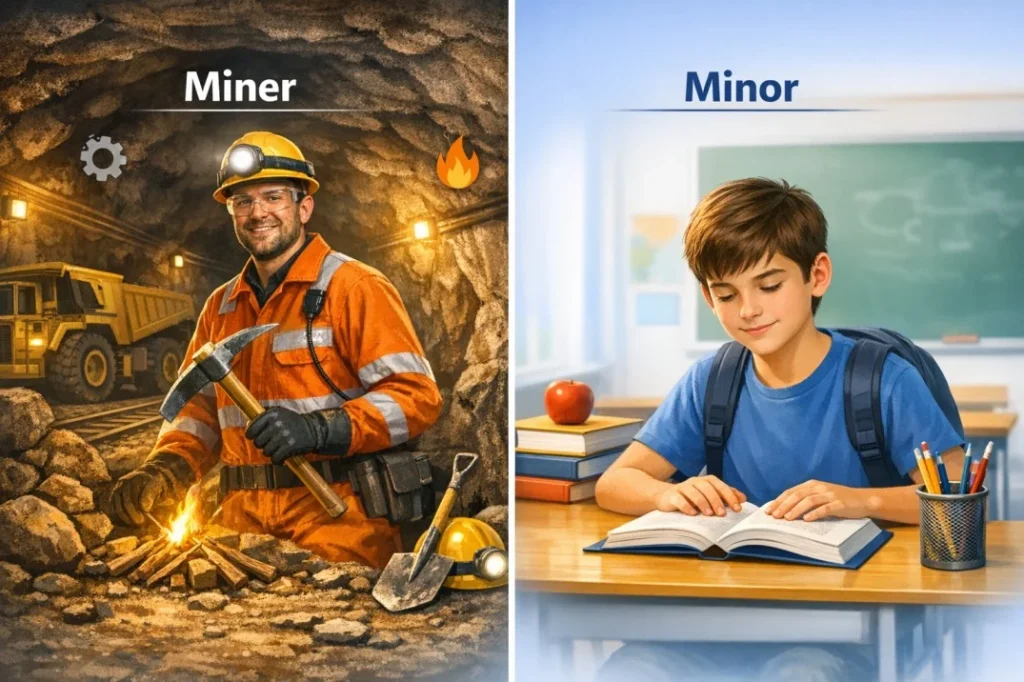
The terms miner and minor are often confused because they sound similar, but their meanings are completely different. A miner is a person who extracts minerals or resources from the earth, while a minor is someone under the legal age or something of lesser importance.
The confusion between miner vs minor is surprisingly common, even among educated writers and professionals. Both words sound almost identical, yet their meanings, usage, and implications are entirely different. A miner is a person who works in mining, extracting valuable resources from the earth, while a minor refers to an individual who has not yet reached legal adulthood or to something considered less significant. Misusing these words can cause legal, professional, or academic errors, making it crucial to understand and apply them correctly from the start.
Miner vs Minor: What’s the Difference?
Understanding the distinction requires knowing the parts of speech and context for each word.
| Feature | Miner | Minor |
|---|---|---|
| Part of Speech | Noun | Noun, Adjective |
| Meaning | A person who extracts minerals, ores, or resources from the earth | A person under legal age; something less important or smaller in scale |
| Example Sentence | The miner worked deep underground for eight hours | The law protects minors from signing contracts |
| Context | Workplace, industrial, technical, historical | Legal, social, academic, general descriptive |
Mini Recap:
Miner relates to a profession, typically in resource extraction, while minor is tied to age or importance. Confusing them can change your sentence meaning completely.
Is Miner vs Minor a Grammar, Vocabulary, or Usage Issue?
This distinction is primarily a vocabulary and usage issue rather than grammar. These words are not interchangeable. Miner is always a noun referring to a person or occupation, whereas minor can be a noun describing age or an adjective describing significance.
In formal writing, minor is used in legal, medical, and academic contexts. Miner is mostly used in historical, industrial, and technological contexts. Casual conversation may rely on context clues, but errors still occur when the words are spoken or written without clarification.
Practical Usage: Miner
Workplace Example:
The miner inspected the tunnels for safety hazards before beginning the shift.
Academic Example:
In the study of industrial history, the life of a miner in the 19th century reveals much about labor conditions.
Technology Example:
Bitcoin miners use specialized computers to solve cryptographic puzzles and earn cryptocurrency.
Usage Recap:
Use miner only when referring to a person or entity involved in resource extraction or technical mining tasks.
Practical Usage: Minor
Workplace Example:
Employees cannot provide insurance benefits to minors without parental consent.
Academic Example:
A psychology minor explores subjects outside a student’s main field of study.
Technology Example:
In medical software, minor errors in dosage calculation can cause serious complications.
Usage Recap:
Minor should be used when referring to age, secondary importance, or small size. Avoid using it to describe a profession or job.
When You Should NOT Use Miner or Minor
- Referring to a child as a worker in a literal mining sense
- Referring to a mining professional as underage
- Calling a legal adult a minor in academic context
- Describing something significant as minor
- Using miner to describe age
- Confusing minor with miner in workplace safety instructions
- Using miner to describe a student’s elective subject
- Replacing minor with miner in technology contexts like cryptocurrency
Correct application avoids legal, technical, and professional errors.
Common Mistakes and Decision Rules
| Correct Sentence | Incorrect Sentence | Explanation |
|---|---|---|
| The miner wore a helmet while working underground | The minor wore a helmet while working underground | Miner refers to the profession; minor refers to age or lesser importance |
| Minors cannot vote until they turn 18 | Miners cannot vote until they turn 18 | Minor refers to age eligibility; miner is a worker |
| The school offers a psychology minor | The school offers a psychology miner | Minor denotes a secondary academic focus |
| Bitcoin miners process transactions | Bitcoin minors process transactions | Only miners can validate blockchain transactions |
Decision Rule Box:
If you mean the person extracting resources, use miner
If you mean a person under legal age or lesser importance, use minor
Miner and Minor in Modern Technology and AI Tools
In modern technology, miners are widely recognized in blockchain and cryptocurrency environments, while minor frequently appears in digital age restrictions, such as social media platform age gates. AI tools, like writing assistants, rely on correct usage to avoid miscommunication. Mislabeling can lead to technical errors or even legal violations when content is age-sensitive.
Authority and Trust
Etymology:
Miner comes from the Latin minare, meaning to drive or excavate. Minor originates from Latin minor, meaning smaller or lesser.
Expert Quotation:
Linguist Dr. Emily Sanders explains, “Misusing miner and minor may seem trivial, but in legal and technical writing, the consequences can be significant.”
Case Study 1:
A mining software company mistakenly listed “minor responsibilities” instead of “miner responsibilities” in its operational manual. This led to workplace confusion and required legal clarification, costing $25,000 in correction and retraining.
Case Study 2:
An academic journal incorrectly referred to students under 18 as miners instead of minors. Peer reviewers flagged the mistake, demonstrating the importance of precise terminology in formal writing.
Author Bio:
Written by Fayqa Shamim, senior SEO strategist and professional linguist with over 10 years of experience clarifying language confusion in competitive niches.
Error Prevention Checklist
Always use miner when:
- Referring to someone working in mining
- Discussing cryptocurrency mining
- Describing a professional extraction context
Never use minor when:
- Referring to a profession
- Talking about mining operations
- Describing cryptocurrency validators
Related Grammar Confusions You Should Master
- Affect vs Effect
- Principle vs Principal
- Complement vs Compliment
- Stationary vs Stationery
- Ensure vs Insure
- Farther vs Further
- Capital vs Capitol
- Accept vs Except
- Loose vs Lose
- Precede vs Proceed
Mastering these ensures writing clarity and precision.
FAQs
1. What is the difference between a miner and a minor?
A miner is a person extracting resources; a minor is a person under legal age or something of lesser importance.
2. Can minor and miner be used interchangeably?
No. They have entirely different meanings and contexts.
3. How do you use miner in a sentence?
Example: The miner inspected the coal tunnel for hazards.
4. How do you use minor in a sentence?
Example: The law protects minors from signing contracts without consent.
5. What is the origin of the words miner and minor?
Miner comes from Latin minare, to dig. Minor comes from Latin minor, meaning smaller.
6. Are there modern contexts where minor is used digitally?
Yes. Social media platforms, apps, and AI tools use minor to indicate underage users.
7. Can you use miner in cryptocurrency contexts?
Yes. Cryptocurrency miners validate transactions and earn digital coins.
8. What are common mistakes people make with minor vs miner?
Common mistakes include using minor to refer to a miner’s occupation or calling someone underage a miner.
9. Is minor always about age?
Not always. Minor can also refer to something of lesser importance or scale.
10. How can I remember the difference?
Think occupation = miner; age or lesser importance = minor.
Conclusion
The distinction between miner vs minor is clear once you understand their definitions, contexts, and usage rules. Miners extract resources, while minors are underage individuals or less important items. Careful attention prevents legal, academic, and professional mistakes. By mastering this and related confusions, your writing achieves clarity, authority, and precision.
Read More Related Articles:
- Nice to Meet You: 30 Better Ways to Say It in English (2026)
- Skillset or Skill Set: Difference and Proper Usage In 2026
- Anual or Annual: Correct Spelling and Meaning Explained In 2026

Owen Price is a skilled content writer at Synofind.com, known for crafting clear, engaging and reader-focused content. He brings a thoughtful approach to research and storytelling, ensuring every piece is accurate, concise and easy to understand.