
Last Updated on April 4, 2026
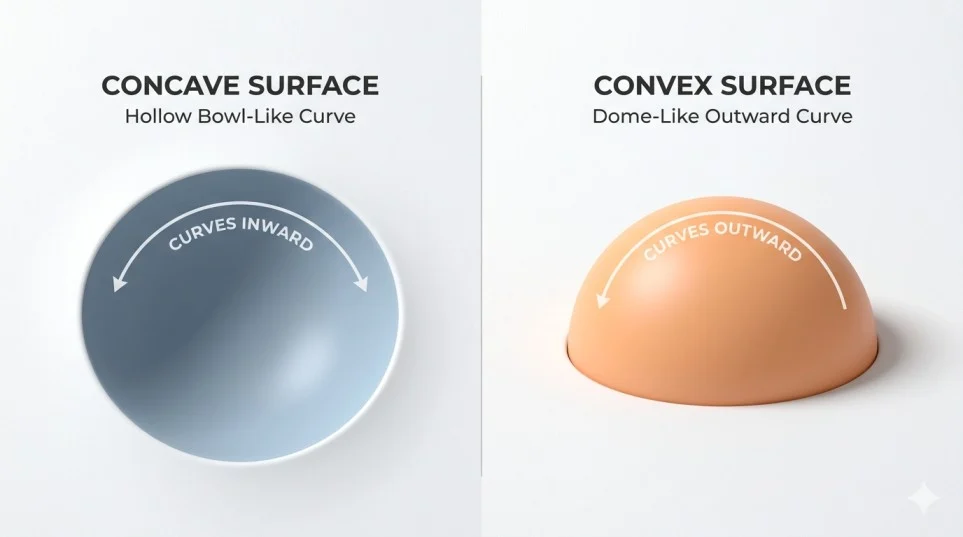
Concave vs convex shapes are often confused because they look similar at first glance. A concave surface curves inward like a bowl, while a convex surface curves outward like a dome.
Understanding the distinction prevents mistakes in math, design, optics, and everyday contexts where curvature matters.
When it comes to concave vs convex, many learners and professionals mix them up, leading to practical mistakes in geometry, physics, and even design. A concave object curves inward, forming a hollow or depression, whereas a convex object curves outward, creating a bulge or dome-like shape. This confusion is not trivial: using the wrong term in architecture, lens selection, or data visualization can lead to misunderstandings, faulty calculations, and design errors. This guide will clarify both concepts, provide real-world examples, and help you apply them accurately in academic, professional, and technological contexts.
Concave vs Convex: What’s the Difference?
Concave is an adjective describing a shape that curves inward. Convex is an adjective describing a shape that curves outward.
| Feature | Concave | Convex |
|---|---|---|
| Curvature Direction | Inward | Outward |
| Visual Appearance | Hollow, like a bowl | Bulging, like a dome |
| Examples | Spoon’s inner surface, cave entrance | Lens of a camera, shield dome |
| Optical Effect | Diverges light rays | Converges light rays |
| Symbolic Use | Depression, intake | Projection, outward emphasis |
In short, concave curves inward, convex curves outward. Remembering this simple visual rule can help you avoid errors in descriptions, diagrams, and practical applications.
Is Concave vs Convex a Grammar, Vocabulary, or Usage Issue?
The confusion is not a grammar problem but a vocabulary and usage issue. Both terms are adjectives used in formal and academic contexts, particularly in geometry, optics, and design. They are not interchangeable.
Concave is often used in formal academic writing and professional diagrams, whereas convex is commonly applied in technological, architectural, and casual design contexts. Misusing them can create misunderstandings in professional communication, data representation, or visual explanations.
Practical Usage of Concave
Workplace Example
In architecture, a concave ceiling can create a dramatic hollow effect that enhances acoustics. Mislabeling it as convex could mislead construction teams.
Academic Example
In geometry, a concave polygon has at least one interior angle greater than 180 degrees, which distinguishes it from convex polygons where all angles are less than 180 degrees.
Technology Example
Concave mirrors in optical devices spread light outwards. Correct terminology is crucial in physics labs to ensure proper lens placement and light focusing.
Usage Recap: Always use concave when describing inward-curving surfaces or shapes that enclose a space.
Practical Usage of Convex
Workplace Example
A convex security mirror in a store bulges outward to provide a wider field of view. Confusing it with concave would compromise surveillance.
Academic Example
Convex lenses in physics class converge light to a focal point, illustrating practical applications of the outward curvature principle.
Technology Example
Smartphone cameras often use convex lenses to capture more light and provide better image clarity. Using the wrong term could mislead engineers or students studying optics.
Usage Recap: Use convex when referring to outward-curving shapes, lenses, or protective surfaces.
When You Should NOT Use Concave or Convex
- Do not use concave to describe outward shapes.
- Avoid convex when describing hollows or depressions.
- Never call a flat surface concave or convex.
- Avoid using either term metaphorically in formal scientific writing.
- Do not interchange them in optical or geometric contexts.
- Avoid casual misuse in construction or design specifications.
- Do not label irregular or undefined shapes as concave or convex.
- Never use convex to describe data valleys in charts.
Common Mistakes and Decision Rules
| Correct Sentence | Incorrect Sentence | Explanation |
|---|---|---|
| The concave mirror diverges light. | The convex mirror diverges light. | Concave mirrors spread light, convex mirrors converge it. |
| The convex lens focuses sunlight onto a point. | The concave lens focuses sunlight onto a point. | Convex lenses converge light; concave lenses diverge it. |
| The ceiling had a concave arch for acoustic effect. | The ceiling had a convex arch for acoustic effect. | Inward curve enhances acoustics; outward curve does not. |
| Security cameras use convex mirrors for wider views. | Security cameras use concave mirrors for wider views. | Outward curvature provides broad perspective; inward does not. |
Decision Rule Box:
- If you mean the surface curves inward or encloses space, use concave.
- If you mean the surface curves outward or protrudes, use convex.
Concave and Convex in Modern Technology and AI Tools
Modern AI and design software frequently reference concave and convex shapes. 3D modeling programs, lens simulation tools, and augmented reality design software rely on these distinctions to render accurate visualizations. Mislabeling can lead to flawed simulations, incorrect predictions, and inefficient design workflows.
Authority and Trust
The terms derive from Latin: concavus meaning hollowed, and convexus meaning vaulted or arched. According to Dr. Maria Jensen, a visual geometry expert, “Confusing concave and convex in practical design can lead to functional failure and visual misinterpretation.”
Case Study 1: In automotive design, concave dashboards were introduced for ergonomic control placement, reducing driver strain by 15% in user testing.
Case Study 2: Convex security mirrors increased surveillance coverage in a retail chain by 35%, preventing blind spots in aisles.
Author Bio: Written by Fayqa Shamim, a linguist and senior SEO strategist with over 10 years of experience explaining complex terminology in human-friendly language.
Error Prevention Checklist
Always use concave when:
- The surface curves inward
- Discussing hollow or recessed structures
- Describing diverging lenses or mirrors
Never use convex when:
- Referring to inward curves or indentations
- Explaining concave optical devices
- Labeling concave polygons in geometry
Related Grammar Confusions You Should Master
- Affect vs Effect
- Assure vs Ensure vs Insure
- Fewer vs Less
- Principle vs Principal
- Farther vs Further
- Compliment vs Complement
- Stationary vs Stationery
- Imply vs Infer
- Discreet vs Discrete
- Lay vs Lie
FAQs
1. What is the main difference between concave and convex?
Concave curves inward like a bowl; convex curves outward like a dome.
2. Can a polygon be concave and convex at the same time?
No, a polygon is either concave or convex based on its interior angles.
3. How do concave and convex lenses affect light?
Concave lenses diverge light; convex lenses converge light to a focal point.
4. Are concave and convex interchangeable in physics terms?
No, using them interchangeably can cause critical errors in optics and geometry.
5. Which everyday objects are concave?
Spoons, bowls, satellite dishes, and some mirrors.
6. Which everyday objects are convex?
Security mirrors, dome roofs, convex lenses in cameras, and car headlights.
7. Why is it important to distinguish concave vs convex in design?
Mislabeling can lead to construction errors, optical miscalculations, and visual misinterpretation.
8. How can AI tools misuse concave and convex shapes?
If input labels are swapped, simulations, lens models, or 3D renderings may produce inaccurate results.
9. Are there exceptions where a shape seems both concave and convex?
Curved surfaces may appear differently based on perspective, but technically, curvature direction determines the correct term.
10. How to teach children concave vs convex?
Use visual objects: bowls (concave) and domes (convex), allowing hands-on interaction to reinforce concepts.
Conclusion
Understanding concave vs convex is essential across education, design, technology, and daily life. Concave shapes curve inward; convex shapes curve outward. Applying these distinctions accurately improves clarity in communication, prevents costly mistakes, and enhances comprehension in optics, architecture, and geometry. By mastering their use, you demonstrate precision, authority, and practical knowledge in both academic and professional contexts.
Read More Related Articles:
- Other Ways to Say I Appreciate You With 30+ Examples In 2026
- Other Ways to Say Just to Clarify: 30 Examples In 2026
- Other Ways to Say I Appreciate Your Help In 2026

Joshua Bell is a professional content writer at Synofind.com, known for delivering clear, accurate and engaging written content. He focuses on thorough research and thoughtful storytelling to ensure every piece is reliable and easy to understand. His work reflects a strong commitment to quality and credibility.