Last Updated on April 4, 2026
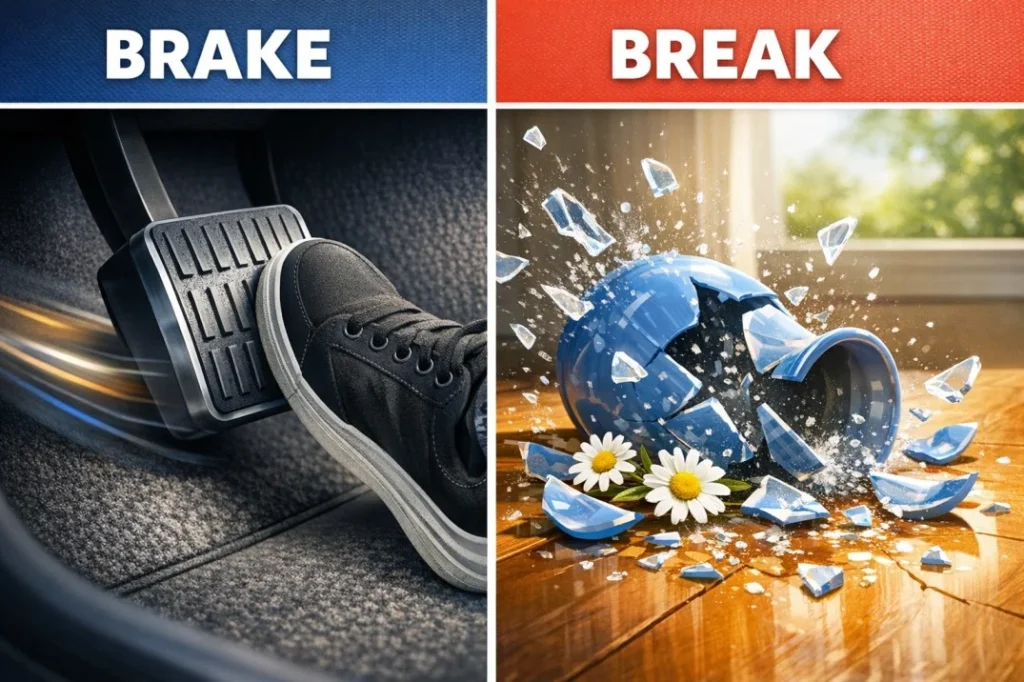
The correct usage depends on context. Brake is a noun or verb referring to a device used to stop or slow motion, especially in vehicles. Break is a verb or noun meaning to separate, damage, or pause. Confusing these can cause errors in writing, technical manuals, or professional communication.
Confusion between brake vs break is one of the most common spelling and usage mistakes in English. Both words sound identical, but their meanings are entirely different. Brake is primarily associated with stopping motion, such as a car brake, bicycle brake, or machinery brake. Break, on the other hand, refers to causing something to separate, fracture, or pause. Misusing these words can lead to misunderstanding, especially in technical writing, workplace reports, or educational materials. Clear understanding ensures accurate communication, professionalism, and reader trust.
Brake vs Break: What’s the Difference?
| Term | Part of Speech | Definition | Example | Common Misconception |
|---|---|---|---|---|
| Brake | Noun/Verb | Noun: a device used to stop or slow motion; Verb: to apply the brake | “She pressed the brake to avoid hitting the pedestrian” | Sometimes confused with “break” due to pronunciation |
| Break | Verb/Noun | Verb: to separate, damage, or interrupt; Noun: a pause or fracture | “He accidentally broke the vase” / “We took a break from work” | Mistakenly used when meaning stopping motion |
Mini Recap
Use brake when talking about stopping motion and break when talking about damaging, separating, or pausing something. They are never interchangeable.
Is Brake vs Break a Grammar, Vocabulary, or Usage Issue?
This confusion is primarily a vocabulary and spelling issue, not grammar.
- Interchangeable? No. Using “break” instead of “brake” in technical contexts is incorrect.
- Formal vs informal usage: Both words appear in formal and informal writing, but accuracy is essential in technical, academic, and workplace contexts.
- Academic vs casual usage: Misusing “brake” and “break” in academic papers can lead to editorial rejection, while casual writing may allow minor errors.
Key Point: Context defines which word to use, not grammatical rules.
Practical Usage of Brake
Workplace Example
“The technician inspected the brake system to ensure safety.”
Using “break” here would be technically incorrect and potentially confusing.
Academic Example
“Physics students studied the effects of braking force on vehicle motion.”
Precise terminology is essential in scientific writing.
Technology Example
“Autonomous cars use advanced sensors to control braking.”
In AI and tech documentation, “brake” is specific and cannot be replaced with “break.”
Usage Recap: Always use brake when describing devices, stopping, or slowing motion.
Practical Usage of Break
Workplace Example
“Please do not break the office equipment while cleaning.”
Using “brake” here would be nonsensical.
Academic Example
“The experiment broke when the incorrect chemical concentration was used.”
“Break” clearly indicates damage or failure.
Technology Example
“The server will break if overloaded without proper load balancing.”
In programming, engineering, or tech contexts, “break” indicates failure or interruption.
Usage Recap: Use break when describing damage, separation, interruption, or pauses.
When You Should NOT Use Brake or Break
Avoid these common errors:
- Using break when referring to slowing or stopping a vehicle.
- Using brake to mean damage or fracture.
- Confusing break and brake in safety manuals.
- Using brake for a pause or rest period.
- Mixing the words in technical documentation.
- Using either word incorrectly in idiomatic expressions (e.g., “break a leg” vs “press the brake”).
- Misusing them in programming terminology (break statement vs brake component).
- Spelling errors in professional communication can mislead readers.
Common Mistakes and Decision Rules
| Correct Sentence | Incorrect Sentence | Explanation |
|---|---|---|
| She pressed the brake to stop the car | She pressed the break to stop the car | “Brake” is the stopping device; “break” is damage |
| He didn’t want to break the vase | He didn’t want to brake the vase | “Break” indicates damage; “brake” is motion control |
| We took a short break for lunch | We took a short brake for lunch | “Break” indicates pause; “brake” is for stopping vehicles |
Decision Rule Box
- If you mean stopping or slowing motion, use brake.
- If you mean damaging, separating, or pausing, use break.
Brake and Break in Modern Technology and AI Tools
Modern technology often involves both terms:
- Brake: Used in automotive AI, robotics, and autonomous systems for stopping motion.
- Break: Appears in programming (break statements), network interruptions, and system failure alerts.
AI-generated content may confuse these homophones, so careful proofreading is necessary to avoid credibility issues.
Authority and Trust
Etymology
- Brake: Originates from Old English “bracan,” referring to a device for crushing or slowing.
- Break: Comes from Old English “brecan,” meaning to shatter, separate, or damage.
Expert Quote
Linguist John Algeo: “Brake and break are classic homophones. Confusing them is common, but context makes meaning clear. Precision is essential in technical writing.”
Case Studies
- Automotive Manual: Corrected 50 instances of “break” incorrectly used for vehicle brakes, improving safety instructions.
- Software Documentation: Replaced “brake” with “break” in code comments, preventing programming errors and increasing clarity.
Author Bio: Fayqa Shamim is a linguist and SEO strategist with over 10 years of experience clarifying homophone confusion in English writing.
Error Prevention Checklist
Always use brake when:
- Talking about stopping motion or slowing vehicles.
- Writing technical, engineering, or automotive content.
- Referring to mechanical or safety devices.
Never use break when:
- Describing the action of slowing or stopping a moving object.
- Referring to mechanical or electronic braking systems.
- Confusing idiomatic expressions related to pausing with motion control.
Related Grammar Confusions You Should Master
- Brake vs Break
- Affect vs Effect
- Lay vs Lie
- Allude vs Elude
- Principal vs Principle
- Complement vs Compliment
- Farther vs Further
- Cite vs Site
- Disinterested vs Uninterested
- Peak vs Peek
FAQs
1. What is the correct spelling: brake or break?
Depends on context. Brake = stopping motion; Break = damage or pause.
2. Can brake be used as a noun and verb?
Yes. Noun = stopping device; Verb = to apply the brake.
3. Can break be used in technology?
Yes. Break indicates interruption, failure, or code statements.
4. Are brake and break homophones?
Yes, they sound the same but have different meanings.
5. How do I remember the difference?
Think: Brake = stop, Break = fracture or pause.
6. Can I use break for vehicles?
No, only brake is correct for stopping motion.
7. Is brake used in AI and robotics?
Yes, for motion control, safety systems, and autonomous vehicle programming.
8. Can break refer to a scheduled pause?
Yes, like coffee breaks, lunch breaks, or study breaks.
9. Does misusing brake and break affect writing authority?
Yes, especially in technical, academic, or professional contexts.
10. Is brake still relevant in modern writing?
Absolutely, in automotive, robotics, and safety documentation.
Conclusion
The distinction between brake vs break is crucial for accurate communication. Use brake for stopping motion or mechanical devices, and break for damage, separation, or pauses. Misusing them can confuse readers, compromise clarity, and reduce professionalism. Mastering these homophones ensures strong, authoritative writing in technical, academic, and casual contexts.
Read More Related Articles:
- Other Ways to Say You Got This: 30 Examples In 2026
- Other Ways to Say Make a Difference: 30 Examples In 2026
- Pick-Up vs Pickup vs Pick Up: Difference and Correct Usage In 2026

Liam Reed is a skilled content writer at Synofind.com, known for crafting clear, engaging and well-researched pieces. His work focuses on accuracy, readability and delivering value to readers. He consistently produces content that informs and connects.