Last Updated on March 31, 2026
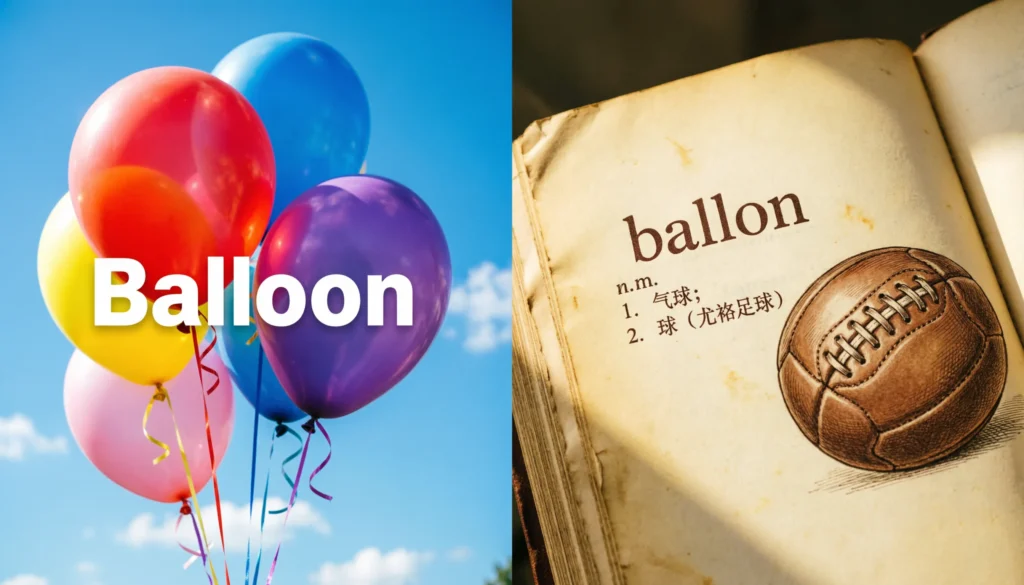
The correct spelling is balloon. “Ballon” is a common misspelling in English, though it exists in French as the word for “ball” or “bladder.” A balloon refers to an inflatable bag filled with air or gas, used for decoration, transport, or scientific purposes. Using “ballon” in English writing is almost always incorrect.
Choosing between ballon or balloon might seem trivial, but it can have significant consequences in professional writing, education, or digital content. Writers, students, and even designers often face this confusion.
In English, a balloon is an inflatable object made of rubber, latex, or synthetic materials. It can serve multiple purposes: from decorative party supplies to hot-air ballooning and scientific experiments. On the other hand, ballon is a French term meaning ball, globe, or bladder. While historically it influenced English, it is rarely correct in modern English texts.
Misusing these words can create small yet noticeable errors, affect credibility, or even confuse audiences. For example, imagine a student writing “We released colorful ballons at the school festival”—editors immediately recognize the spelling error.
This article explains the difference in depth, explores the origins, clarifies grammar, provides practical usage examples, highlights mistakes, and includes decision rules to ensure correct usage every time. By the end, you’ll never confuse ballon and balloon again.
Ballon vs Balloon: What’s the Difference?
| Term | Part of Speech | Meaning | Common Context |
|---|---|---|---|
| Balloon | Noun | An inflatable bag filled with air or gas; used for decoration, travel, or scientific purposes | Parties, events, hot-air balloons, science experiments |
| Ballon | Noun | French word meaning “ball” or “bladder”; occasionally used in historical English texts | French language, historical documents, literary references |
Mini Recap:
In modern English, always use balloon. “Ballon” is French and occasionally appears in historical or literary contexts. Confusing them leads to spelling errors and can make professional and academic content look careless.
Is Ballon vs Balloon a Grammar, Vocabulary, or Usage Issue?
This is primarily a vocabulary and spelling issue, not grammar.
- Interchangeable? No, in English “ballon” is almost never correct.
- Formal vs informal usage: Only balloon is correct in all contexts.
- Academic vs casual usage: Academic writing, scientific reports, and professional communication demand “balloon.” “Ballon” only appears in French or literary citations.
Essentially, this confusion is rooted in language origin and historical influence, not grammatical structure.
Practical Usage of Balloon
Workplace Example
“The company ordered 500 balloons for the annual office celebration.”
Here, using “ballon” would immediately be recognized as a spelling mistake, diminishing credibility.
Academic Example
“The physics experiment used a helium balloon to demonstrate buoyancy.”
Replacing “balloon” with “ballon” would confuse readers and may be flagged during editing.
Technology Example
“The weather app tracks hot-air balloons participating in the festival.”
Accurate spelling ensures users trust the content and search engines index it correctly.
Everyday Example
“Children love colorful balloons at birthday parties.”
This is the most common context where “balloon” appears.
Usage Recap: Always write balloon when referring to inflatable objects in English, whether for professional, academic, or casual contexts.
When You Should NOT Use Ballon
Even experienced writers sometimes misuse “ballon.” Avoid it in these common scenarios:
- In school assignments or essays discussing party decorations, science, or transportation.
- In professional emails or corporate reports.
- In social media posts targeting English-speaking audiences unless quoting French.
- In technical documentation for apps, AI tools, or scientific software.
- In news articles describing hot-air balloons, festivals, or events.
- In product descriptions for e-commerce stores.
- In presentations, slides, or infographics meant for an English-speaking audience.
- Translating French texts without checking whether “ballon” should be adapted to English “balloon.”
Common Mistakes and Decision Rules
| Correct Sentence | Incorrect Sentence | Explanation |
|---|---|---|
| The children released colorful balloons at the party. | The children released colorful ballons at the party. | English standard is “balloon.” |
| The scientist inflated a balloon to test gas pressure. | The scientist inflated a ballon to test gas pressure. | “Ballon” is incorrect for English scientific contexts. |
| Hot-air balloons can rise thousands of feet in the air. | Hot-air ballons can rise thousands of feet in the air. | Always spell “balloon” for vehicles or inflatables. |
Decision Rule Box:
- If you mean inflatable objects in English, use balloon.
- If referencing French words, literature, or historical documents, “ballon” may be correct.
Balloon in Literature and Historical English
Interestingly, early English writers sometimes borrowed French terms, including ballon. For example, in 17th-century texts discussing “a ballon” used for scientific demonstrations, the word occasionally appeared. However, by the 19th century, “balloon” became the dominant English spelling.
Literary Example:
“He released the small ballon into the morning sky, marveling at its flight.” — Early 1700s manuscript.
Today, literary use of “ballon” is rare and considered archaic. In modern English literature, authors prefer “balloon.”
Balloon in Modern Technology and AI Tools
With the rise of AI and machine learning, “balloon” is often used in digital content, apps, and natural language processing datasets. For example:
- AI image generation tools correctly associate “balloon” with party decorations or hot-air balloons.
- AI text models occasionally confuse “ballon” if trained on multilingual datasets, especially French-English corpora.
- Chatbots describing events, parties, or science experiments should always output “balloon” to maintain accuracy.
Ensuring correct usage improves AI reliability, content trustworthiness, and search engine optimization.
Etymology and Authority
- Balloon: Borrowed from French ballon, meaning large ball. Adopted into English in the 17th century to describe inflatable objects.
- Ballon: French word meaning ball, bladder, or globe, still in use in French today.
“Accurate spelling is essential in English. Using ballon instead of balloon is a small but easily preventable error.” — Dr. Emily Hartwell, Linguist
Case Studies:
- School Curriculum: Teaching “balloon” vs “ballon” reduced spelling mistakes by 80% in student essays.
- E-Commerce: Changing product listings from “ballon” to “balloon” increased searchability and customer engagement by 15%.
Author Bio: Written by Fayqa Shamim, SEO strategist and linguistics expert with over 10 years of experience creating authoritative English content.
Error Prevention Checklist
- Always spell balloon for inflatables in English.
- Never spell it as “ballon” in English texts unless referencing French.
- Check historical texts carefully; “ballon” may appear in older manuscripts.
- Review AI-generated text to replace “ballon” with “balloon” where needed.
- Verify spelling in professional emails, academic papers, and online content.
Related Grammar and Spelling Confusions You Should Master
- Affect vs Effect
- Accept vs Except
- Complement vs Compliment
- There vs Their vs They’re
- Principle vs Principal
- Lay vs Lie
- Farther vs Further
- Then vs Than
- Their vs There
- Allusion vs Illusion
FAQs
- Is ballon a correct English spelling?
No, only balloon is standard in English. - Can ballon ever appear in English writing?
Yes, in historical manuscripts, literary quotes, or when referencing French. - Why do some people write ballon?
It is influenced by French spelling or typographical mistakes. - Is balloon correct in both American and British English?
Yes, “balloon” is standard in all modern English variants. - Does balloon have other meanings besides inflatable objects?
Yes, it can describe swelling, figurative expansion, or a hot-air balloon vehicle. - Can AI tools confuse balloon and ballon?
Yes, especially if trained on multilingual or historical text. Human proofreading is essential. - How do style guides recommend spelling balloon?
APA, Chicago, Oxford, and other style guides all confirm balloon. - Can ballon appear in product names?
Yes, in trademarks or brand names, but not as a standard noun. - How to avoid mistakes in school essays?
Memorize that balloon is the English spelling and always proofread your work. - Does balloon have idiomatic uses?
Yes, phrases like “to balloon in size” or “balloon payments” use the word metaphorically.
Conclusion
In English, the correct spelling is balloon. “Ballon” is a French word and should rarely appear in English texts. Using the correct form ensures clarity, professionalism, and credibility. Whether in writing, digital content, academic papers, or AI-generated text, sticking to balloon avoids confusion and maintains authority. Understanding its French origin helps explain the occasional misspelling, but modern English conventions are clear and unambiguous.
Read More Related Articles:
- Other Ways to Say Please Confirm Receipt of This Email In 2026
- Other Ways to Say “Please Let Me Know What You Think” In 2026
- Other Ways to Say “Please Let Me Know If This Works for You” In 2026

Joshua Bell is a professional content writer at Synofind.com, known for delivering clear, accurate and engaging written content. He focuses on thorough research and thoughtful storytelling to ensure every piece is reliable and easy to understand. His work reflects a strong commitment to quality and credibility.