
Last Updated on April 4, 2026
Quick Answer:
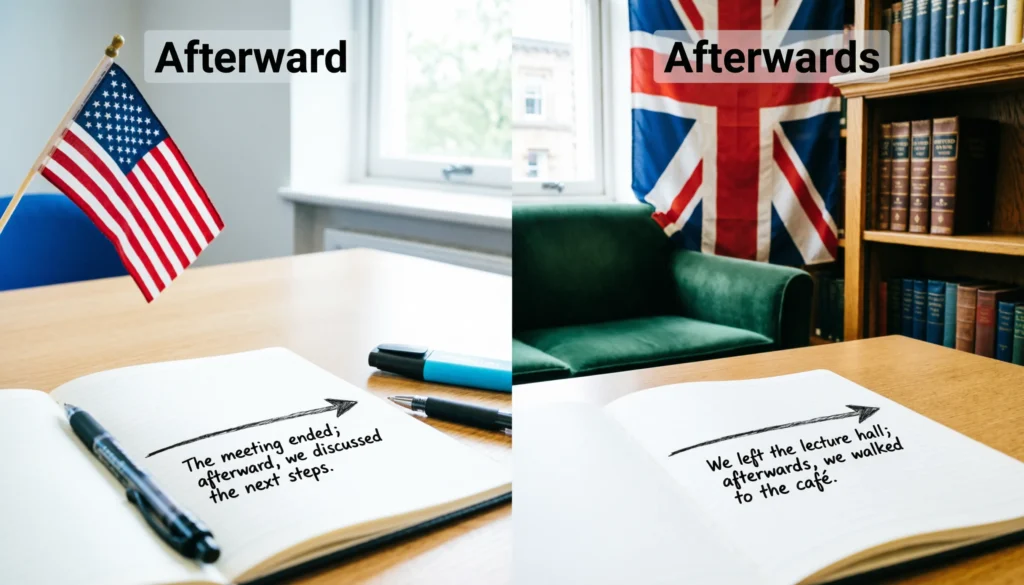
The terms afterward and afterwards are interchangeable adverbs meaning “at a later time” or “following an event.” Afterward is more common in American English, while afterwards is preferred in British English. Both are correct, but choosing the wrong variant in a formal or international context can appear unpolished or inconsistent.
Many writers and speakers wonder about the proper use of afterward vs afterwards. Both words function as adverbs indicating something that occurs later in time. The confusion arises because their meanings are identical, yet their usage depends on regional norms, context, and formality.
Misusing one over the other can lead to subtle grammar mistakes, especially in professional writing, academic papers, or content intended for a global audience. Understanding the distinction is essential to maintain clarity, credibility, and stylistic consistency in English writing.
Afterward vs Afterwards: What’s the Difference?
Both afterward and afterwards are adverbs that refer to a subsequent action or event. They share the same definition but vary in regional preference.
| Term | Part of Speech | Definition | Regional Preference | Formality Level |
|---|---|---|---|---|
| Afterward | Adverb | At a later time, following an event | American English | Neutral/Formal |
| Afterwards | Adverb | At a later time, following an event | British English | Neutral/Formal |
Mini Recap: Both words mean “later” or “subsequently,” but afterward is American, and afterwards is British. Understanding your audience determines which form to use.
Is Afterward vs Afterwards a Grammar, Vocabulary, or Usage Issue?
The difference is primarily a usage and regional preference issue rather than a strict grammar rule. Neither term is incorrect, but they are not always equally accepted in every variant of English.
- Interchangeable: Yes, meaning-wise.
- Formal vs Informal: Both are acceptable in formal writing; afterward may feel slightly more concise.
- Academic vs Casual: Academic writing in the U.S. leans toward afterward, while UK institutions prefer afterwards. In casual contexts, either is fine as long as consistency is maintained.
This shows that knowing your audience and the style guide of your document is critical.
Practical Usage
Afterward in Sentences
- Workplace Example: The team met to review the proposal and met with the client afterward to finalize details.
- Academic Example: The experiment produced unexpected results, and the researchers discussed them afterward in the seminar.
- Technology Example: Users submit the form, and the system sends a confirmation email afterward.
Usage Recap: Afterward works naturally in American English and is versatile across formal, academic, and technical contexts.
Afterwards in Sentences
- Workplace Example: The manager conducted the meeting, and the team reviewed the notes afterwards.
- Academic Example: The lecture concluded, and the students debated the topic afterwards in groups.
- Technology Example: The application installs automatically, and the user is prompted to configure settings afterwards.
Usage Recap: Afterwards is preferred in British English, functioning identically to afterward in meaning and style.
When You Should NOT Use Afterward or Afterwards
Avoid using these words in the following situations:
- As a noun (they are adverbs only)
- At the beginning of a sentence where “later” or “subsequently” is clearer
- When writing highly informal or chatty text—“later” is preferred
- With idiomatic phrases where neither fits naturally
- Redundantly with phrases like “afterward later”
- In tense inconsistencies (don’t mix past and future awkwardly)
- When your audience expects consistent British or American spelling
- In headlines or SEO titles where brevity matters
Common Mistakes and Decision Rules
| Correct Sentence | Incorrect Sentence | Explanation |
|---|---|---|
| She finished her homework afterward. | She finished her homework afterwards. (US context) | Afterward is preferred in American English. |
| They went to the park afterwards. | They went to the park afterward. (UK context) | Afterwards is standard in British English. |
| The system processed the data and notified users afterward. | The system processed the data and notified users afterwards. (US context) | Regional choice matters in formal writing. |
Decision Rule Box:
- If you are writing for an American audience or style guide, use afterward.
- If you are writing for a British audience or style guide, use afterwards.
Afterward and Afterwards in Modern Technology and AI Tools
Even in AI-generated content or software interfaces, the choice between afterward and afterwards reflects regional localization settings. For instance, U.S. versions of productivity apps like Microsoft Office or Grammarly suggest afterward, whereas UK versions suggest afterwards. Being aware of this nuance can prevent subtle stylistic errors in technical documentation, automated emails, and AI-driven content workflows.
Authority and Trust
Etymology:
Both terms derive from Middle English phrases. Afterward evolved from “after word,” literally meaning following a word or event. Afterwards shares the same roots but gained the extra “s” in British English over time.
Expert Insight:
Linguist David Crystal notes, “Regional preference often dictates choice, not correctness. Awareness of audience ensures clarity without compromising style.”
Case Studies:
- Publishing Industry: A UK academic journal reported fewer editing corrections when authors used afterwards consistently.
- Corporate Communication: An American tech firm standardized on afterward in all reports, improving clarity for multinational teams.
Author Bio: Fayqa Shamim is a linguist and SEO strategist with over 10 years of experience helping writers master subtle English usage and grammar distinctions.
Error Prevention Checklist
- Always use afterward when writing for American audiences.
- Never use afterwards in American formal documents unless consistent with style guides.
- Use afterwards for British audiences.
- Avoid either term in informal, casual, or conversational contexts where “later” suffices.
- Ensure tense consistency around these adverbs.
- Review content localization settings in AI and tech tools.
Related Grammar Confusions You Should Master
- Later vs Latter
- Since vs Because
- Fewer vs Less
- Bring vs Take
- Among vs Between
- Who vs Whom
- Compliment vs Complement
- Then vs Than
- Already vs All ready
- Lie vs Lay
FAQs
1. Afterward vs Afterwards meaning in American English?
In American English, afterward is the preferred adverb for “later” or “following an event,” while afterwards is uncommon but still understandable.
2. Is afterwards correct in formal writing?
Yes, in British English, afterwards is fully correct in both formal and casual writing contexts.
3. Can I use afterward and afterwards interchangeably?
Yes, the meaning is the same, but the choice should match regional spelling conventions.
4. Is afterward more common in academic papers?
In U.S.-based academic writing, afterward is slightly more prevalent due to regional preference.
5. Should I avoid afterwards in American emails?
Consistency is more important than strict prohibition, but afterward aligns with standard American usage.
6. Is there a difference in pronunciation?
Both terms are pronounced similarly, with minor accent variations between U.S. and UK English.
7. Can AI tools correct afterward vs afterwards automatically?
Yes, modern grammar checkers adjust suggestions based on regional settings.
8. What’s the historical reason for the ‘s’ in afterwards?
The ‘s’ reflects an older Middle English construction and became standard in British English over time.
9. Which is better for SEO content?
Match the target audience. Use afterward for U.S. readers, afterwards for U.K. readers.
10. Can I mix afterward and afterwards in one document?
No, mixing forms may appear inconsistent. Pick one and use it consistently.
Conclusion
Understanding afterward vs afterwards is a simple yet crucial step toward writing precision and stylistic consistency. While both adverbs mean “later” or “subsequently,” regional norms dictate which form fits best. Writers, editors, and professionals should choose according to audience, context, and stylistic conventions. Careful use enhances clarity, avoids subtle errors, and ensures polished, authoritative communication.
Read More Related Articles:
- Other Ways to Say Please Let Me Know Your Thoughts: 30+ Examples In 2026
- Other Ways to Say I’m Sorry for Your Loss: 30 Examples In 2026
- Other Ways to Say “Please Confirm Receipt of This Email” In 2026

Joshua Bell is a professional content writer at Synofind.com, known for delivering clear, accurate and engaging written content. He focuses on thorough research and thoughtful storytelling to ensure every piece is reliable and easy to understand. His work reflects a strong commitment to quality and credibility.