
Last Updated on April 2, 2026
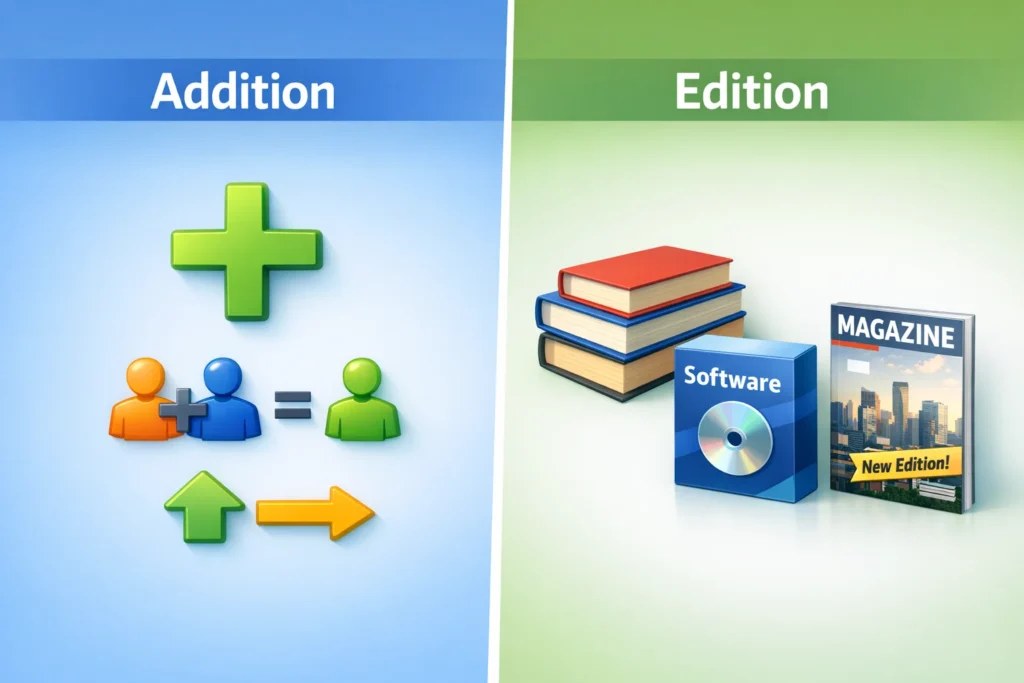
The difference between addition and edition is clear: addition refers to the act of adding something or a mathematical operation, while edition refers to a version of a publication, software, or media. Confusing these terms can lead to miscommunication in writing, academic work, or professional documents.
Many writers, students, and professionals often search for addition vs edition to clarify which term fits their context. Both words sound similar and appear related, yet their meanings diverge significantly. Addition is typically a noun that denotes the act of adding something, a sum, or an increase. Edition, on the other hand, refers to a particular version of a book, software, magazine, or other media. This subtle difference causes real mistakes, from academic citations to workplace communication and software updates, making a clear understanding essential.
Addition vs Edition: What’s the Difference?
Understanding the distinction begins with part of speech, meaning, and usage:
| Term | Part of Speech | Definition | Example |
|---|---|---|---|
| Addition | Noun | The act of adding something to an existing entity or a mathematical sum | The new wing was an addition to the school building |
| Edition | Noun | A particular version or release of a publication, software, or media | The second edition of the textbook included updated research |
In short, addition deals with adding, increasing, or including, while edition identifies a version or iteration. Mixing them can confuse readers and alter meaning.
Mini Recap: Addition is about adding, edition is about versions. Clear separation ensures precise communication in all contexts.
Is Addition vs Edition a Grammar, Vocabulary, or Usage Issue?
The confusion is primarily a vocabulary and usage issue, not a grammatical one. Both words are nouns, and neither is interchangeable. Addition is more general and action-oriented, suitable for formal and informal writing. Edition is version-specific and more common in academic, publishing, and technology contexts. Using them incorrectly can reduce clarity, especially in professional or academic documents.
Practical Usage: Addition
Workplace Example
In a corporate email:
“The addition of new team members will strengthen our project capabilities.”
Academic Example
In a research paper:
“The addition of recent studies enhanced the literature review section.”
Technology Example
In software updates:
“The addition of new features improved user experience in the latest version.”
Usage Recap: Addition emphasizes adding or increasing. Do not use it to describe a version of a document or media.
Practical Usage: Edition
Workplace Example
In publishing or corporate reports:
“The third edition of our company handbook includes updated compliance policies.”
Academic Example
In textbooks or journals:
“This is the fifth edition of the chemistry textbook, revised with new experiments.”
Technology Example
In software and gaming:
“The deluxe edition of the software comes with additional plugins and support.”
Usage Recap: Edition identifies a version or release. Avoid using it to describe the act of adding content.
When You Should NOT Use Addition or Edition
- Using addition to refer to a version of a book or magazine
- Using addition to describe software updates labeled as “editions”
- Using edition when you mean the act of adding data or features
- Confusing edition with addition in emails or reports about incremental growth
- Saying “new edition of our staff” instead of “addition of staff”
- Replacing edition with addition in academic citations
- Mislabeling digital content versions as additions
- Using addition in marketing copy to promote version-based products
Clear avoidance improves readability and professionalism.
Common Mistakes and Decision Rules
| Correct Sentence | Incorrect Sentence | Explanation |
|---|---|---|
| The addition of a new chapter improved the book | The edition of a new chapter improved the book | Addition is about adding content; edition refers to the version |
| This is the third edition of the magazine | This is the third addition of the magazine | Edition indicates the version; addition would confuse readers |
| The software’s deluxe edition includes extra features | The software’s deluxe addition includes extra features | Edition correctly refers to version; addition misrepresents meaning |
Decision Rule Box:
- If you mean the act of adding or increasing something, use addition
- If you mean a version, release, or iteration, use edition
Addition and Edition in Modern Technology and AI Tools
With AI tools and software, distinguishing between addition and edition is increasingly important. For instance, a software edition may have premium features, while an addition refers to new modules or plugins. In AI-generated content, confusion between these terms can affect version control, release notes, and user instructions.
Authority and Trust
Etymology
- Addition comes from Latin additio, meaning “a adding”
- Edition derives from Latin editio, meaning “a bringing forth, publication”
Expert Insight
Linguist Dr. Anne Carter says, “Understanding subtle distinctions like addition and edition prevents minor errors from becoming major miscommunications in professional writing.”
Case Studies
- Publishing Industry: A textbook publisher corrected over 500 misprinted notices where editions were mistakenly labeled as additions, improving reader clarity and reducing customer service calls.
- Software Release Notes: A tech company clarified its product versions versus feature additions, decreasing support inquiries by 28 percent.
Author Bio: Written by Fayqa Shamim, a senior SEO strategist and professional linguist specializing in grammar clarity and high-authority content.
Error Prevention Checklist
- Always use addition when referring to adding content, staff, features, or sums
- Never use edition to describe growth or increase
- Use edition when referring to a version, release, or publication
- Avoid mixing the two in academic or professional writing
- Double-check context in software, publishing, and academic documents
Related Grammar Confusions You Should Master
- Affect vs Effect
- Principle vs Principal
- Compliment vs Complement
- Ensure vs Insure
- Further vs Farther
- Cite vs Site vs Sight
- Assure vs Ensure vs Insure
- Capital vs Capitol
- Stationary vs Stationery
- Discreet vs Discrete
FAQs
1. What is the difference between addition and edition in writing?
Addition refers to including or increasing content, while edition indicates a version or release of a publication.
2. Can addition and edition be used interchangeably?
No. They serve different purposes: addition for growth, edition for versions.
3. Is addition formal or informal?
Addition is neutral and can be used in both formal and informal contexts.
4. Is edition only used in publishing?
Primarily yes, but it also applies to software, games, and other versioned media.
5. How do you avoid confusing addition and edition?
Remember: addition = act of adding; edition = version or release.
6. Can you say “second addition of a magazine”?
Incorrect. The correct term is “second edition.”
7. Does addition apply to digital content?
Yes, addition can refer to added features or modules in digital products.
8. Are there cultural differences in using edition?
Slightly. British English often uses “edition” in publishing more extensively than casual American English.
9. How does AI affect the addition vs edition confusion?
AI-generated content may produce both additions (features) and editions (versions), making precise terminology crucial.
10. What’s a simple tip for students?
Always check if you mean an action (addition) or a version (edition) before writing.
Conclusion
Mastering the difference between addition vs edition is crucial for accurate communication across writing, publishing, academic work, and technology. Addition emphasizes growth, inclusion, or numeric increases, while edition identifies versions and releases. Correct usage avoids confusion, enhances professionalism, and ensures your writing is precise and credible.
Read More Related Articles:
- Possible or Possible: Understanding the Difference In 2026
- Sueing or Suing: Avoiding Common Mistakes In 2026
- Other Ways to Say Not My Problem: 30+ Examples In 2026

Owen Price is a skilled content writer at Synofind.com, known for crafting clear, engaging and reader-focused content. He brings a thoughtful approach to research and storytelling, ensuring every piece is accurate, concise and easy to understand.